🎯 Key Points
- v=ωr, a_t=αr, a_c=ω²r; rotational kinematics mirror linear kinematics with θ,ω,α replacing x,v,a
- I = Σmr²; Parallel axis: I=Icm+Md²; Perpendicular axis (planar bodies only): Iz=Ix+Iy
- τ = r×F = Iα; L = Iω; τ=dL/dt; L is conserved when net external torque = 0
- Rolling without slipping: KE_total = ½mv²(1+I/mR²); acceleration down incline a=g sinθ/(1+I/mR²)
- KE_rot/KE_total ratios: solid sphere=2/7, disk=1/3, ring=1/2 — smaller I/mR² means faster rolling down a slope
Angular Kinematic Quantities
- Angular displacement: θ (radians)
- Angular velocity: ω = dθ/dt (rad/s)
- Angular acceleration: α = dω/dt (rad/s²)
- Linear-angular relations: v = ωr, a_tangential = αr, a_centripetal = ω²r
- Rotational equations: ω = ω₀ + αt, θ = ω₀t + ½αt², ω² = ω₀² + 2αθ
Moment of Inertia (I)
- I = Σm_i·r_i² (sum of mass × distance² from axis)
- Uniform rod about centre: I = ML²/12; about end: I = ML²/3
- Solid cylinder/disk about axis: I = MR²/2
- Hollow cylinder about axis: I = MR²
- Solid sphere about diameter: I = 2MR²/5
- Hollow sphere about diameter: I = 2MR²/3
- Ring about axis: I = MR²; about diameter: I = MR²/2
Theorems of MI
- Parallel Axis: I = I_cm + Md² (axis parallel to CM axis, distance d away)
- Perpendicular Axis: I_z = I_x + I_y (only for flat planar bodies)
Torque and Angular Momentum
Torque about axis O equals the force F multiplied by the perpendicular distance r⊥ from the axis to the line of action of the force, producing rotation.
- Torque: τ = r × F = I·α (rotational analogue of force)
- Angular momentum: L = Iω = r × p
- τ = dL/dt (Newton's 2nd law for rotation)
- Conservation of L: if τ_net = 0, then L = constant (e.g., ice skater pulling arms in)
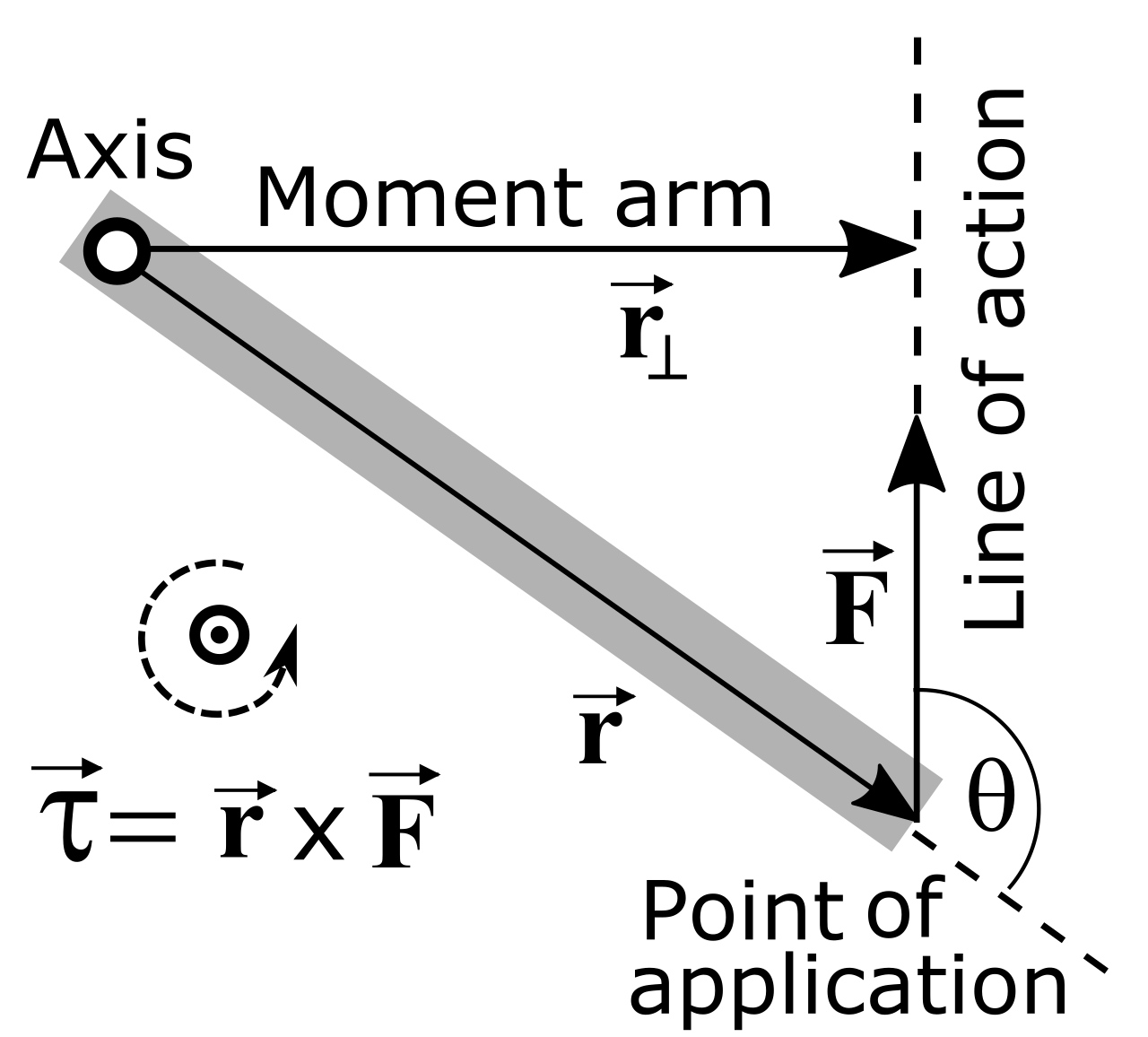
Torque τ = r × F. The moment (lever) arm r⊥ is the perpendicular distance from the axis to the force's line of action. Image: Guy vandegrift, CC BY-SA 4.0, via Wikimedia Commons.
Rotational Kinetic Energy
- KE_rot = ½Iω²
- Rolling without slipping: KE_total = ½mv² + ½Iω² = ½mv²(1 + I/mR²)
- For solid sphere: KE_rot/KE_total = 2/7; for disk: 1/3; for ring: 1/2
- Acceleration down incline: a = g·sinθ/(1 + I/mR²)
Centre of Mass
- Centre of mass (CM) is the point where the entire mass of a system can be taken to be concentrated for describing its translational motion
- For a system of particles: x_cm = (Σm_i·x_i)/(Σm_i), and similarly for y_cm, z_cm
- For continuous bodies: x_cm = (∫x·dm)/(∫dm)
- The CM of a uniform, symmetric body lies at its geometric centre (centre of a ring, disk, sphere, rod)
- Two particles: CM divides the joining line in the inverse ratio of masses (closer to the heavier mass)
Centre of Mass of Common Bodies
| Body | Position of CM |
|---|---|
| Uniform rod | Midpoint (L/2) |
| Triangular lamina | Centroid (at h/3 from base) |
| Semicircular ring | 2R/π from centre along axis of symmetry |
| Semicircular disc | 4R/3π from centre |
| Solid hemisphere | 3R/8 from flat face |
| Solid cone | h/4 from base along axis |
Motion of the Centre of Mass
- Velocity of CM: v_cm = (Σm_i·v_i)/(Σm_i); total momentum P = M·v_cm
- The CM moves as if all external forces acted on the total mass concentrated there: F_ext = M·a_cm
- If net external force is zero, v_cm stays constant (internal forces, like in an explosion, cannot change the CM's motion)
- In projectile motion, if a shell explodes mid-flight, the CM of the fragments continues on the original parabolic path
Equilibrium of a Rigid Body
- A rigid body is in mechanical equilibrium when both conditions hold simultaneously:
- Translational equilibrium: net external force is zero (ΣF = 0)
- Rotational equilibrium: net external torque about any axis is zero (Στ = 0)
- Couple: two equal and opposite parallel forces not along the same line; produces pure rotation, torque = force × perpendicular distance between them
- Centre of gravity is the point where the total gravitational torque on the body is zero; it coincides with the CM in a uniform gravitational field
🚀 JEE Advanced Edge
Race down an incline: Since a = g sinθ/(1+I/mR²), a body with SMALLER I/mR² accelerates faster — so for objects of the same shape category released together: solid sphere > solid cylinder/disk > hollow sphere > hollow cylinder/ring, regardless of their mass or radius (those cancel out of the ratio).
Instantaneous axis of rotation (rolling): For a body rolling without slipping, the point of contact with the ground is momentarily at rest — treating it as a fixed pivot lets you directly compute torque/angular momentum about that point without needing to separately track translational + rotational motion.
Worked problem: A solid sphere and a hollow sphere of the same mass and radius are released from rest at the top of an incline. Find the ratio of times taken to reach the bottom. Approach: a_solid = g sinθ/(1+2/5) = (5/7)g sinθ; a_hollow = g sinθ/(1+2/3) = (3/5)g sinθ. Since distance s=½at² for both (same s), t∝1/√a, so t_solid/t_hollow = √(a_hollow/a_solid) = √((3/5)/(5/7)) = √(21/25) ≈ 0.917 — the solid sphere reaches the bottom faster.