🎯 Key Points
- Thomson's model: Atom is a sphere of uniform positive charge with electrons embedded like plums in a pudding. Failed to explain large-angle alpha scattering.
- Rutherford's alpha-scattering experiment: Thin gold foil bombarded with alpha particles — most passed straight through, a few deflected at large angles, very few bounced back.
- Rutherford's nuclear model conclusions: Nucleus is tiny (~10⁻¹⁵ m) compared to atom (~10⁻¹⁰ m); most of the atom is empty space; nearly all mass and all positive charge are concentrated in the nucleus; electrons orbit the nucleus at large distances.
- Distance of closest approach: d = kZe²/E_k (all kinetic energy converts to electrostatic potential energy at the turning point).
- Impact parameter (b): Perpendicular distance between the initial trajectory of alpha particle and the central line. Smaller b → larger deflection angle θ.
- Limitation of Rutherford's model: Classically, an orbiting electron continuously radiates energy (accelerated charge), spirals inward, and collapses into the nucleus in ~10⁻⁸ s — atom would be unstable. Also cannot explain discrete atomic spectra.
- Bohr's postulates (1913):
- Electrons revolve in certain allowed circular orbits (stationary states) without radiating energy.
- Angular momentum is quantised: L = mvr = nh/2π (n = 1, 2, 3, … is the principal quantum number).
- Radiation is emitted (or absorbed) only when an electron transitions between two orbits: hf = E_initial − E_final.
- Bohr radius (hydrogen): rn = n²a₀, where a₀ = 0.529 Å = 0.529 × 10⁻¹⁰ m (Bohr radius). r₁ = 0.529 Å, r₂ = 2.12 Å, r₃ = 4.76 Å.
- Energy of nth orbit (hydrogen): En = −13.6/n² eV. Ground state (n=1): E₁ = −13.6 eV. First excited state (n=2): E₂ = −3.4 eV. Ionisation energy from ground state = 13.6 eV.
- Velocity of electron: vn = v₁/n, where v₁ = 2.18 × 10⁶ m/s (speed in n=1 orbit).
- Rydberg formula: 1/λ = RH(1/nf² − 1/ni²), RH = 1.097 × 10⁷ m⁻¹. Use hf = hc/λ to get frequency or energy.
- Spectral series of hydrogen:
- Lyman series: nf = 1, ni = 2, 3, 4, … → Ultraviolet region.
- Balmer series: nf = 2, ni = 3, 4, 5, … → Visible region (Hα 656 nm red, Hβ 486 nm blue-green, Hγ 434 nm violet).
- Paschen series: nf = 3, ni = 4, 5, 6, … → Near infrared.
- Brackett series: nf = 4, ni = 5, 6, 7, … → Infrared.
- Pfund series: nf = 5, ni = 6, 7, 8, … → Far infrared.
- Photon energy and wavelength link: hf = E_i − E_f; since c = fλ, wavelength λ = hc/(E_i − E_f). Use hc = 1240 eV·nm for quick calculations.
- Limitations of Bohr's model: Works only for hydrogen and hydrogen-like ions (He⁺, Li²⁺, …); fails for multi-electron atoms; cannot explain fine structure, Zeeman effect (splitting in magnetic field), or intensity of spectral lines; treats electron as a classical particle.
📖 Full Explanation
1. Thomson's Model (1904) J.J. Thomson proposed the "plum-pudding" model: a uniformly distributed positive sphere of radius ~10⁻¹⁰ m with electrons embedded within it. The model predicted that alpha particles should pass through the atom with only small deflections (a few degrees at most). This was quickly disproved by Rutherford's experiment. 2. Rutherford's Alpha-Particle Scattering Experiment (1911) Hans Geiger and Ernest Marsden, under Rutherford, directed a beam of alpha particles (helium nuclei, charge +2e, from a radioactive source) at a thin gold foil (~100 nm thick). A circular ZnS fluorescent screen surrounded the foil to detect scattered particles at all angles. Observations:- Most alpha particles (~99%) passed straight through — atom is mostly empty space.
- A small fraction were deflected at large angles (>90°).
- About 1 in 8000 particles bounced almost straight back (θ ≈ 180°).
- Lyman (n_f = 1): Transitions from n=2,3,4,… to n=1. Largest energy differences → shortest wavelengths → ultraviolet. Series limit (n_i → ∞): λ_min = 1/(R_H) ≈ 91.2 nm.
- Balmer (n_f = 2): Transitions from n=3,4,5,… to n=2. Partially in visible light. Hα (3→2): 656 nm (red); Hβ (4→2): 486 nm; Hγ (5→2): 434 nm; Hδ (6→2): 410 nm. Series limit: ~364.6 nm (UV).
- Paschen (n_f = 3): n=4,5,6,… → n=3. Near infrared (~820 nm to 1875 nm).
- Brackett (n_f = 4): n=5,6,7,… → n=4. Mid infrared.
- Pfund (n_f = 5): n=6,7,8,… → n=5. Far infrared.
- Works only for one-electron systems (H, He⁺, Li²⁺, …).
- Cannot explain the spectra of multi-electron atoms.
- Cannot account for the fine structure (splitting of spectral lines due to relativistic corrections and spin-orbit coupling).
- Cannot explain the Zeeman effect (splitting of spectral lines in a magnetic field) or Stark effect (in an electric field).
- Gives no information about the relative intensities of spectral lines.
- Treats the electron classically as a particle in a definite orbit — inconsistent with wave-particle duality (de Broglie) and the Heisenberg uncertainty principle.
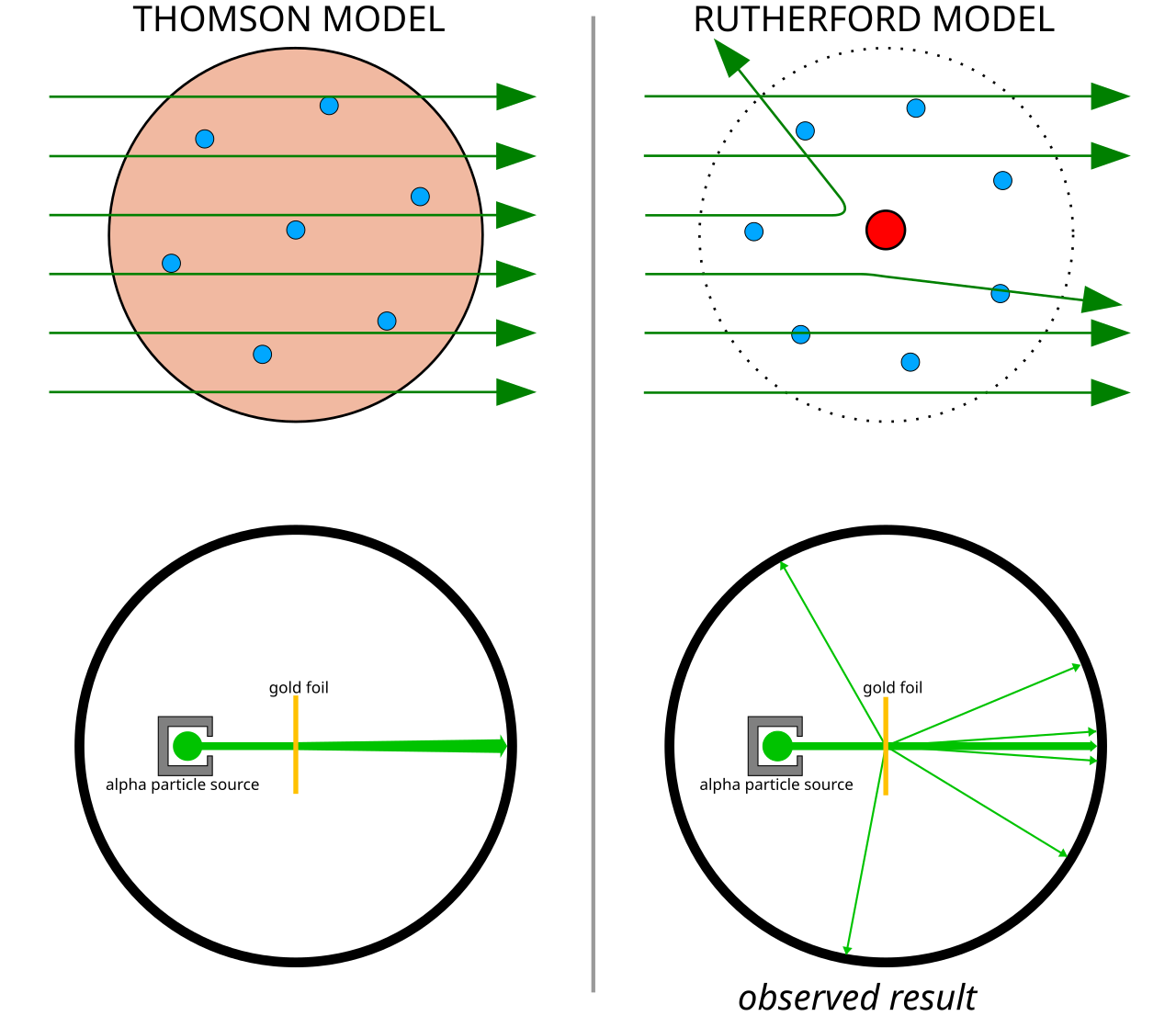
The Geiger–Marsden alpha-scattering result: a few alpha particles bounce back at large angles, which rules out Thomson’s diffuse model and demands a tiny, massive, positively charged nucleus. Image: Kurzon, CC BY 3.0, via Wikimedia Commons.
Emission and Absorption Spectra
- A continuous spectrum (all wavelengths) is produced by incandescent solids, liquids, or dense gases.
- An emission line spectrum is a set of bright, discrete coloured lines emitted by an excited low-pressure gas as electrons drop to lower energy levels; each element has its own characteristic set of lines — a spectral fingerprint.
- An absorption spectrum is a continuous spectrum crossed by dark lines, produced when white light passes through a cooler gas that absorbs exactly those wavelengths it would itself emit.
- The dark Fraunhofer lines in the Sun's spectrum are absorption lines that reveal the composition of the solar atmosphere; the emission and absorption lines of a given element occur at the same wavelengths (Kirchhoff).
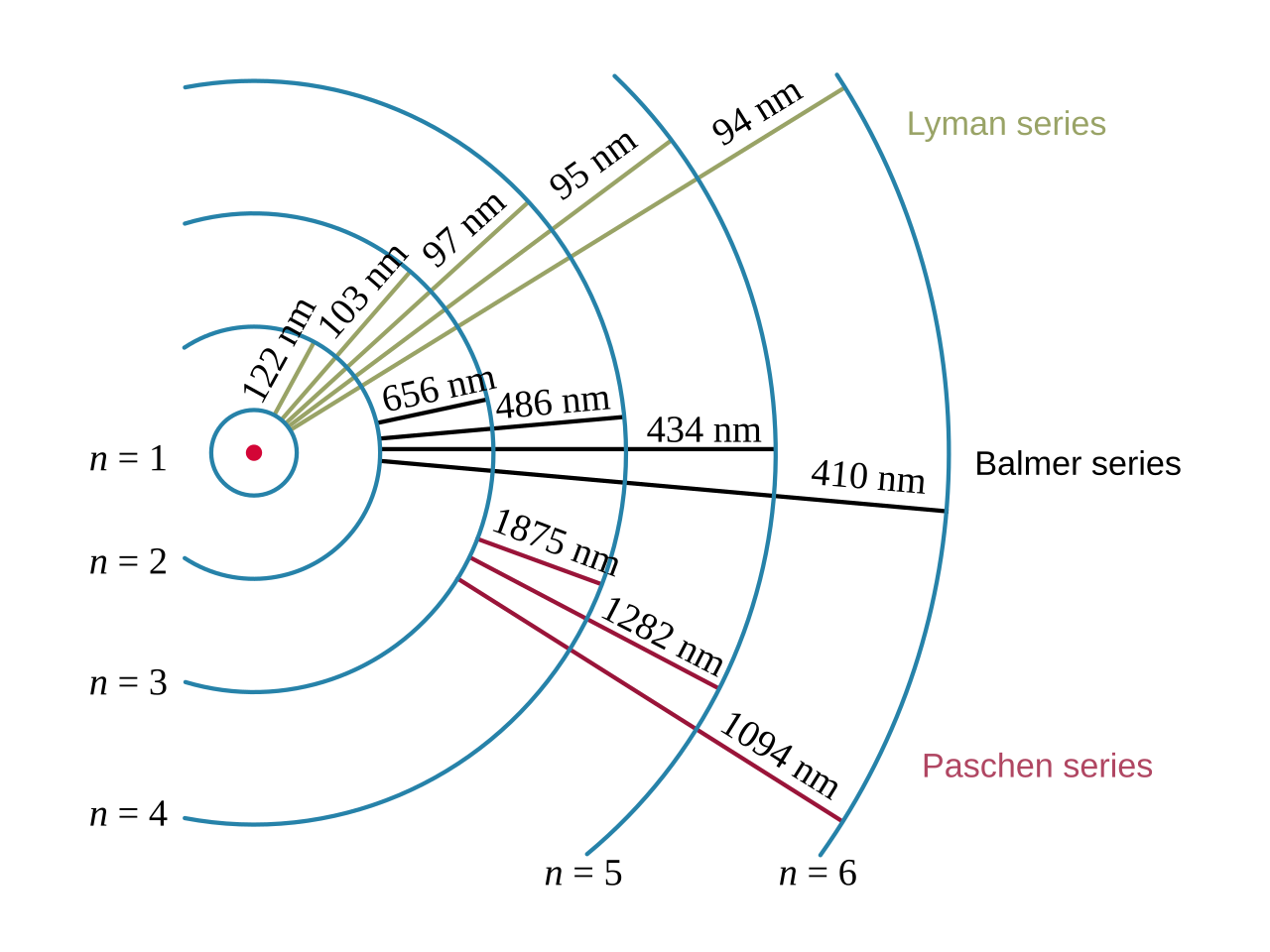
Hydrogen spectral series: transitions ending on n=1 give the Lyman series (ultraviolet), on n=2 the Balmer series (visible), and on n=3 the Paschen series (infrared). Image: Szdori, OrangeDog, CC BY 2.5, via Wikimedia Commons.
Energy Level Diagram and Excitation of Atoms
- The allowed energies En = −13.6/n² eV are drawn as horizontal lines forming an energy level diagram — closely spaced near the top (n → ∞, E = 0) and widely spaced at the bottom (ground state n=1).
- Excitation: an atom in the ground state is raised to a higher level by absorbing exactly the right energy, either from a photon (hf = Ei − Ef) or from an inelastic collision with an electron.
- Excitation energy is the energy needed to raise the atom from the ground state to an excited state (10.2 eV for the n=1→2 transition in hydrogen); the excitation potential is the corresponding accelerating voltage (10.2 V).
- An excited atom is unstable and returns to lower levels within ~10⁻⁸ s, emitting photons — this de-excitation produces the emission line spectrum.
Franck-Hertz Experiment: Evidence for Energy Levels
- Franck and Hertz (1914) passed accelerated electrons through mercury (or other) vapour and measured the collector current against the accelerating voltage.
- The current rose with voltage but dropped sharply at regular intervals (about every 4.9 V for mercury), showing that electrons lose energy only in fixed, discrete amounts.
- These dips occur because an electron can transfer energy to an atom only when it carries at least the exact excitation energy of that atom — direct proof that atomic energy levels are quantised.
- The excited mercury atoms then emit ultraviolet photons of the corresponding energy (253.7 nm), independently confirming Bohr's model.
🚀 JEE Advanced Edge
De Broglie's justification of Bohr's quantisation: The allowed Bohr orbits are those for which an integer number of electron de Broglie wavelengths (λ = h/mv) fit around the circumference: 2πr = nλ = nh/mv → mvr = nh/2π. This bridges classical orbits and wave mechanics. Number of spectral lines from level N: If an electron drops from the nth level, the total number of possible spectral lines = n(n−1)/2. From n=4: 4×3/2 = 6 lines. Ionisation from excited states: Energy to ionise from level n = |E_n| = 13.6/n² eV. From n=2 (first excited state), ionisation energy = 3.4 eV. This is frequently tested in NEET/JEE multiple-choice. Excitation energy vs. ionisation energy: Excitation energy to go from n=1 to n=2 = E₂ − E₁ = −3.4 − (−13.6) = 10.2 eV. Minimum photon energy to ionise from ground state = 13.6 eV. Velocity in nth orbit: v_n = e²/(2ε₀nh) = αc/n, where α = 1/137 is the fine-structure constant and c is the speed of light. So v₁ = c/137 ≈ 2.18 × 10⁶ m/s ≈ 0.73% of c (non-relativistic, justifying Bohr's classical treatment for low n). Orbital time period: T_n = 2πr_n/v_n ∝ n³. T₁ ≈ 1.52 × 10⁻¹⁶ s. Hydrogen-like ion trap: For He⁺ (Z=2), the Balmer series of He⁺ overlaps with spectral lines of H in some wavelengths — a classic source of confusion in JEE problems. Always check Z when applying Rydberg. Recoil of nucleus during emission: When a photon of energy hf is emitted, the atom recoils. By conservation of momentum, p_atom = hf/c. The recoil kinetic energy = (hf)²/(2Mc²), which is negligible for atoms but is tested conceptually. Correspondence principle: At very large n, the frequency of revolution of the electron equals the frequency of the emitted photon when it drops to n−1. Bohr's model merges with classical electrodynamics for high quantum numbers. Quick formula card:- r_n = 0.529 n² Å (H); r_n = 0.529 n²/Z Å (hydrogen-like)
- E_n = −13.6/n² eV (H); E_n = −13.6 Z²/n² eV (hydrogen-like)
- v_n = 2.18 × 10⁶/n m/s
- 1/λ = 1.097 × 10⁷ (1/n_f² − 1/n_i²) m⁻¹
- hc = 1240 eV·nm (use for fast λ ↔ energy conversion)
- Lines from level n: n(n−1)/2
Worked Example: Wavelength of Hα line (Balmer series)
Find the wavelength of the first line of the Balmer series (Hα line) of hydrogen. Given: n_f = 2, n_i = 3, R_H = 1.097 × 10⁷ m⁻¹. Apply Rydberg formula: 1/λ = R_H(1/2² − 1/3²) = 1.097 × 10⁷ × (1/4 − 1/9) = 1.097 × 10⁷ × (9 − 4)/36 = 1.097 × 10⁷ × 5/36 = 1.097 × 10⁷ × 0.1389 = 1.524 × 10⁶ m⁻¹ Therefore: λ = 1/(1.524 × 10⁶) = 6.56 × 10⁻⁷ m = 656 nm (red light — this is the famous red Hα line, first in the Balmer series, visible to the naked eye in hydrogen discharge tubes and in the spectra of stars). Energy of this photon: Using hc = 1240 eV·nm: E = 1240/656 ≈ 1.89 eV (= E₃ − E₂ = −1.51 − (−3.4) = 1.89 eV ✓)