🎯 Key Points
- R=R₀A^(1/3) — nuclear radius grows slowly with mass number; nuclear density is roughly CONSTANT for all nuclei
- Binding energy BE=Δm·c²; BE per nucleon is MAXIMUM for Fe-56 — both fission (heavy→medium) and fusion (light→medium) release energy by moving toward this peak
- N=N₀e^(−λt); half-life T½=0.693/λ; mean life τ=1/λ≈1.44×T½; after n half-lives, fraction remaining=(1/2)ⁿ
- Alpha: least penetrating, most ionizing; Beta: moderate; Gamma: most penetrating, least ionizing, uncharged
- Fission splits heavy nuclei (controlled via moderators+control rods); Fusion combines light nuclei (needs extreme T, P — powers stars)
Binding energy per nucleon rises sharply for light nuclei, peaks around iron-56 (the most stable nucleus), then slowly declines for heavier nuclei — which is exactly why fusing light nuclei or splitting heavy nuclei both release energy: each moves the products toward this stability peak.
Nuclear Properties
- Notation: ᴬzX (A = mass number, Z = atomic number)
- Nuclear radius: R = R₀·A^(1/3) (R₀ ≈ 1.2 fm)
- Nuclear density ≈ 2.3 × 10¹⁷ kg/m³ (same for all nuclei)
Binding Energy
- Mass defect: Δm = (Z·m_p + N·m_n) - M_nucleus
- Binding energy: BE = Δm·c²
- BE per nucleon is maximum for iron-56 (most stable)
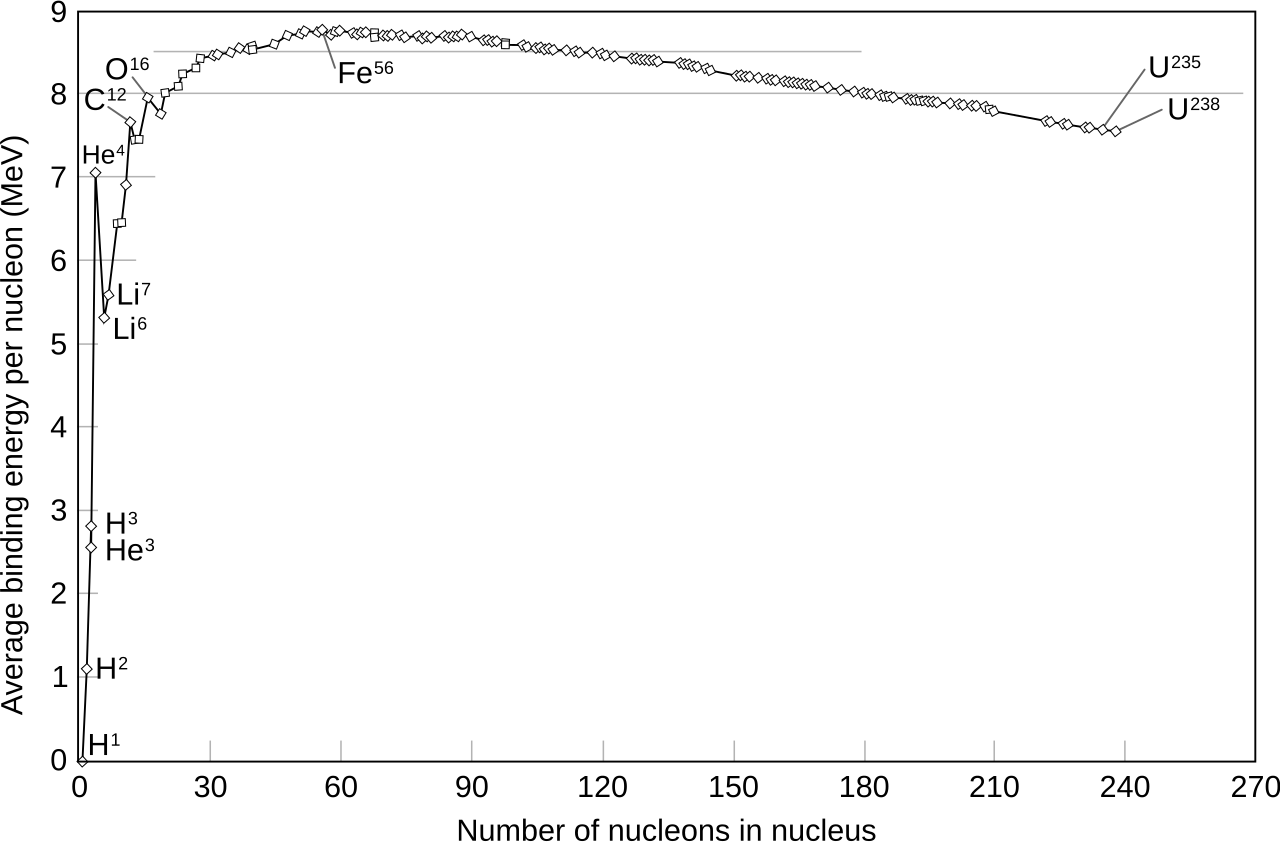
Binding energy per nucleon peaks near ⁶⁶Fe, so light nuclei release energy by fusion and heavy nuclei by fission. Image: Fastfission, Public Domain, via Wikimedia Commons.
Radioactivity
- Alpha decay: ᴬzX → ᴬ⁻⁴_(z-2)Y + ⁴₂He
- Beta-minus decay: n → p + e⁻ + anti-neutrino
- Gamma radiation: no change in A or Z, just energy release
- Decay law: N = N₀·e^(-λt)
- Half-life: T₁/₂ = ln2/λ = 0.693/λ
Nuclear Reactions
- Fission: heavy nucleus splits (U-235 + n → smaller nuclei + energy)
- Fusion: light nuclei combine (H + H → He + energy; powers the sun)
- Q value = (mass_reactants - mass_products) × c²
Properties of Radioactive Emissions
- Alpha particles: helium nuclei, charge +2e, least penetrating (stopped by paper/skin), most ionizing, deflect slightly in magnetic field
- Beta particles: high-speed electrons (or positrons in β⁺ decay), charge ∓e, moderate penetration (stopped by few mm aluminium), deflect more than alpha in a magnetic field
- Gamma rays: high-energy EM photons, no charge, most penetrating (need thick lead/concrete to stop), least ionizing, undeflected by electric/magnetic fields
- Beta-plus (positron) decay: p → n + e⁺ + neutrino (occurs in proton-rich nuclei)
Activity and Decay Law in Detail
- Activity: A = -dN/dt = λN = λN₀e^(-λt) = A₀e^(-λt)
- SI unit of activity: becquerel (Bq) = 1 decay/s; older unit: curie (Ci) = 3.7 × 10¹⁰ Bq
- Mean (average) life: τ = 1/λ = T₁/₂/0.693 (τ is about 1.44 times the half-life)
- After n half-lives, fraction remaining = (1/2)ⁿ
Fission and Fusion in Detail
- Chain reaction: each fission of U-235 releases 2-3 neutrons that can trigger further fissions; controlled using moderators (water, graphite) to slow neutrons and control rods (boron, cadmium) to absorb excess neutrons
- Critical mass: minimum mass needed to sustain a chain reaction
- Energy released per fission of U-235 ≈ 200 MeV
- Fusion requires extremely high temperature (~10⁷ K) and pressure to overcome Coulomb repulsion between nuclei; this is why fusion is hard to sustain on Earth but powers stars
- Mass-energy equivalence: E = mc² links mass defect directly to the binding energy released in both fission and fusion
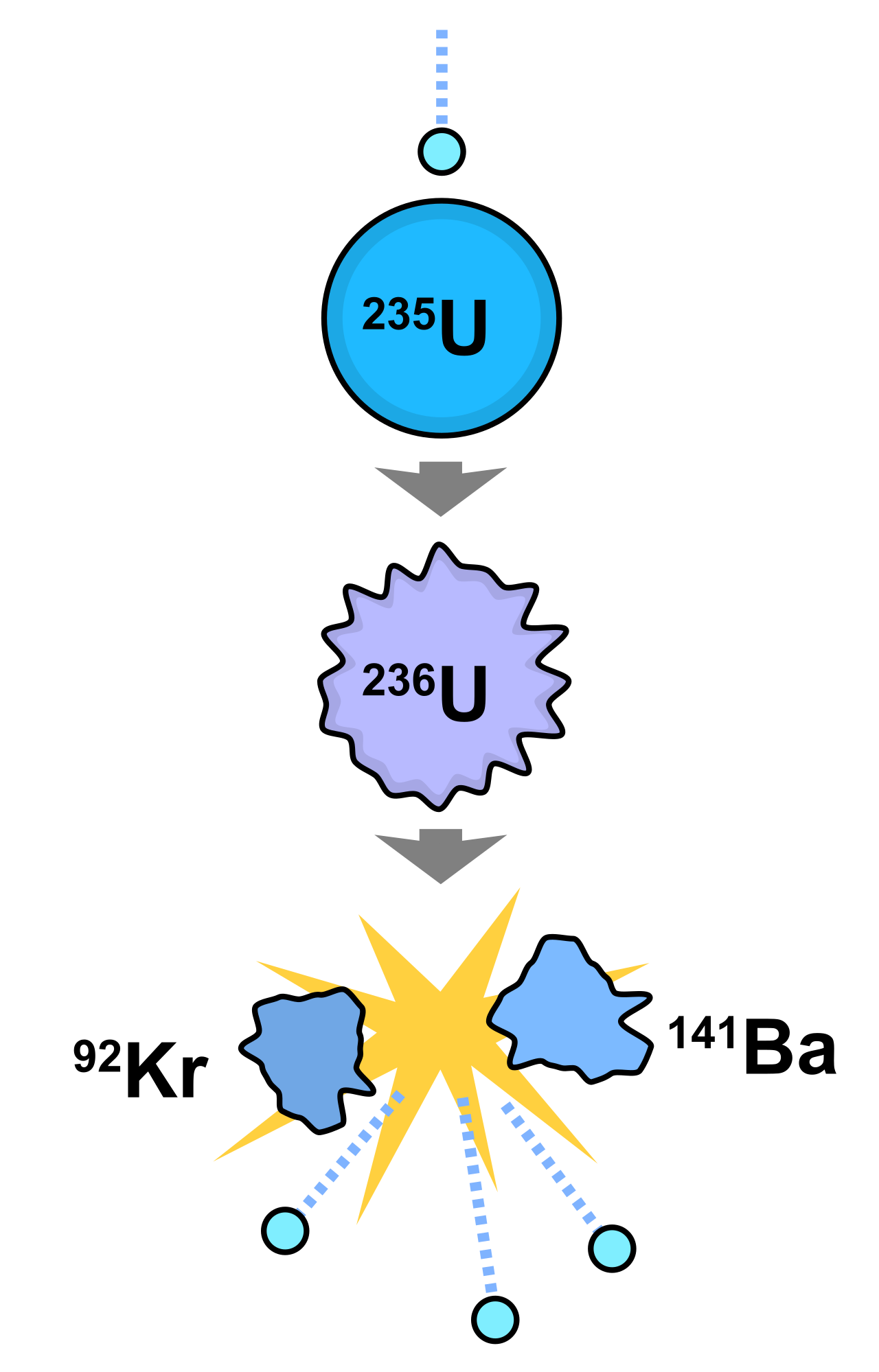
Induced fission of ²³⁵U: neutron capture forms unstable ²³⁶U, which splits into lighter fragments plus about three neutrons — the basis of a chain reaction. Image: Fastfission, Public Domain, via Wikimedia Commons.
Atomic Mass Unit and Composition of the Nucleus
- Atomic mass unit (u): defined as 1/12 the mass of a neutral carbon-12 atom; 1 u = 1.66 × 10⁻²⁷ kg and is equivalent to 931.5 MeV of energy
- The nucleus contains protons and neutrons (collectively nucleons): number of protons = Z (atomic number), number of neutrons = A − Z, total nucleons = A (mass number)
- Isotopes: same Z, different A (same element, e.g. ¹H, ²H, ³H); isobars: same A, different Z; isotones: same number of neutrons (A − Z)
- Neutron mass (1.00867 u) is slightly greater than proton mass (1.00728 u); both are far heavier than the electron
Mass-Energy Equivalence
- Einstein's relation: E = mc² — mass and energy are interconvertible; even a tiny mass corresponds to an enormous energy (c² is very large)
- A mass change of 1 u releases 931.5 MeV, the standard conversion used in all nuclear energy calculations
- In every nuclear reaction the total mass of products is slightly less than that of reactants; this "missing" mass appears as the released energy (Q-value)
- This principle underlies binding energy, the energy output of fission and fusion, and the power of stars
Nuclear Force
- The strong nuclear force binds protons and neutrons together despite the electrostatic repulsion between protons
- Short range: effective only within a few femtometres (~2-3 fm); beyond this it drops rapidly to zero, unlike gravity or the Coulomb force
- Charge independent: acts equally between p-p, n-n, and p-n pairs; it is the strongest of the fundamental forces at nuclear distances
- It is attractive at normal nucleon separations but becomes strongly repulsive at very short range, giving the nucleus a nearly constant density
Energy from Stars (Stellar Fusion)
- Stars shine by fusing light nuclei into heavier ones, releasing energy as their products move toward the binding-energy peak
- Proton-proton cycle (dominant in the Sun): hydrogen nuclei fuse in steps to form helium-4, releasing about 26 MeV per helium nucleus formed
- Carbon-nitrogen (CNO) cycle: an alternative hydrogen-to-helium route that dominates in hotter, more massive stars
- Fusion requires the extreme temperature and pressure of stellar cores to overcome the Coulomb barrier between nuclei; the Sun's energy has powered life on Earth for billions of years
🚀 JEE Advanced Edge
Successive/branching decay chains: When a parent decays into a daughter which itself is radioactive, the daughter's population first rises then falls over time (it's being created and destroyed simultaneously) — requiring a system of coupled differential equations, though JEE typically asks about the simpler case of activity ratios at specific times.
Carbon dating reasoning: Living organisms maintain a constant ¹⁴C ratio while alive (replenished via the carbon cycle); after death, the ¹⁴C decays with no replenishment, so measuring the REMAINING activity ratio against the known half-life (5730 years) gives the time since death — t = (T½/0.693)×ln(A₀/A).
Worked problem: A radioactive sample has activity 8000 dps initially; after 30 minutes, it drops to 1000 dps. Find the half-life. Approach: A/A₀=1000/8000=1/8=(1/2)³ → 3 half-lives have passed in 30 minutes → T½=10 minutes.