🎯 Key Points
- P = P₀ + ρgh; buoyant force = ρ_fluid × V_submerged × g (Archimedes)
- Continuity: A₁v₁ = A₂v₂; Bernoulli: P + ½ρv² + ρgh = constant along a streamline
- Torricelli: efflux velocity = √(2gh); Stokes' law: F=6πηrv; terminal velocity v_t ∝ r²
- Excess pressure: bubble ΔP=4T/r (two surfaces), droplet ΔP=2T/r (one surface)
- Reynolds number <1000 laminar, >2000 turbulent — predicts flow regime from velocity, density, viscosity, pipe diameter
Since the same volume of fluid must pass every cross-section per second (continuity), the fluid speeds up where the pipe narrows; Bernoulli's equation then says this faster-moving fluid has lower pressure — the principle behind a venturi meter and an aircraft wing's lift.
Pressure
- P = F/A; Pressure in fluid: P = P₀ + ρgh
- Pascal's Law: pressure applied to an enclosed fluid is transmitted equally in all directions
- Hydraulic press: F₁/A₁ = F₂/A₂ (pressure multiplier)
Buoyancy (Archimedes' Principle)
- Buoyant force = weight of fluid displaced = ρ_fluid × V_submerged × g
- Floating condition: weight of object = buoyant force
- Relative density = weight in air / (weight in air - weight in water)
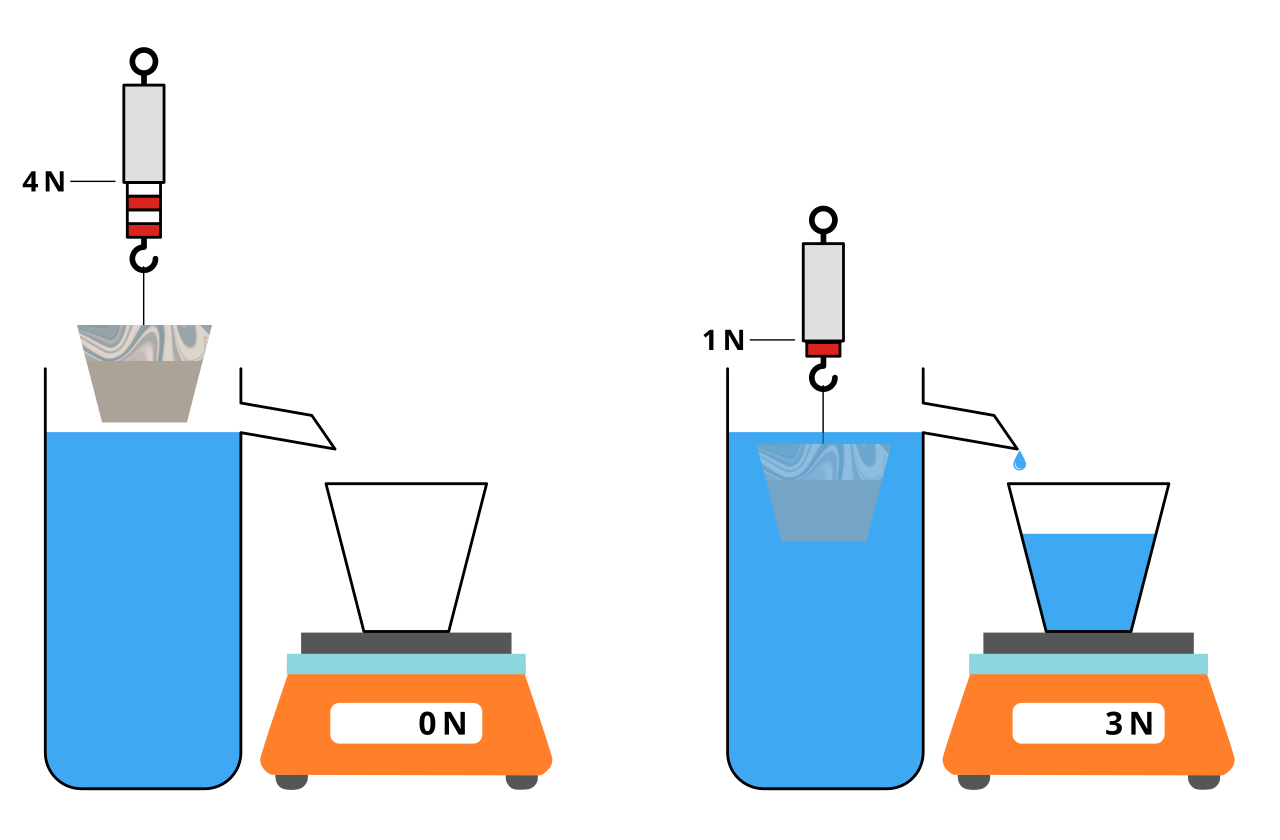
Archimedes' principle: the apparent loss in weight of a submerged body (4 N → 1 N) equals the weight of the fluid it displaces (3 N). Image: MikeRun, CC BY-SA 4.0, via Wikimedia Commons.
Equation of Continuity
- A₁v₁ = A₂v₂ (for incompressible fluid in a pipe)
- Where pipe is wider, flow is slower and vice versa
Bernoulli's Equation
- P + ½ρv² + ρgh = constant (along a streamline)
- Torricelli's theorem: velocity of efflux = √(2gh)
- Applications: aeroplane lift, Venturi meter, spray pump
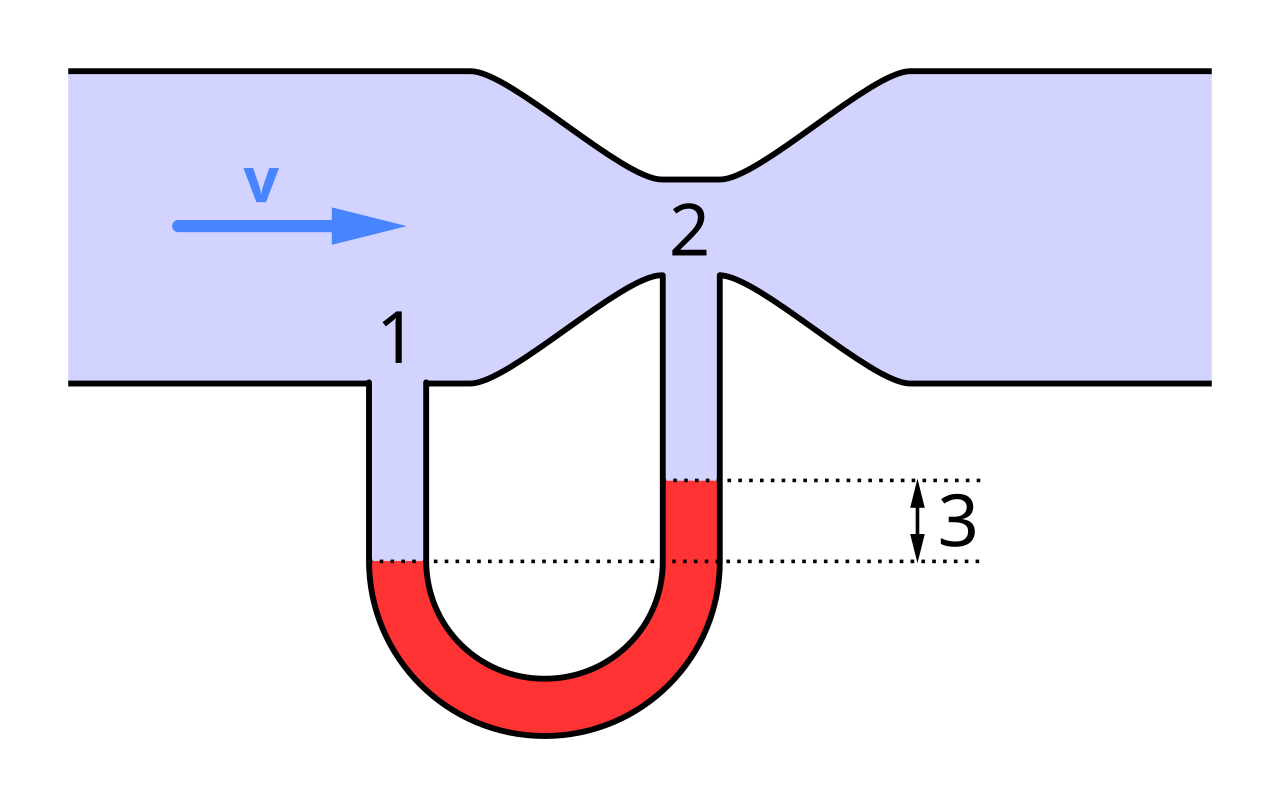
Venturi effect (Bernoulli's principle): where the tube narrows (2) the fluid speeds up and its pressure falls, shown by the manometer height difference. Image: MikeRun, CC BY-SA 4.0, via Wikimedia Commons.
Viscosity
- Viscous force: F = ηA(dv/dx) (Newton's law of viscosity)
- Stokes law: F = 6πηrv (drag on sphere)
- Terminal velocity: v_t = 2r²(ρ-σ)g/9η
Surface Tension
- T = F/L (force per unit length)
- Excess pressure inside bubble: ΔP = 4T/r (soap bubble, two surfaces); ΔP = 2T/r (droplet)
- Capillary rise: h = 2T·cosθ/(ρgr)
Streamline and Turbulent Flow
- Streamline (laminar) flow: fluid particles follow smooth, well-defined paths without crossing; occurs at low velocity
- Turbulent flow: irregular, chaotic flow with eddies; occurs above a critical velocity
- Reynolds number: N_R = ρvd/η; flow is laminar for N_R < 1000, turbulent for N_R > 2000
Critical Velocity and Energy of Flowing Fluid
- Critical velocity: v_c = N_R·η/(ρd), the speed beyond which flow becomes turbulent
- Bernoulli's equation expresses conservation of energy per unit volume of an ideal (non-viscous, incompressible) fluid in streamline flow: pressure energy + kinetic energy + potential energy per unit volume is constant
Angle of Contact and Detergent Action
- Angle of contact determines whether a liquid wets a surface; water in a clean glass tube has a small angle of contact (wets glass, rises in capillary), mercury has an obtuse angle (does not wet glass, depressed in capillary)
- Detergents and surfactants lower the surface tension of water, helping it penetrate fabric fibres and lift dirt
Atmospheric Pressure and Its Measurement
- Atmospheric pressure is the weight of the air column above unit area; at sea level it is about 1.013 × 10⁵ Pa = 1 atm ≈ 760 mm of mercury (torr) = 1.013 bar
- Mercury barometer (Torricelli): a tube of mercury inverted over a trough; atmospheric pressure supports a column of height h given by P₀ = ρgh, so a taller column means higher pressure
- Gauge pressure = absolute pressure − atmospheric pressure = ρgh, the excess pressure a manometer reads; absolute pressure P = P₀ + ρgh
- Open-tube manometer: measures gauge pressure of a gas from the difference in liquid levels in a U-tube
- Mercury is preferred over water in barometers because of its high density (a water barometer would need a column over 10 m tall)
Surface Energy
- Surface tension can also be defined as surface energy per unit area: T = work done / increase in surface area (unit J/m² = N/m)
- Increasing a liquid surface by area ΔA requires work W = T·ΔA against inward molecular attraction; this work is stored as surface potential energy
- Breaking a big drop of radius R into n small droplets increases total surface area, so energy must be supplied: ΔE = T·4π(nr² − R²) with R = n^(1/3)·r
- When small drops coalesce into a bigger drop, surface area decreases and energy is released (often as a slight rise in temperature)
Effect of Temperature on Viscosity and Surface Tension
- Liquids: both surface tension and viscosity DECREASE as temperature rises (hot water cleans better; warm oil flows more easily)
- Gases: viscosity INCREASES with temperature (faster molecules transfer more momentum between layers)
- Surface tension becomes zero at the critical temperature, where the liquid-vapour distinction disappears
Dynamic Lift and the Magnus Effect
- Dynamic lift is the upward force on a body moving through a fluid, arising from a pressure difference between its two sides (a direct consequence of Bernoulli's principle)
- Aerofoil (aeroplane wing): shaped so air moves faster over the top than the bottom; lower pressure above produces net upward lift
- Magnus effect: a spinning ball drags air around it, making flow faster on one side and slower on the other; the resulting pressure difference curves its path (swing bowling, topspin in tennis)
🚀 JEE Advanced Edge
Venturi meter numericals: Combining continuity (A₁v₁=A₂v₂) with Bernoulli's equation between a wide and narrow section gives v₁ = A₂√(2gh/(A₁²−A₂²)) for a manometer height difference h — a standard derivation for flow-rate measurement problems.
Terminal velocity sign and direction: If the object's density ρ is LESS than the fluid's density σ, the formula v_t = 2r²(ρ−σ)g/9η gives a negative value — correctly indicating the object rises (buoyancy-driven) rather than falls, with the same Stokes' drag balance principle applying in the opposite direction.
Worked problem: A small steel ball of radius 1 mm and density 7800 kg/m³ falls through glycerine (η=0.83 Pa·s, density 1260 kg/m³). Find its terminal velocity. Approach: v_t = 2r²(ρ−σ)g/9η = 2×(10⁻³)²×(7800−1260)×9.8/(9×0.83) ≈ 1.74×10⁻² m/s — illustrating how small, dense objects in viscous fluids reach low terminal speeds.