🎯 Key Points
- Mirror formula: 1/v+1/u=1/f, f=R/2; Lens formula: 1/v−1/u=1/f (note the sign difference from mirrors)
- Snell's law: n₁sinθ₁=n₂sinθ₂; TIR occurs only going denser→rarer when θ>critical angle, sinθc=1/n
- Lens power P=1/f (dioptres); combined power of lenses in contact: P=P₁+P₂
- Magnification: mirrors m=−v/u; lenses m=v/u
- Compound microscope magnification = m_objective × m_eyepiece; telescope M=f_objective/f_eyepiece
Reflection
- Laws of reflection: angle of incidence = angle of reflection
- Mirror formula: 1/v + 1/u = 1/f; f = R/2
- Magnification: m = -v/u = h_i/h_o
- Sign convention: distances measured from pole; incident light direction is positive
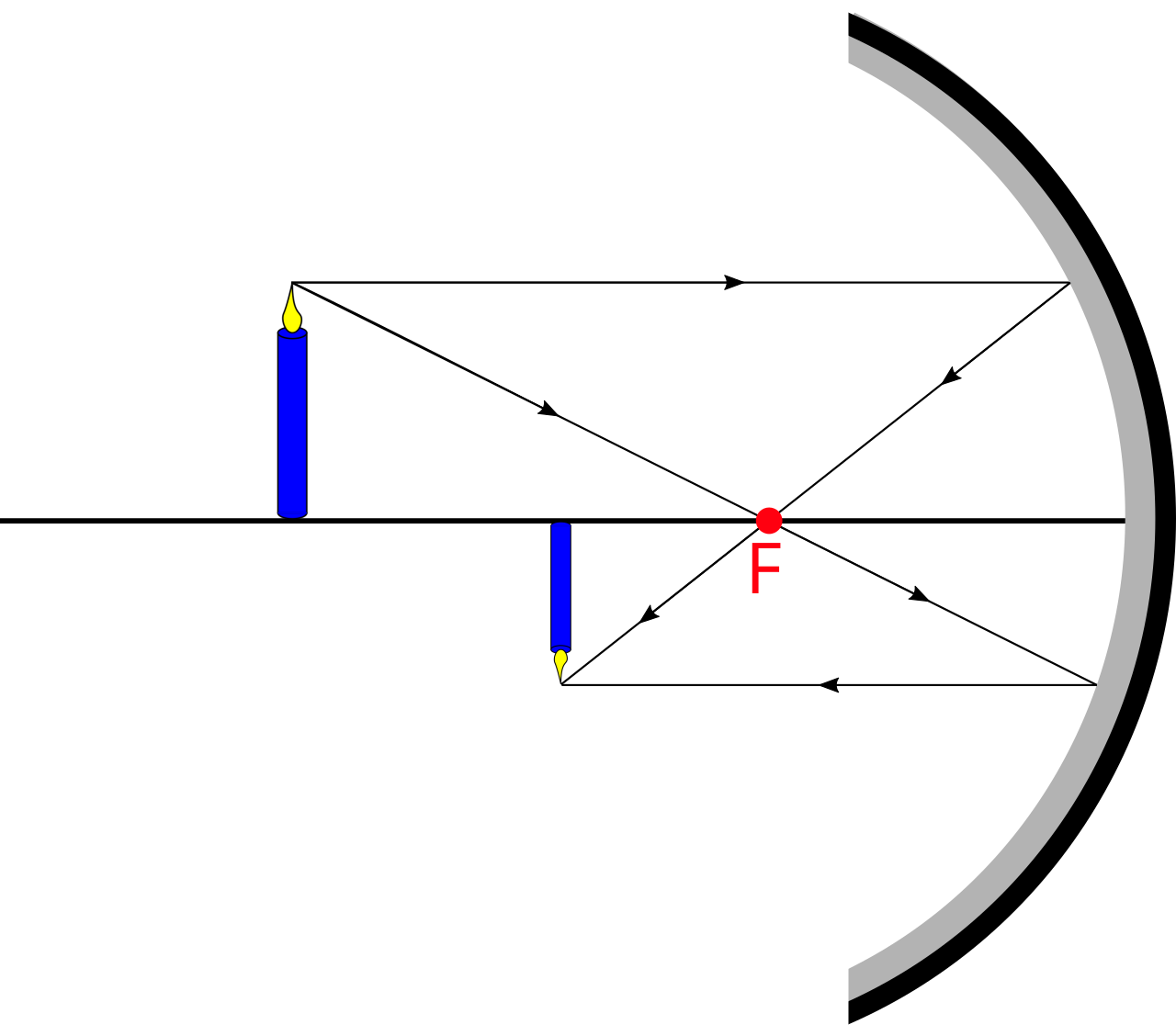
Concave mirror ray construction: a ray parallel to the axis reflects through F, and a ray through F reflects parallel, locating the inverted real image. Image: Maxmath12, CC0, via Wikimedia Commons.
Refraction
- Snell's law: n₁·sinθ₁ = n₂·sinθ₂
- Refractive index: n = c/v = sin(i)/sin(r)
- Total Internal Reflection: occurs when light goes from denser to rarer medium and θ > θ_c
- Critical angle: sin(θ_c) = n₂/n₁ (= 1/n for air-glass interface)
Lenses
For an object placed beyond 2F, a convex lens forms a real, inverted, and diminished image between F and 2F on the other side, located where the refracted principal rays intersect.
- Lens formula: 1/v - 1/u = 1/f
- Lens maker's equation: 1/f = (n-1)(1/R₁ - 1/R₂)
- Power: P = 1/f (in dioptres); P_combined = P₁ + P₂
- Magnification: m = v/u
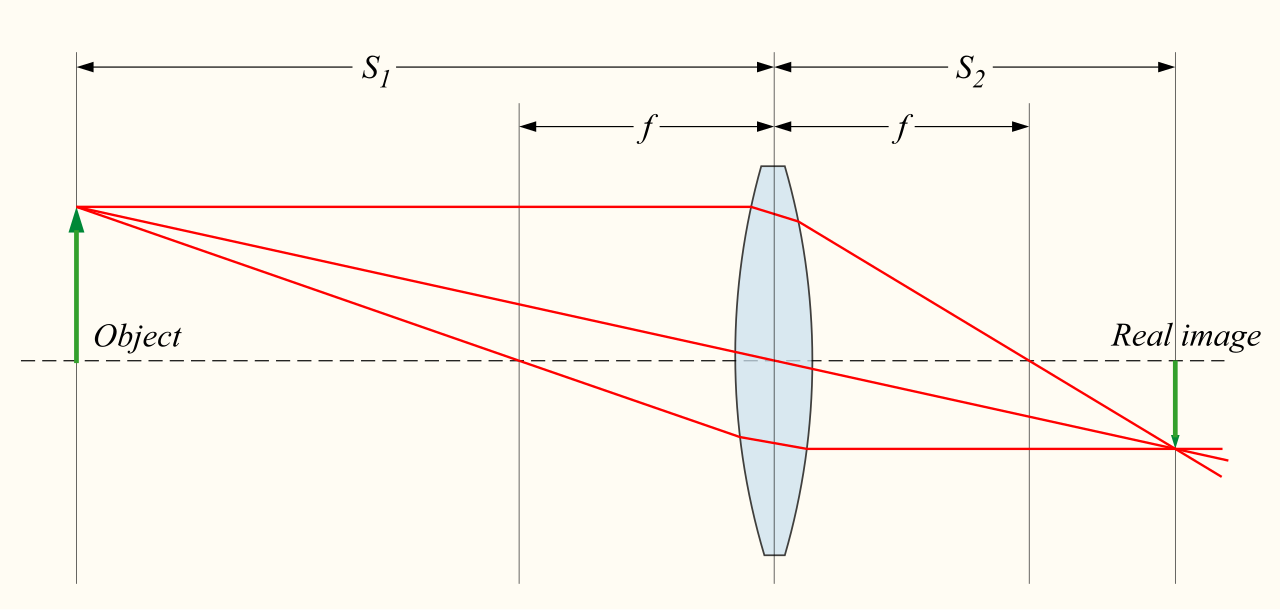
Real image formation by a convex lens, the geometry behind 1/v − 1/u = 1/f and m = v/u. Image: DrBob, CC BY-SA 3.0, via Wikimedia Commons.
Optical Instruments
- Compound microscope: total magnification = m_obj × m_eye
- Telescope (astronomical): M = f_obj/f_eye
- Normal adjustment: image at infinity
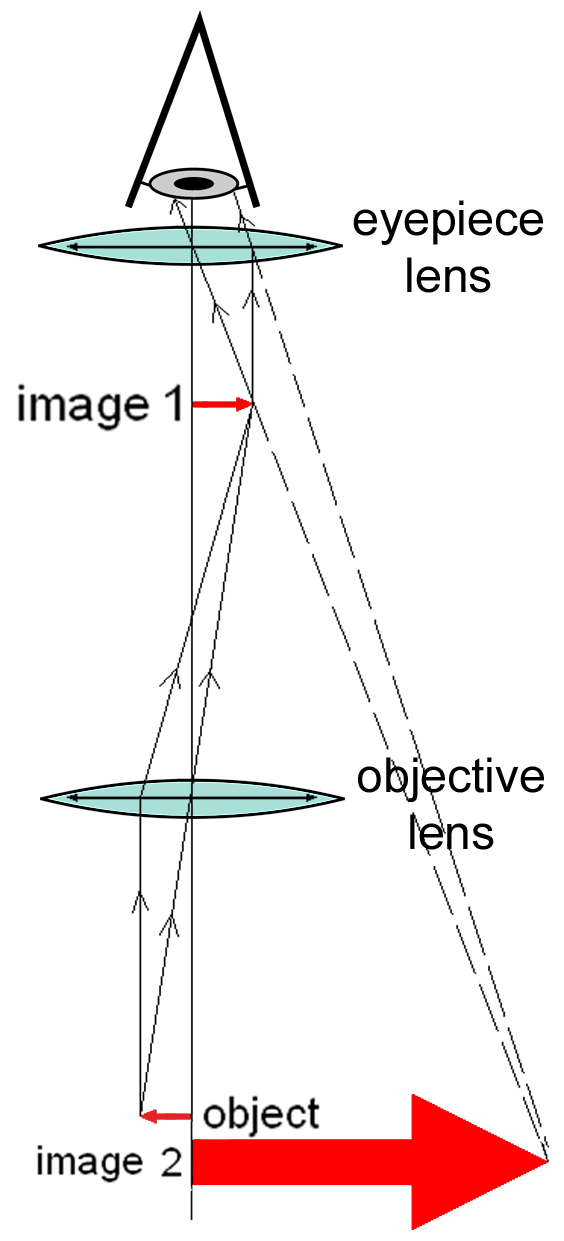
Compound microscope: the objective forms a real intermediate image which the eyepiece magnifies further, so M = m_objective × m_eyepiece. Image: Fountains of Bryn Mawr, CC BY-SA 3.0, via Wikimedia Commons.
Refraction at a Spherical Surface and Apparent Depth
- For refraction at a single spherical surface: n₂/v − n₁/u = (n₂ − n₁)/R (all distances from the pole, sign convention applied)
- Applying this at both surfaces of a thin lens gives the lens maker's formula 1/f = (n − 1)(1/R₁ − 1/R₂)
- Apparent depth: an object in a denser medium seen from above appears raised — real depth / apparent depth = n (refractive index)
- This is why a pool looks shallower than it is and a stick appears bent at the water surface; normal shift = t(1 − 1/n)
Refraction Through a Prism
- For a prism of angle A, the ray relation is A + δ = i + e, and A = r₁ + r₂ (r = refraction angles inside)
- As the angle of incidence varies, deviation δ passes through a minimum value δ_m, where the ray passes symmetrically (i = e, r₁ = r₂)
- Prism formula: n = sin[(A + δ_m)/2] / sin(A/2) — used to measure refractive index
- Thin prism (small A): deviation δ = (n − 1)A, independent of the angle of incidence
Dispersion and Scattering of Light
- Dispersion: white light splits into its colours (VIBGYOR) through a prism because refractive index depends on wavelength (violet bends most, red least)
- Angular dispersion = δ_violet − δ_red = (n_v − n_r)A; dispersive power ω = (n_v − n_r)/(n − 1)
- Rayleigh scattering: intensity of scattered light ∝ 1/λ⁴, so shorter (blue) wavelengths scatter far more than red
- This explains the blue sky (blue scattered in all directions) and red sunrise/sunset (blue scattered away over the long slant path, leaving red to reach the eye)
Total Internal Reflection: Applications
- Optical fibres: light is guided along a thin glass fibre by repeated total internal reflection, even around bends — the basis of high-speed data and endoscopy
- Sparkle of diamond: its very high refractive index gives a small critical angle (≈ 24°), so light entering is repeatedly totally internally reflected before emerging
- Mirage: on a hot day, layers of air near the ground are less dense; light from the sky bends and undergoes TIR, creating a shimmering water-like image
- Totally reflecting prisms: right-angled glass prisms (critical angle ≈ 42°) turn light through 90° or 180° in periscopes and binoculars with no loss
Optical Instruments in Detail
- Simple microscope (magnifying glass): magnifying power M = 1 + D/f when the image is at the near point D (25 cm); M = D/f when image is at infinity
- Compound microscope: M = (L/f_o)(D/f_e) approximately, where L is the tube length; both focal lengths are kept small for high magnification
- Astronomical telescope: in normal adjustment M = f_o/f_e with tube length f_o + f_e; a large objective focal length and aperture give high magnification and resolving power
- Telescope objectives are large to gather more light and improve resolution; microscope objectives are small-focal-length lenses close to the object
🚀 JEE Advanced Edge
Combination of lenses with separation: For two thin lenses separated by distance d, the equivalent focal length is 1/F = 1/f₁ + 1/f₂ − d/(f₁f₂) — reduces to the simple P=P₁+P₂ rule only when d=0 (lenses in contact).
Silvering one face of a lens: A plano-convex lens with its curved/flat face silvered behaves as an equivalent mirror; combine the lens power (light passes through once) with the mirror power (reflection) and the lens power again (light passes back through) — Power_eq = 2P_lens + P_mirror — a classic JEE "lens-mirror" combination problem.
Worked problem: An object is placed 30 cm from a convex lens of focal length 20 cm. Find the image position and magnification. Approach: Using 1/v−1/u=1/f with u=−30: 1/v = 1/20 + 1/(−30) = (3−2)/60 = 1/60 → v=60 cm (real image, same side as where light exits). m=v/u=60/(−30)=−2 (inverted, magnified 2×).