🎯 Key Points
- c=1/√(μ₀ε₀)=3×10⁸ m/s; E, B, and propagation direction are mutually perpendicular; E₀/B₀=c
- Displacement current I_d=ε₀(dΦ_E/dt) — Maxwell's fix that makes Ampere's law work even where there's no actual charge flow (e.g. between capacitor plates)
- EM spectrum (increasing frequency/energy): Radio < Microwave < Infrared < Visible < UV < X-ray < Gamma ray
- Radiation pressure = I/c; intensity I=½ε₀cE₀²
- Energy is shared EQUALLY between electric and magnetic fields on time-average in an EM wave
In an electromagnetic wave, the oscillating electric field (E) and magnetic field (B) are perpendicular to each other and to the direction the wave travels — a purely transverse wave that needs no medium, unlike sound.
Maxwell's Equations (Concept)
- Gauss's law for E: electric flux from charge
- Gauss's law for B: no magnetic monopoles (magnetic flux always zero)
- Faraday's law: changing B creates E
- Ampere-Maxwell law: changing E creates B (displacement current)
- Displacement current: I_d = ε₀ × dΦ_E/dt (fills gap between capacitor plates)
Properties of EM Waves
- Speed in vacuum: c = 1/√(μ₀ε₀) = 3 × 10⁸ m/s
- E, B, and propagation direction are mutually perpendicular
- E₀/B₀ = c (ratio of field amplitudes)
- Transverse waves; can travel in vacuum
- Carry energy and momentum: pressure = I/c (intensity/speed)
Electromagnetic Spectrum
- Radio waves (> 0.1 m): radio, TV, MRI
- Microwaves (1 mm - 0.1 m): microwave ovens, radar, satellite
- Infrared (700 nm - 1 mm): thermal imaging, remote controls, heating
- Visible (400-700 nm): VIBGYOR (violet to red)
- Ultraviolet (10-400 nm): sterilization, vitamin D synthesis, skin cancer
- X-rays (0.01-10 nm): medical imaging, crystallography
- Gamma rays (< 0.01 nm): cancer treatment, nuclear reactions
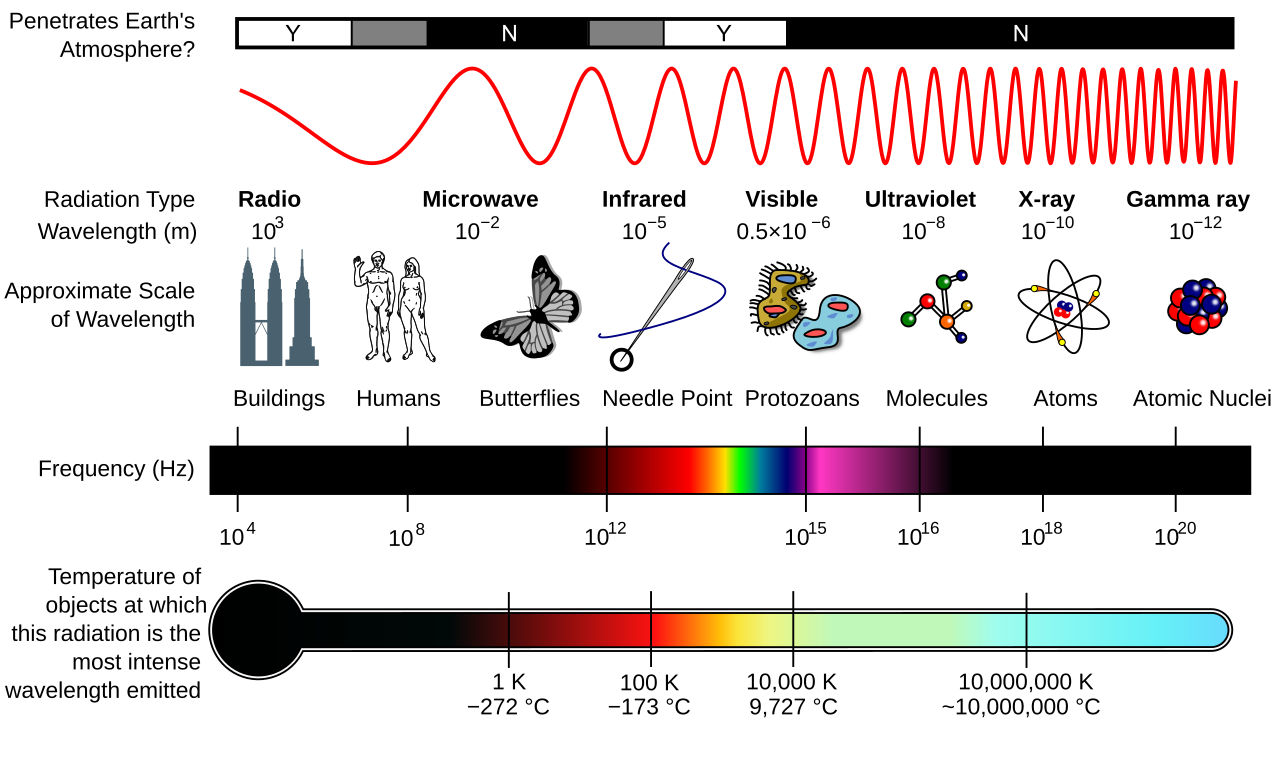
The electromagnetic spectrum: all bands travel at c, with wavelength falling and frequency (and photon energy) rising from radio to gamma rays. Image: Inductiveload, NASA, CC BY-SA 3.0, via Wikimedia Commons.
Applications
- Radio: AM (amplitude modulation), FM (frequency modulation)
- Microwaves: heating water molecules (dielectric heating)
- X-rays: discovered by Roentgen; Bragg diffraction for crystal structure
Displacement Current in Detail
- Displacement current arises from a changing electric field (not actual charge flow) and was introduced by Maxwell to make Ampere's law consistent with charge conservation in situations like a charging capacitor
- Total current (conduction + displacement) is continuous across any circuit, including the gap between capacitor plates
- Modified Ampere-Maxwell law: ∮B·dl = μ₀(I_c + I_d)
Energy in EM Waves
- EM waves carry energy equally shared between electric and magnetic fields on time-average
- Average energy density: u_avg = ½ε₀E₀² (electric) + B₀²/2μ₀ (magnetic), each contributing equally
- Intensity (average power per unit area): I = ½ε₀cE₀²
Sources of EM Waves by Band
- Radio and microwaves: produced by oscillating currents in electronic circuits and antennas
- Infrared: produced by hot bodies and molecular vibrations
- Visible and ultraviolet: produced by electronic transitions in atoms
- X-rays: produced by sudden deceleration of high-energy electrons striking a target (bremsstrahlung) or inner-shell electron transitions
- Gamma rays: produced by nuclear transitions and radioactive decay
Nature and Mathematical Description of EM Waves
- For a wave travelling along x, the fields vary as E = E₀ sin(kx − ωt) along one transverse axis (say y) and B = B₀ sin(kx − ωt) along the perpendicular axis (z) — E and B oscillate in phase, reaching their maxima and zeros together
- The wave number k = 2π/λ and angular frequency ω = 2πf are linked by the wave speed ω/k = c = fλ
- EM waves are purely transverse (E and B both perpendicular to the propagation direction) and, unlike mechanical waves, require no material medium — they travel through vacuum
- An accelerating (or oscillating) electric charge is the fundamental source of an electromagnetic wave, radiating at the frequency of its oscillation
Speed of EM Waves in a Material Medium
- In a medium of permeability μ and permittivity ε, the wave speed is v = 1/√(με), which is always less than the vacuum speed c = 1/√(μ₀ε₀)
- The refractive index is n = c/v = √(μ_r ε_r); for most transparent non-magnetic media μ_r ≈ 1, so n ≈ √ε_r
- When an EM wave enters a medium its frequency stays fixed (set by the source) while its speed and wavelength both decrease by the factor n
🚀 JEE Advanced Edge
Radiation pressure — absorption vs reflection: A surface that fully ABSORBS incident EM radiation experiences pressure P=I/c; a surface that fully REFLECTS it experiences DOUBLE the pressure, P=2I/c, since the wave's momentum is reversed rather than just absorbed (analogous to elastic vs inelastic collision momentum transfer).
Calculating fields from intensity: Since I=½ε₀cE₀², given a known intensity (e.g. solar constant ≈1400 W/m² at Earth) you can solve for E₀=√(2I/ε₀c), and then B₀=E₀/c — a common way numericals connect EM wave energy to field amplitudes.
Worked problem: Sunlight has an intensity of 1400 W/m² at Earth's surface. Find the radiation pressure on a perfectly absorbing surface, and compare it to a perfectly reflecting one. Approach: P_absorb=I/c=1400/(3×10⁸)≈4.67×10⁻⁶ Pa. P_reflect=2I/c≈9.33×10⁻⁶ Pa — twice as much.