🎯 Key Points
- 118 elements arranged in 7 periods (rows) and 18 groups (columns), ordered by increasing atomic number
- Across a period (left→right): atomic radius ↓, ionization energy ↑, electronegativity ↑, metallic character ↓
- Down a group (top→bottom): atomic radius ↑, ionization energy ↓, electronegativity ↓, metallic character ↑
- s-block = Groups 1-2; p-block = Groups 13-18; d-block = Groups 3-12; f-block = lanthanides & actinides
- Anomaly: IE(N) > IE(O) because N's half-filled 2p³ is extra stable
- Diagonal relationship: Li ~ Mg, Be ~ Al (similar charge density despite being in different groups)
- Inert pair effect makes heavy p-block elements (Tl, Pb, Bi) prefer an oxidation state 2 less than the group's maximum
Modern Periodic Law
Properties of elements are periodic functions of their atomic numbers (Mendeleev originally arranged elements by atomic mass; Moseley's X-ray studies later established atomic number as the correct basis). The table has 118 confirmed elements in 7 periods (rows) and 18 groups (columns).
Periodic Trends Overview
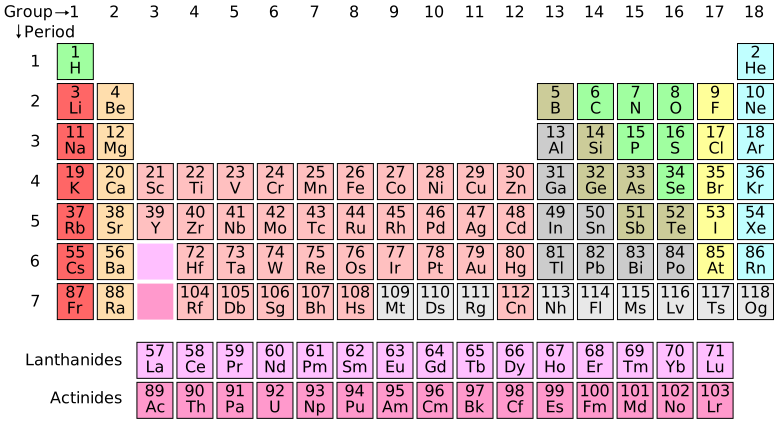
The complete modern periodic table (118 elements). Image: Cepheus et al., Public Domain, via Wikimedia Commons.
The two fundamental directions of periodic trends: across a period, and down a group.
- Atomic radius: Decreases across a period (nuclear charge increases, pulling electrons closer); increases down a group (extra electron shells dominate)
- Ionic radius: Cations are always smaller than their parent atom (lost outer shell or lost electron density); anions are always larger (gained electron density, same nuclear charge spread over more electrons)
- Ionization energy (IE): Energy needed to remove the outermost electron from a gaseous atom. Increases across a period; decreases down a group. Successive ionization energies (IE₁ < IE₂ < IE₃...) always increase, with a sharp jump once a stable noble-gas-like configuration is reached
- Electronegativity: Tendency of an atom to attract shared electrons in a bond. Increases across a period; decreases down a group. Fluorine is the most electronegative element (3.98 on the Pauling scale)
- Electron gain enthalpy / Electron affinity: Generally becomes more negative (more favourable) across a period, with the most negative values in Group 17 (halogens)
- Metallic / non-metallic character: Metallic character decreases across a period and increases down a group (opposite to electronegativity) — this is why the bottom-left of the table is most metallic and the top-right is most non-metallic
- Acidic/basic nature of oxides: Oxides become more acidic across a period (e.g. Na₂O basic → MgO basic → Al₂O₃ amphoteric → SiO₂ weakly acidic → Cl₂O₇ strongly acidic) and more basic down a group
Blocks of the Periodic Table
- s-block: Groups 1-2 (alkali and alkaline earth metals) — valence electrons fill the s-subshell
- p-block: Groups 13-18 (non-metals, metalloids, noble gases) — valence electrons fill the p-subshell
- d-block: Groups 3-12 (transition metals) — valence electrons fill the d-subshell; show variable oxidation states and form coloured complexes
- f-block: Lanthanides and actinides (inner transition) — valence electrons fill the f-subshell; lanthanides show the "lanthanide contraction" (steady, gradual decrease in atomic/ionic radius across the series due to poor shielding by f-electrons)
Important Groups
- Group 1: Alkali metals (Li, Na, K) — highly reactive, soft, low density, always +1 ion, react vigorously with water
- Group 2: Alkaline earth metals (Be, Mg, Ca) — less reactive than alkali metals, always +2 ion
- Group 17: Halogens (F, Cl, Br, I) — most electronegative group, exist as diatomic molecules, always −1 ion in simple compounds
- Group 18: Noble gases (He, Ne, Ar) — fully filled valence shell, chemically inert (though Xe and Kr can form compounds under special conditions)
Effective Nuclear Charge and Shielding
- Effective nuclear charge (Zeff): Net positive charge actually felt by valence electrons after accounting for shielding/screening by inner electrons. Approximated by Zeff = Z − σ (σ = shielding constant)
- Zeff increases across a period (electrons added to the same outer shell shield each other poorly), causing atomic radius to shrink and ionization energy to rise
- Down a group, extra inner shells shield the nucleus more effectively, so Zeff felt by the outermost electron stays roughly constant while the radius increases due to the added shells
Anomalous Periodic Trends (Common Exceptions)
- Ionization energy of O is lower than N, because N has a stable half-filled 2p³ configuration that resists electron removal, while O's 2p⁴ has one paired set that's easier to remove
- Ionization energy of Be and Mg are higher than their neighbours B and Al, due to the extra stability of a fully filled s-orbital (ns²)
- Electron gain enthalpy of F is less negative than Cl, because of F's very small size causing strong electron-electron repulsion in the compact 2p shell — the incoming electron is repelled more than expected
Diagonal Relationship
- Elements diagonally placed in the periodic table show similar properties because of comparable charge density (charge/size ratio), even though they belong to different groups
- Li (Group 1) resembles Mg (Group 2): both form a nitride directly with N₂, their carbonates decompose easily on heating, and their fluorides/carbonates are poorly soluble
- Be (Group 2) resembles Al (Group 13): both form amphoteric oxides, covalent chlorides that exist as dimers (BeCl₂, AlCl₃), and are passivated by a protective oxide layer
Periodicity in Valence and Oxidation States
- Maximum covalency/oxidation state of a p-block element generally equals the group number minus 10 (e.g., Group 17 max state = +7, Group 15 max state = +5)
- Inert pair effect: Heavier p-block elements (like Tl, Pb, Bi) prefer an oxidation state two units lower than the group oxidation state, because their ns² valence electron pair is held tightly (poor shielding from intervening d/f electrons) and resists participating in bonding
Common Exam Question
Q: Arrange Na, Mg, Al in order of increasing first ionization energy and explain.
A: Na < Al < Mg. Across the period, IE generally rises (Na < Mg), but Al's IE dips slightly below Mg's because removing Al's single 3p electron is easier than disturbing Mg's stable, fully-filled 3s² configuration.
Genesis of Periodic Classification
The modern table is the result of several earlier attempts to organise the elements:
- Döbereiner's Triads: Grouped elements in threes where the atomic mass of the middle element was roughly the average of the other two (e.g. Li, Na, K). Limited — very few such triads exist.
- Newlands' Law of Octaves: Arranged by increasing atomic mass, every eighth element had similar properties (like musical notes). Worked only up to calcium.
- Mendeleev's Periodic Table: Arranged by increasing atomic mass into periods and groups based on similar properties. His great success was leaving gaps and predicting undiscovered elements (eka-aluminium = Ga, eka-silicon = Ge) with remarkable accuracy. Its defects: no fixed place for isotopes, and some pairs (Ar/K, Co/Ni, Te/I) had to be placed out of mass order to fit their properties.
- Moseley's contribution: X-ray studies showed atomic number (not mass) is the fundamental property, resolving Mendeleev's anomalies and giving the modern periodic law.
IUPAC Nomenclature of Elements (Z > 100)
Elements with atomic number above 100 are given temporary systematic names until officially confirmed, using numerical roots for each digit of the atomic number, with the suffix "-ium".
- Roots: 0 = nil, 1 = un, 2 = bi, 3 = tri, 4 = quad, 5 = pent, 6 = hex, 7 = sept, 8 = oct, 9 = enn.
- Example: element 120 = un-bi-nil-ium = "Unbinilium" (symbol Ubn); element 118 = un-un-oct-ium = "Ununoctium" (now officially Oganesson, Og).
- Once confirmed, the discoverers propose a permanent name (e.g. 101 = Mendelevium, 118 = Oganesson).
Types of Atomic Radius
Because an atom has no sharp boundary, "atomic radius" is defined operationally in different ways depending on bonding:
- Covalent radius: Half the distance between the nuclei of two identical atoms joined by a single covalent bond (e.g. half the Cl–Cl bond length in Cl₂).
- Metallic radius: Half the internuclear distance between two adjacent atoms in a metallic crystal lattice. Slightly larger than covalent radius (metallic bonding is weaker/looser than covalent).
- Van der Waals radius: Half the distance between the nuclei of two non-bonded atoms of adjacent molecules in the solid state. It is the largest of the three, since no bonding pulls the atoms close.
- Order for the same element: van der Waals radius > metallic radius > covalent radius.
Electronegativity Scales
- Pauling scale: The most widely used; based on bond dissociation energies. Fluorine is assigned the maximum value of 3.98 (highest of all elements).
- Mulliken scale: Defines electronegativity as the average of ionization energy and electron affinity: EN = (IE + EA)/2. Mulliken values are about 2.8 times the Pauling values.
- Electronegativity is a property of an atom in a bonded state (not an isolated atom), and it increases with higher oxidation state and greater s-character of the hybrid orbital (sp > sp² > sp³).
Isoelectronic Species
Isoelectronic species are atoms and ions that contain the same number of electrons (and the same electronic configuration).
- Example set (10 electrons each): N³⁻, O²⁻, F⁻, Ne, Na⁺, Mg²⁺, Al³⁺.
- Within an isoelectronic series, size decreases as the nuclear charge (Z) increases, because the same number of electrons is pulled in more tightly: N³⁻ > O²⁻ > F⁻ > Ne > Na⁺ > Mg²⁺ > Al³⁺.
- General rule: the greater the positive charge, the smaller the ion; the greater the negative charge, the larger the ion.
Cause of Periodicity & Types of Elements
Periodicity — the recurrence of similar properties at regular intervals — arises because elements with similar valence-shell (outermost) electronic configurations recur at fixed intervals of atomic number. It is the outer-shell configuration, not the total electron count, that governs chemical behaviour.
On the basis of electronic configuration, elements are grouped into four types:
- Representative (main-group) elements: s-block and p-block (Groups 1, 2 and 13–17); outer s/p shells being filled, showing the most varied chemistry.
- Noble gases: Group 18; completely filled valence shells (ns²np⁶, except He 1s²), chemically very stable.
- Transition elements: d-block (Groups 3–12); the (n−1)d orbitals are being filled.
- Inner-transition elements: f-block (lanthanoids and actinoids); the (n−2)f orbitals are being filled.
Periodic Trends in Chemical Reactivity
- Chemical reactivity is highest at the two extremes of a period and lowest in the centre. On the left, reactivity of metals increases down the group (easier to lose electrons); on the right, reactivity of non-metals decreases down the group (harder to gain electrons).
- The most reactive metal is caesium (bottom-left region) and the most reactive non-metal is fluorine (top-right).
- Reactivity links directly to ionization enthalpy and electron gain enthalpy: low IE → reactive metal; highly negative electron gain enthalpy → reactive non-metal.
- Metallic character (and basic nature of oxides) rises down a group and falls across a period; non-metallic character (and acidic nature of oxides) does the reverse.
🚀 JEE Advanced Edge
Slater's rules (approximate Zeff calculation): Electrons in the same group as the electron of interest contribute 0.35 each to shielding; electrons in the shell just below contribute 0.85 each; electrons further inside contribute 1.00 each. Zeff = Z − (sum of these contributions).
Successive ionization energy jumps: A very large jump between IEn and IEn+1 reveals the number of valence electrons — e.g. if IE₃ ≫ IE₂ for an element, it has 2 valence electrons (removing the 3rd electron means breaking into a stable, lower noble-gas-like shell).
Lanthanide contraction's knock-on effect: Because of lanthanide contraction, the atomic radii of the 5d transition series elements (right after the lanthanides) are almost identical to their 4d counterparts (e.g. Zr and Hf, Nb and Ta have nearly the same radius), causing these element pairs to have very similar chemical properties and making them notoriously hard to separate.
Worked comparison: Explain why the ionic radius order is N³⁻ > O²⁻ > F⁻ > Na⁺ > Mg²⁺ > Al³⁺ even though all are isoelectronic (10 electrons each). Answer: All have the same electron count, but nuclear charge increases steadily from N (Z=7) to Al (Z=13); higher nuclear charge pulls the same number of electrons in tighter, so radius shrinks steadily as Z increases across this isoelectronic series.