🎯 Key Points
- Hydrogen sits in Group 1 but also resembles halogens — it can lose OR gain one electron
- Three isotopes: Protium (¹H, 99.99%), Deuterium (²H/D), Tritium (³H/T, radioactive)
- Three hydride classes: ionic/saline (NaH), covalent/molecular (CH₄, NH₃), metallic/interstitial (PdHx)
- H₂O₂ is both an oxidising AND reducing agent depending on what it reacts with
- Heavy water (D₂O) is used as a neutron moderator in nuclear reactors
- Lab prep: Zn + dilute acid → H₂; Industrial: electrolysis of brine/water, or the Bosch process from water gas
Each water molecule's O-H bonds (covalent, solid) can hydrogen-bond (dashed) to neighbouring molecules, forming an extended network responsible for water's unusually high boiling point and density anomaly.
Unique Position of Hydrogen
Hydrogen is placed in Group 1 but also resembles halogens (Group 17). It can lose one electron (like alkali metals) or gain one (like halogens), making it anomalous.
Isotopes of Hydrogen
- Protium (¹H): 1 proton, 0 neutrons; 99.99% of natural hydrogen
- Deuterium (²H or D): 1 proton, 1 neutron; used in heavy water for nuclear reactors
- Tritium (³H or T): 1 proton, 2 neutrons; radioactive
Properties and Reactions
- Colourless, odourless, lightest gas; highly flammable
- Combustion: 2H₂ + O₂ → 2H₂O
- Reduces metal oxides: CuO + H₂ → Cu + H₂O
- Reacts with halogens: H₂ + Cl₂ → 2HCl
Water (H₂O)
- Bent molecule; sp³ hybridisation; bond angle 104.5°
- High boiling point (100°C) due to extensive H-bonding
- Universal solvent; amphoteric (acts as both acid and base)
- Maximum density at 4°C (ice floats on water)
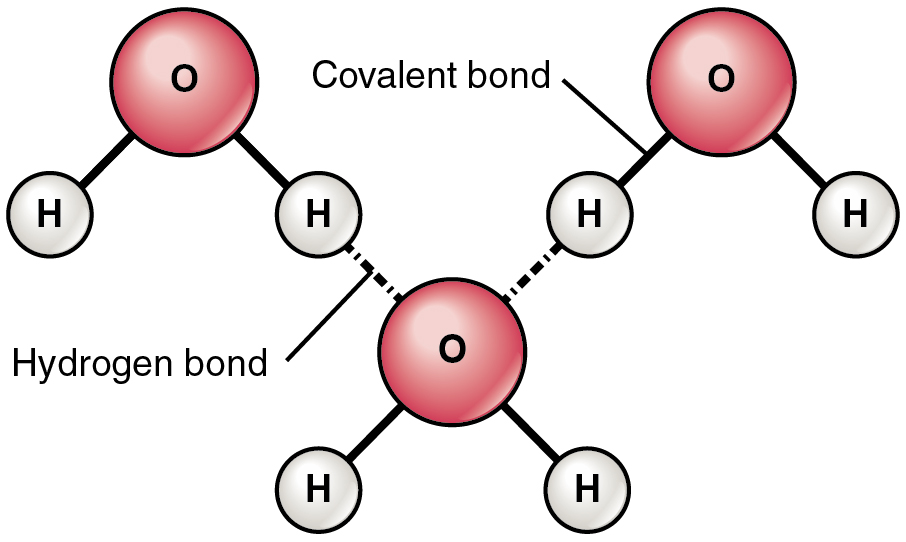
Hydrogen bonding in water: the strong O–H covalent bonds are drawn as solid lines, while the weaker hydrogen bonds (dashed) link the δ+ hydrogen of one molecule to a lone pair on the δ− oxygen of a neighbour. This extensive network explains water's high boiling point and why ice is less dense than liquid water. Image: OpenStax College, CC BY 3.0, via Wikimedia Commons.
Hydrogen Peroxide (H₂O₂)
- Pale blue liquid in pure form; used as bleach and antiseptic
- Acts as both oxidising and reducing agent
- Decomposes: 2H₂O₂ → 2H₂O + O₂ (accelerated by MnO₂)
Industrial Uses of Hydrogen
- Haber process: N₂ + 3H₂ → 2NH₃ (ammonia for fertilisers)
- Hydrogenation of vegetable oils to make vanaspati
- Rocket fuel and fuel cells (clean energy)
Preparation of Hydrogen
- Laboratory: Zn + dilute H₂SO₄ → ZnSO₄ + H₂ (using Kipp's apparatus)
- Industrial (electrolysis): Electrolysis of acidified or brine water gives high-purity H₂ at the cathode
- From water gas (Bosch process): Steam over coke gives water gas (CO + H₂); CO is then converted with more steam over a catalyst, and CO₂ is scrubbed out, leaving pure H₂
- Electrolysis of brine: Produces H₂ as a byproduct of chlor-alkali process alongside Cl₂ and NaOH
Classification of Hydrides
- Ionic (saline) hydrides: Formed by s-block metals (NaH, CaH₂); contain H⁻ ion; react violently with water releasing H₂
- Covalent (molecular) hydrides: Formed by p-block non-metals (CH₄, NH₃, H₂O, HF); held by covalent bonds
- Metallic (interstitial) hydrides: Formed by d- and f-block metals (Pd, Ni); H atoms occupy interstitial spaces in the metal lattice, often non-stoichiometric
Heavy Water (D₂O)
- Prepared by prolonged electrolysis of ordinary water (D₂O concentrates as ordinary water is preferentially electrolysed)
- Used as a moderator in nuclear reactors to slow down fast neutrons without absorbing them
- Physical properties differ slightly from H₂O: higher melting point (3.8°C), boiling point (101.4°C), and density
- Toxic to biological systems in large amounts as it slows down enzyme-catalysed reactions (kinetic isotope effect)
Hydrogen Economy and Hydrogen Bonding
- Hydrogen economy: vision of using H₂ as a clean fuel, since it produces only water on combustion and can be stored/transported as a liquid or in metal hydrides
- Hydrogen bonding (in H₂O, HF, NH₃) explains unusually high boiling points and the lower density of ice compared to liquid water
Hardness of Water and Its Removal
- Hard water contains dissolved salts of calcium and magnesium (bicarbonates, chlorides, sulphates) and does not lather easily with soap
- Temporary hardness: due to Ca(HCO₃)₂ and Mg(HCO₃)₂; removed by (a) boiling — Ca(HCO₃)₂ → CaCO₃↓ + H₂O + CO₂, or (b) Clark's method — adding a calculated amount of slaked lime Ca(OH)₂ that precipitates the insoluble carbonate
- Permanent hardness: due to chlorides and sulphates of Ca/Mg; not removed by boiling. Removed by (a) washing soda Na₂CO₃ (precipitates CaCO₃/MgCO₃), (b) Calgon process (sodium hexametaphosphate forms a soluble complex), or (c) ion-exchange (zeolite/permutit) which swaps Ca²⁺/Mg²⁺ for Na⁺
- Synthetic ion-exchange resins: a cation-exchange resin (RSO₃H) plus an anion-exchange resin together give completely demineralised (deionised) water
Structure and Preparation of Hydrogen Peroxide
- Preparation: (a) acidifying barium peroxide — BaO₂·8H₂O + H₂SO₄ → BaSO₄↓ + H₂O₂; (b) industrially by air auto-oxidation of 2-ethylanthraquinol; (c) electrolysis of 50% H₂SO₄ to peroxydisulphate followed by hydrolysis
- Structure: H₂O₂ has a non-planar, open-book (skew) shape — the two O-H bonds lie in different planes. Gas-phase dihedral angle is about 111°, falling to about 90° in the solid
- Storage: decomposes (disproportionates) slowly on standing, so it is kept in wax-lined dark bottles away from light and dust, with urea added as a stabiliser
- Concentration: often quoted as "volume strength" — 10-volume H₂O₂ liberates 10 mL of O₂ per mL of solution at STP
Reactions and Uses of Dihydrogen
- With metals: combines with strongly electropositive s-block metals to give ionic hydrides (2Na + H₂ → 2NaH)
- With non-metals: forms covalent hydrides (N₂ + 3H₂ → 2NH₃ in the Haber process; H₂ + Cl₂ → 2HCl)
- Reducing action: reduces many metal oxides to the metal (CuO + H₂ → Cu + H₂O)
- Hydrogenation: adds across unsaturated oils over a Ni catalyst to make vanaspati; the oxo (hydroformylation) process makes aldehydes from alkenes, CO and H₂
- Atomic hydrogen and oxy-hydrogen torches reach very high temperatures (about 4000 K) used for welding and cutting refractory metals
🚀 JEE Advanced Edge
H₂O₂ dual behaviour with equations: As an oxidising agent: H₂O₂ + 2KI → I₂ + 2KOH. As a reducing agent: H₂O₂ + 2KMnO₄... actually H₂O₂ reduces acidified KMnO₄: 2KMnO₄ + 3H₂SO₄ + 5H₂O₂ → K₂SO₄ + 2MnSO₄ + 8H₂O + 5O₂. Whether H₂O₂ oxidises or reduces depends on whether the other species has a more negative or more positive reduction potential than the H₂O₂/H₂O couple.
Volume strength of H₂O₂: "20 volume" H₂O₂ means 1 mL of that solution releases 20 mL of O₂ gas (at STP) on complete decomposition. Strength (g/L) = (Volume strength × 1.71... ) — derived from 2H₂O₂ → 2H₂O + O₂, relating moles of H₂O₂ to moles of O₂ released.
Kinetic isotope effect: Bonds to heavier isotopes (D vs H) break more slowly because of the lower zero-point vibrational energy of the C-D (or O-D) bond compared to C-H — this is why D₂O reactions are measurably slower than equivalent H₂O reactions, and underlies its mild biological toxicity.