🎯 Key Points
- Thomson → plum pudding model; Rutherford → nucleus + mostly empty space; Bohr → fixed circular orbits with quantised energy; Quantum mechanical model → orbitals (probability regions), current accepted model
- Bohr orbit energy: En = −13.6 Z²/n² eV (for hydrogen-like species)
- 4 quantum numbers: n (size/energy), l (shape, 0 to n−1), ml (orientation, −l to +l), ms (spin, ±½)
- Max electrons in a shell = 2n²; max electrons in a subshell = 2(2l+1)
- Aufbau, Pauli Exclusion, and Hund's Rule govern how electrons fill orbitals
- de Broglie wavelength: λ = h/mv; Heisenberg uncertainty: Δx·Δp ≥ h/4π
- Exceptions to expected configuration: Cr ([Ar]3d⁵4s¹), Cu ([Ar]3d¹⁰4s¹) — half-filled/fully-filled d-subshells are extra stable
Discovery of the Atom's Structure
Before quantum mechanics, several landmark experiments built up our picture of the atom piece by piece:
- J.J. Thomson (1897, cathode ray experiment) discovered the electron and proposed the "plum pudding model" — a sphere of positive charge with electrons embedded in it like raisins in a pudding.
- Ernest Rutherford (1911, alpha-particle gold foil experiment) fired alpha particles at thin gold foil. Most passed straight through, but a small fraction deflected sharply or bounced back. This proved the atom has a tiny, dense, positively charged nucleus at its centre, with electrons orbiting in mostly empty space.
- James Chadwick (1932) discovered the neutron, completing the basic picture of protons + neutrons in the nucleus, electrons outside it.
Bohr's Atomic Model
Bohr's model: electrons occupy fixed circular shells (K, L, M) around the nucleus, with each shell holding up to 2n^2 electrons.
Electrons revolve around the nucleus in fixed circular orbits called shells, each with a definite, quantised energy. They emit or absorb energy (as a photon) only when jumping between orbits, not while staying in one — this explained the discrete line spectra of hydrogen (Lyman, Balmer, Paschen series etc.) where Bohr's model had its biggest success.
- Shell K (n=1): max 2 electrons
- Shell L (n=2): max 8 electrons
- Shell M (n=3): max 18 electrons
- Any shell n: max 2n² electrons
- Energy of an electron in orbit n (hydrogen-like, atomic number Z): En = −13.6 (Z²/n²) eV
- Radius of orbit n: rn = 0.529 (n²/Z) Å
Limitations of Bohr's model: It works well only for hydrogen and hydrogen-like (single-electron) species; it fails to explain the spectra of multi-electron atoms, the Zeeman effect (splitting of spectral lines in a magnetic field), and it violates the Heisenberg uncertainty principle by assuming electrons move in fixed, precisely-defined circular paths.
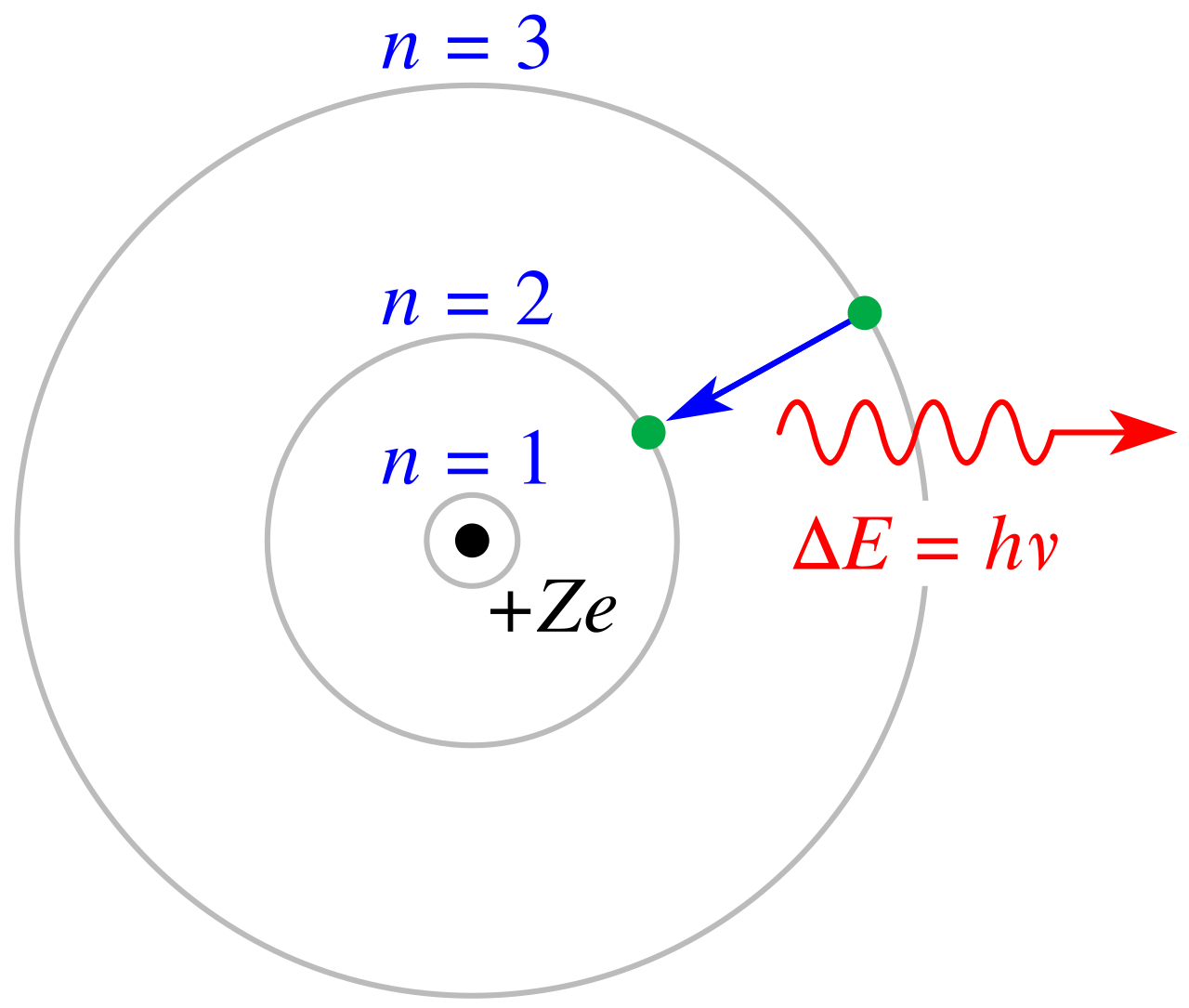
An electron falling to a lower orbit releases the exact energy gap as a photon — this is why atomic spectra show sharp lines. Image: JabberWok at English Wikipedia, CC BY-SA 3.0, via Wikimedia Commons.
Dual Nature of Matter & Light
Louis de Broglie proposed that, just as light shows both wave and particle nature, matter (electrons, in particular) also has a dual wave-particle character. Every moving particle has an associated wavelength:
de Broglie wavelength: λ = h / (mv) = h / p, where h is Planck's constant, m is mass, v is velocity, and p is momentum.
Heisenberg's Uncertainty Principle states that it is impossible to simultaneously know both the exact position and exact momentum of a microscopic particle like an electron: Δx · Δp ≥ h/4π. This is the theoretical reason Bohr's idea of a "fixed orbit" had to be replaced — instead, we now speak of orbitals, three-dimensional regions of space where the probability of finding an electron is high, not fixed paths.
Quantum Numbers
- Principal (n): Determines the energy level (shell) and overall size of the orbital. n = 1, 2, 3...
- Azimuthal / Angular momentum (l): Determines the shape of the subshell. l = 0 (s), 1 (p), 2 (d), 3 (f); ranges from 0 to (n−1)
- Magnetic (ml): Determines the orientation of the orbital in space. Ranges from −l to +l, giving (2l+1) possible orientations per subshell
- Spin (ms): Describes the electron's intrinsic spin; only two values, +½ or −½
Total electron capacity: a subshell holds 2(2l+1) electrons (s=2, p=6, d=10, f=14); a shell holds 2n² electrons.
Orbital Shapes & Nodes
Simplified 2D cross-sections of the s, p, and d orbital shapes, showing increasing complexity in electron cloud geometry.
- s orbital: Spherical, non-directional, one orientation only
- p orbital: Dumbbell-shaped, three orientations (px, py, pz) along the three axes
- d orbital: Double dumbbell / cloverleaf shaped, five orientations
Nodes are regions where the probability of finding an electron is zero. Radial nodes = n − l − 1; angular nodes = l; total nodes = n − 1.
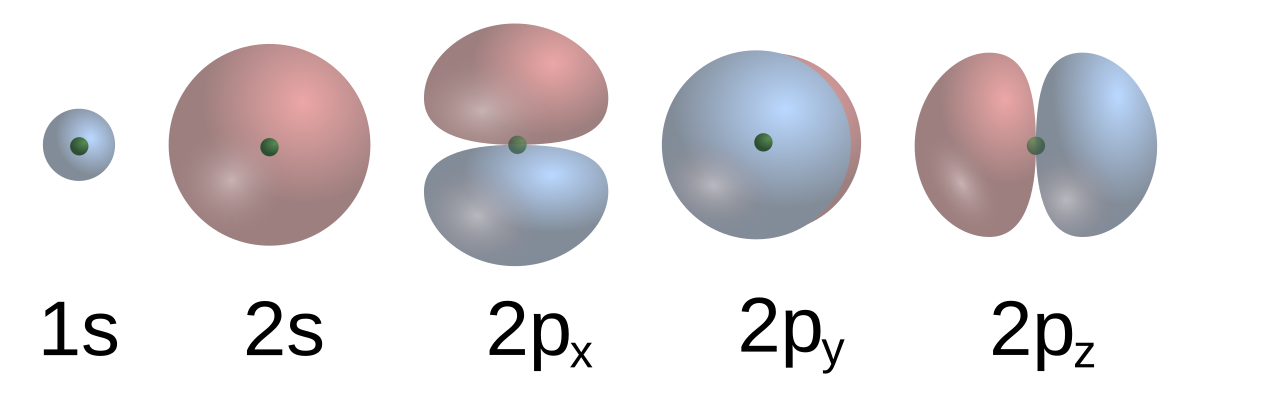
s orbitals are spherical; each p orbital is a two-lobed dumbbell along one axis, and the two colours mark opposite phases of the wave function. Image: User:Sven, CC BY-SA 3.0, via Wikimedia Commons.
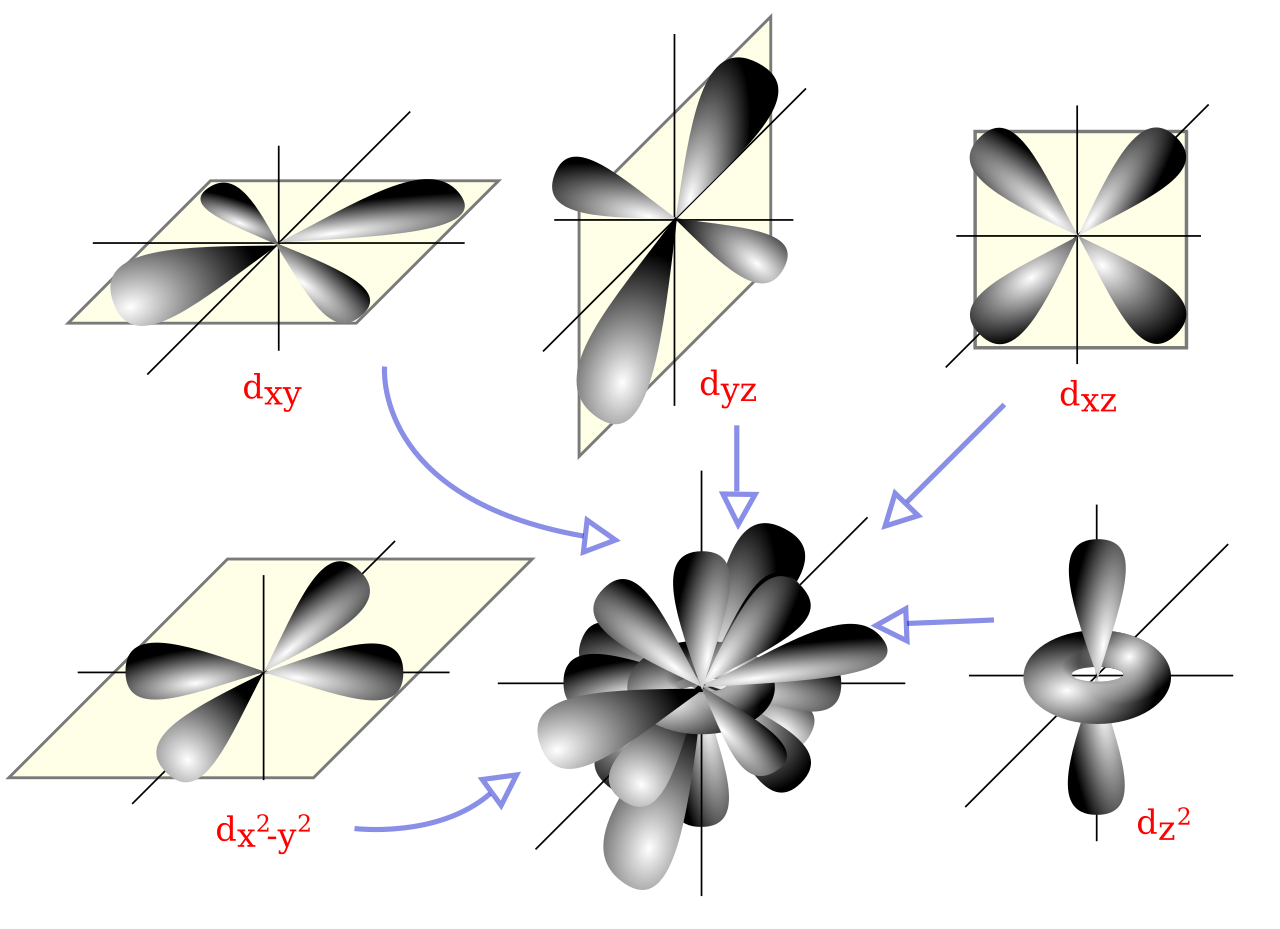
Four of the five d orbitals are four-lobed cloverleaves; only dz2 differs, with two lobes plus a doughnut-shaped ring. Image: User:Sven, CC BY-SA 3.0, via Wikimedia Commons.
Configuration Rules
- Aufbau Principle: Electrons fill orbitals starting from the lowest energy level and moving upward.
- Pauli Exclusion Principle: No two electrons in the same atom can have an identical set of all four quantum numbers — in practice, an orbital can hold at most 2 electrons, and they must have opposite spins.
- Hund's Rule of Maximum Multiplicity: Within a subshell, electrons occupy degenerate (equal-energy) orbitals singly first, with parallel spins, before any orbital gets a second electron. This minimises electron-electron repulsion.
Filling Order (n+l rule)
1s, 2s, 2p, 3s, 3p, 4s, 3d, 4p, 5s, 4d, 5p, 6s, 4f, 5d, 6p, 7s, 5f, 6d...
Note that 4s fills before 3d (lower n+l value), which is why transition metal configurations are written with 4s before 3d, but electrons are removed from 4s first when forming cations (e.g. Fe²⁺ is [Ar]3d⁶, not [Ar]3d⁴4s²).
Exceptions: Extra Stability of Half-Filled & Fully-Filled Subshells
Half-filled (p³, d⁵, f⁷) and fully-filled (p⁶, d¹⁰, f¹⁴) subshells have extra stability due to symmetric charge distribution and maximum exchange energy. This causes some elements to "borrow" an electron from the s-subshell:
- Chromium (Z=24): Expected [Ar]3d⁴4s², actual [Ar]3d⁵4s¹ (half-filled d gives extra stability)
- Copper (Z=29): Expected [Ar]3d⁹4s², actual [Ar]3d¹⁰4s¹ (fully-filled d gives extra stability)
Common Exam Question
Q: Write the electronic configuration of Fe (Z=26).
A: [Ar] 3d⁶ 4s² — fill 1s²2s²2p⁶3s²3p⁶4s²3d⁶ in Aufbau order, then conventionally write 3d before 4s in the final answer.
Q: How many electrons can the 3p subshell hold, and how are they arranged per Hund's rule for 3p³?
A: 3p holds max 6 electrons (2(2×1+1)=6). For 3p³, each of the three p orbitals (px, py, pz) gets exactly one electron, all with parallel spin, before any pairs up.
Planck's Quantum Theory & the Photoelectric Effect
Classical physics could not explain black-body radiation. Max Planck proposed that energy is emitted or absorbed not continuously but in discrete packets called quanta (a quantum of light is a photon). The energy of one quantum is E = hν = hc/λ, where h = 6.626 × 10⁻³⁴ J·s (Planck's constant), ν is frequency, and λ is wavelength.
The photoelectric effect (explained by Einstein, 1905) is the ejection of electrons from a metal surface when light of sufficient frequency strikes it. Key observations that only the quantum (photon) picture explains:
- Emission occurs only if the frequency exceeds a minimum threshold frequency (ν₀), no matter how intense the light — intensity does not compensate for too-low frequency.
- Increasing intensity (at ν > ν₀) increases the number of electrons ejected, not their kinetic energy.
- The kinetic energy of ejected electrons depends only on the frequency of light: hν = W₀ + ½mv², where W₀ = hν₀ is the work function (minimum energy to release an electron).
- Emission is instantaneous — there is no time lag between light striking and electron ejection.
Electromagnetic Spectrum & Atomic Spectra
- The electromagnetic spectrum (in increasing frequency / decreasing wavelength): radio < microwave < infrared < visible < ultraviolet < X-rays < gamma rays. Visible light spans roughly 400–750 nm.
- A continuous spectrum (e.g. white light through a prism) contains all wavelengths with no gaps.
- An emission (line) spectrum shows bright coloured lines at specific wavelengths — produced when excited electrons fall to lower energy levels and emit photons; it is a "fingerprint" unique to each element.
- An absorption spectrum shows dark lines on a continuous background, at the same wavelengths the element emits — light of those energies is absorbed to promote electrons upward.
Hydrogen Spectrum & Rydberg Equation
When hydrogen gas is excited, its emission spectrum consists of distinct series of lines. The wavenumber of each line is given by the Rydberg equation:
1/λ = RH (1/n₁² − 1/n₂²), where RH = 1.097 × 10⁷ m⁻¹ (Rydberg constant), n₁ < n₂ are the lower and upper energy levels.
- Lyman series (n₁ = 1): ultraviolet region
- Balmer series (n₁ = 2): visible region — the only series visible to the eye
- Paschen (n₁ = 3), Brackett (n₁ = 4), Pfund (n₁ = 5): all in the infrared region
Bohr's model successfully derived this equation and calculated RH, which was its greatest triumph.
Quantum Mechanical Model of the Atom
The modern model, based on the Schrödinger wave equation (Hψ = Eψ), treats the electron as a wave. Solving it gives allowed energy levels and wave functions (ψ) — each corresponding to an orbital.
- ψ itself has no direct physical meaning, but ψ² (probability density) gives the probability of finding the electron at a point in space.
- An orbital is the region of space around the nucleus where the probability of finding an electron is maximum (conventionally, the boundary enclosing about 90% probability).
- This wave-mechanical picture naturally incorporates Heisenberg's uncertainty principle — we can only speak of probability, never a definite path, replacing Bohr's fixed orbits.
- Each orbital is fully described by the set of three quantum numbers (n, l, ml), while the electron within it needs the fourth (ms).
🚀 JEE Advanced Edge
de Broglie wavelength numericals: λ = h/(mv). For an electron accelerated through potential V, kinetic energy = eV = ½mv², so v = √(2eV/m), then substitute into λ = h/(mv) = h/√(2meV).
Photoelectric effect connection: Energy of incident photon E = hν = hc/λ must exceed the work function (Φ) of the metal for photoemission; the excess energy becomes the kinetic energy of the ejected electron: hν = Φ + KEmax.
Isotopes, isobars, isotones: Isotopes have the same Z, different mass number A (e.g. ¹H, ²H, ³H). Isobars have the same A, different Z (e.g. ¹⁴C and ¹⁴N). Isotones have the same number of neutrons (A−Z) but different Z and A.
Worked problem: Calculate the wavelength of the electron in the lowest Bohr orbit of hydrogen and verify it matches the orbit's circumference (Bohr's quantisation condition mvr = nh/2π is equivalent to saying the orbit circumference equals a whole number of de Broglie wavelengths: 2πr = nλ).