🎯 Key Points
- SN2: one step, backside attack, inversion, favoured by 1° + polar aprotic solvent; SN1: two steps via carbocation, racemisation, favoured by 3° + polar protic solvent
- SN1 reactivity: 3° > 2° > 1°; SN2 reactivity: 1° > 2° > 3°
- Haloarenes have a stronger C-X bond (resonance, partial double-bond character) and resist nucleophilic substitution unlike haloalkanes
- Halogen on a benzene ring is deactivating but ortho/para directing (resonance donates, induction withdraws — induction wins on reactivity, resonance wins on direction)
- Grignard reagent (RMgX) must be prepared/used under strictly anhydrous conditions; reacts with carbonyls to give alcohols, CO₂ to give acids, water to give alkane (decomposes it)
- CFCs deplete ozone via Cl• radical chain reactions; DDT causes biomagnification up the food chain
Classification and Nomenclature
Haloalkanes have a halogen attached to an sp³ carbon; haloarenes have a halogen attached directly to an aromatic ring.
- Primary (1°): halogen on carbon with one alkyl group; e.g., CH₃CH₂Cl (chloroethane)
- Secondary (2°): halogen on carbon with two alkyl groups; e.g., (CH₃)₂CHCl
- Tertiary (3°): halogen on carbon with three alkyl groups; e.g., (CH₃)₃CCl
Methods of Preparation
- Free-radical halogenation of alkanes (UV light): CH₄ + Cl₂ → CH₃Cl + HCl
- Addition of HX to alkenes (Markovnikov): CH₂=CH₂ + HBr → CH₃CH₂Br
- Reaction of alcohols with HX, PCl₃, PCl₅, or SOCl₂; SOCl₂ is preferred (gives pure product with SO₂ and HCl as gases)
- Halogen exchange (Finkelstein reaction): RCl + NaI → RI + NaCl (in dry acetone)
- Swarts reaction: RCl + AgF → RF + AgCl (preparation of fluoroalkanes)
Nucleophilic Substitution: SN1 vs SN2
SN2 proceeds in a single step with backside attack and inversion of configuration, while SN1 forms a planar carbocation intermediate first, leading to racemisation.
- SN2: One step; back-side attack; inversion of configuration (Walden inversion); favoured by primary substrates and polar aprotic solvents (DMF, DMSO, acetone)
- SN1: Two steps; carbocation intermediate; racemisation; favoured by tertiary substrates and polar protic solvents (water, ethanol)
- Reactivity toward SN1: 3° > 2° > 1°; Reactivity toward SN2: 1° > 2° > 3°
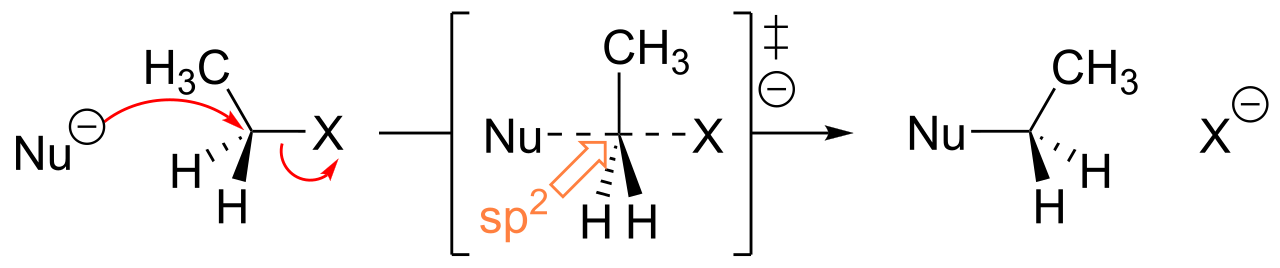
The SN2 mechanism: the nucleophile attacks carbon from the side opposite the leaving group in a single concerted step, passing through a trigonal-bipyramidal (sp2-like) transition state and inverting the configuration (Walden inversion). Rate depends on both substrate and nucleophile; favoured by 1° substrates. Image: Pillsmarch, CC BY 4.0, via Wikimedia Commons.
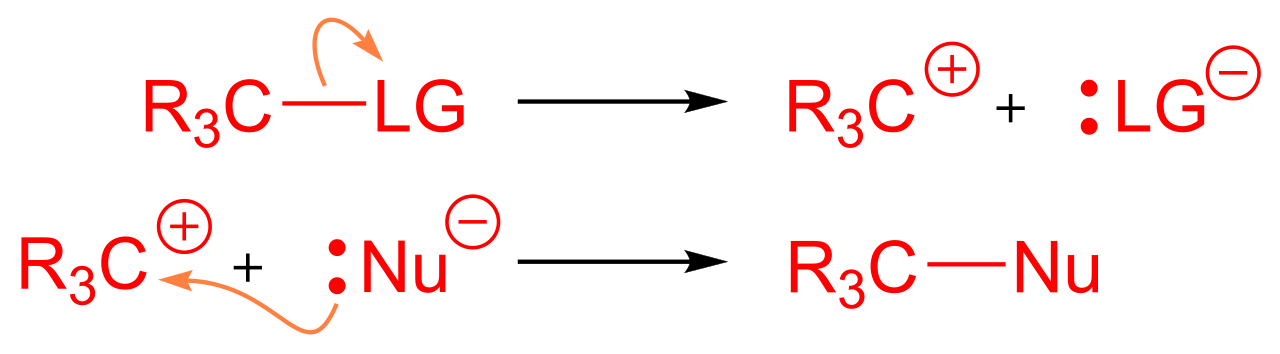
The SN1 mechanism: the leaving group departs first to give a planar carbocation, which the nucleophile then attacks from either face (giving racemisation). Rate depends only on the substrate concentration; favoured by 3° substrates and polar protic solvents. Image: Pillsmarch, CC BY 4.0, via Wikimedia Commons.
Elimination Reactions
- Dehydrohalogenation with strong base (KOH/alcohol): produces alkene; follows Zaitsev's rule (more substituted alkene is major product)
- E2 (one step, bimolecular) and E1 (two-step via carbocation) mechanisms
Stereochemistry
- Chiral centre: carbon bonded to four different groups
- R/S configuration: assign priorities by CIP rules; clockwise = R, anticlockwise = S
- Enantiomers: non-superimposable mirror images; equal and opposite optical rotation
- Racemic mixture: 50:50 mixture of enantiomers; optically inactive
Haloarenes
- C-X bond in haloarenes is stronger (partial double-bond character due to resonance) than in haloalkanes
- Less reactive than haloalkanes toward nucleophilic substitution
- Nucleophilic substitution possible only under drastic conditions (high T and P) or when strongly electron-withdrawing groups are present ortho/para
- Electrophilic aromatic substitution: halogen is deactivating but ortho/para directing (due to resonance)
Grignard Reagent
- RX + Mg in dry ether → RMgX (Grignard reagent)
- Reacts with carbonyl compounds to give alcohols; with CO₂ to give carboxylic acids; with water to give alkane
- Must be prepared and used under strictly anhydrous conditions
Environmental Effects
- Freons (chlorofluorocarbons, CFCs): used as refrigerants; deplete the ozone layer by releasing Cl• radicals in the stratosphere
- DDT (dichlorodiphenyltrichloroethane): first synthetic insecticide; persistent organic pollutant; causes biomagnification; now banned in most countries
Reactions with Metals
- Wurtz reaction: 2 R-X + 2 Na (dry ether) → R-R + 2 NaX; used to make symmetrical alkanes with an even number of carbons
- Wurtz-Fittig reaction: aryl halide + alkyl halide + Na → alkylarene (couples an aryl and an alkyl group)
- Fittig reaction: 2 aryl halides + Na → biaryl (e.g. two C₆H₅X → biphenyl)
- Grignard formation (RX + Mg) already covered — a further metal-insertion reaction
Common Nucleophilic Substitutions and Ambident Nucleophiles
- -OH (aq. KOH) → alcohol; -OR (Williamson) → ether; -CN → nitrile; -SH → thiol; -NH₂ → amine
- KCN vs AgCN: KCN (ionic) attacks through C → alkyl cyanide (nitrile); AgCN (covalent) attacks through N → alkyl isocyanide
- KNO₂ vs AgNO₂: KNO₂ gives alkyl nitrite (R-O-N=O); AgNO₂ gives nitroalkane (R-NO₂)
- These are ambident nucleophiles — they can attack through either of two atoms, giving different products depending on the counter-ion
- Reduction: R-X + LiAlH₄ (or Zn/HCl) → R-H (alkane)
Polyhalogen Compounds
- Chloroform (CHCl₃): solvent and former anaesthetic; slowly oxidised by air/light to poisonous phosgene (COCl₂), so stored in dark bottles filled to the brim with a little ethanol added
- Iodoform (CHI₃): yellow solid, antiseptic (action due to liberated iodine); formed in the iodoform test
- Carbon tetrachloride (CCl₄): solvent and former fire extinguisher (Pyrene); harmful to the ozone layer
- Freons (CFCs) and DDT: covered under environmental effects; both persistent and ozone-depleting/biomagnifying
🚀 JEE Advanced Edge
Ozone depletion chain mechanism: UV light splits a C-Cl bond in a CFC, releasing a Cl• radical. Cl• reacts with O₃ to form ClO• + O₂; ClO• then reacts with another O atom to regenerate Cl•, which goes on to destroy more ozone — each Cl atom can destroy thousands of O₃ molecules before being deactivated, explaining why even trace CFC releases cause large-scale ozone depletion.
Why retention of configuration occurs in SN1 (sometimes) vs full racemisation: If the leaving group doesn't fully depart before the nucleophile attacks (tight/contact ion pair), there can be a slight preference for attack from the same side the leaving group departed, giving partial (not full 50:50) racemisation with a slight excess of inverted product — full racemisation is the idealised case assuming a completely free, planar carbocation.
Worked problem: Predict the major product when 2-bromobutane reacts with alcoholic KOH vs aqueous KOH. Approach: Alcoholic KOH favours E2 elimination (strong base, low nucleophilicity in alcohol solvent) → major product is but-2-ene (Zaitsev, more substituted alkene). Aqueous KOH favours SN2 substitution (better nucleophile in protic solvent, weaker base character relatively) → major product is butan-2-ol. The SAME reagent (KOH) gives opposite dominant pathways depending purely on solvent choice.