🎯 Key Points
- Inductive effect acts through σ bonds (short range, permanent); resonance/hyperconjugation involve π/lone-pair or σ-C-H delocalisation
- Carbocation stability: 3° > 2° > 1° > methyl (more alkyl groups = more hyperconjugation/+I donation)
- SN1: 2-step, via carbocation, racemisation, favoured by 3° substrates + polar protic solvent; SN2: 1-step, backside attack, inversion (Walden inversion), favoured by 1° substrates
- Markovnikov's rule: H adds to the carbon already having more H atoms in HX addition to an unsymmetrical alkene
- Optical isomerism needs a chiral centre (4 different groups on one C); geometric (cis-trans) isomerism needs restricted rotation (C=C or ring) + 2 different groups per carbon
Electronic Effects in Organic Chemistry
- Inductive effect: Electron withdrawal or donation through sigma bonds, weakening with distance. Electron-withdrawing groups (-I): -NO₂, -CN, -COOH, halogens. Electron-donating groups (+I): alkyl groups, -O⁻
- Resonance: Delocalisation of pi electrons or lone pairs over conjugated systems; stabilises intermediates like carbocations and carbanions, and explains why phenol/aniline are more reactive than benzene in EAS reactions
- Hyperconjugation: Overlap of a sigma C-H bond with an adjacent empty or pi orbital ("no-bond resonance"); stabilises carbocations and alkenes — more alkyl groups (more C-H bonds available to donate) means more stability
- Electromeric effect: Complete transfer of a shared pi-electron pair to one atom in the presence of an attacking reagent, operating only during the reaction (temporary), important in addition reactions to multiple bonds
Reaction Types
- Substitution: Atom or group replaced by another. SN1 (unimolecular): two-step via a planar carbocation intermediate, gives racemisation, rate depends only on substrate concentration, favoured by 3° substrates and polar protic solvents. SN2 (bimolecular): one-step backside attack, gives inversion of configuration (Walden inversion), rate depends on both substrate and nucleophile concentration, favoured by 1° substrates and polar aprotic solvents (less steric hindrance to backside attack).
- Addition: Two reactants combine to give one product; occurs at double or triple bonds (electrophilic addition for alkenes, nucleophilic addition for carbonyls)
- Elimination: Loss of atoms to form a double bond; E1 (via carbocation, like SN1) and E2 (single-step, anti-periplanar geometry preferred) are the main mechanisms
Types of Isomerism
Geometric (cis-trans) isomers of 1,2-dichloroethene differ only in the relative arrangement of groups across the rigid C=C double bond.
- Structural isomers: Same formula, different connectivity; chain, position, functional group isomers
- Geometric (cis-trans): Different arrangement around a double bond; requires two different groups on each carbon
- Optical isomers: Non-superimposable mirror images; require a chiral centre (4 different groups on one carbon)
- Enantiomers: Mirror images; rotate polarised light in opposite directions
- Diastereomers: Stereoisomers that are not mirror images
Key Intermediates
- Carbocation: Positive carbon; stability: 3° > 2° > 1° > methyl (more hyperconjugation/+I donation stabilises positive charge)
- Carbanion: Negative carbon; stability order REVERSED from carbocation: methyl > 1° > 2° > 3° (alkyl groups' +I effect destabilises the already electron-rich carbanion)
- Free radical: Unpaired electron on carbon; stability order same as carbocation (3° > 2° > 1° > methyl), since hyperconjugation stabilises radicals too
Tetravalence and Hybridisation of Carbon
- Carbon is tetravalent and forms four covalent bonds by hybridising its 2s and 2p orbitals
- sp³: 4 sigma bonds, tetrahedral, bond angle 109.5° (e.g. CH₄, alkanes)
- sp²: 3 sigma + 1 pi bond, trigonal planar, 120° (e.g. C₂H₄, alkenes, carbonyl carbon)
- sp: 2 sigma + 2 pi bonds, linear, 180° (e.g. C₂H₂, alkynes, nitriles)
- Greater s-character (sp > sp² > sp³) holds the bonding electrons closer to the nucleus, giving shorter, stronger bonds and a more electronegative carbon
Classification and IUPAC Nomenclature
- Classification: acyclic (open-chain/aliphatic) vs cyclic; cyclic divides into homocyclic (alicyclic and aromatic) and heterocyclic, and compounds are further grouped by functional group into homologous series
- Homologous series: successive members differ by a -CH₂- unit, share the same general formula and similar chemical behaviour, with a gradual gradation in physical properties
- IUPAC name = prefix (substituents) + root word (number of carbons: meth, eth, prop, but, pent...) + suffix (principal functional group)
- The parent chain is the longest chain containing the principal functional group; it is numbered to give the lowest set of locants to that group first, then to substituents
- Order of seniority for the suffix group: -COOH > -SO₃H > ester > amide > nitrile > -CHO > >C=O > -OH > -NH₂; groups such as halo, nitro and alkyl are always named as prefixes
Fission of Covalent Bonds: Nucleophiles and Electrophiles
- Homolytic fission: the bond breaks so each atom keeps one electron, giving free radicals (shown by single-headed "fish-hook" arrows); favoured in the gas phase, non-polar solvents or under UV light
- Heterolytic fission: one atom takes both bonding electrons, giving a carbocation and a carbanion; favoured in polar solvents
- Nucleophiles: electron-rich electron-pair donors that attack electron-poor centres (e.g. OH⁻, CN⁻, NH₃, H₂O)
- Electrophiles: electron-deficient electron-pair acceptors that attack electron-rich centres (e.g. H⁺, NO₂⁺, carbocations, AlCl₃)
- A curved double-headed arrow shows the movement of a pair of electrons from the nucleophile toward the electrophile
Purification of Organic Compounds
- Crystallisation: separates a solid from soluble impurities using a solvent in which the compound is far more soluble hot than cold
- Sublimation: purifies solids that sublime (e.g. camphor, naphthalene, benzoic acid) from non-sublimable impurities
- Distillation: simple distillation for large boiling-point gaps; fractional distillation for close boiling points; steam distillation for steam-volatile, water-immiscible substances (e.g. aniline); distillation under reduced pressure for liquids that decompose at their boiling point (e.g. glycerol)
- Differential extraction: separates a compound from an aqueous solution by shaking with an immiscible organic solvent in which it is more soluble
- Chromatography: separation by differential adsorption or partition — adsorption (column, TLC) and partition (paper); a component's Rf = distance moved by solute / distance moved by solvent
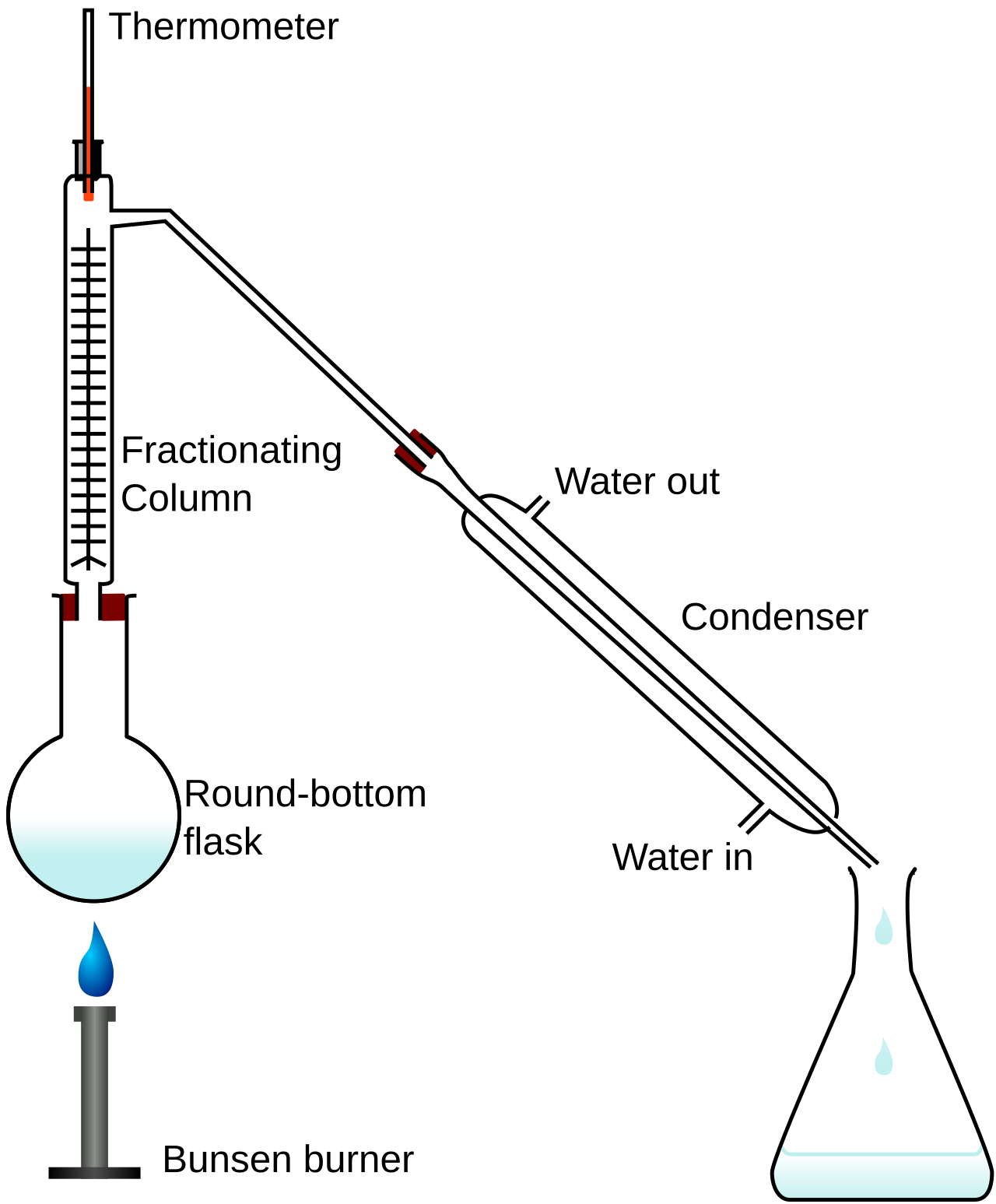
Fractional distillation separates two miscible liquids with close boiling points. Vapour rising through the fractionating column undergoes repeated cycles of condensation and re-vaporisation, so the more volatile component reaches the condenser first — the technique used to separate crude-oil fractions or acetone from water. Image: Theresa Knott / John Kershaw, CC BY-SA 3.0, via Wikimedia Commons.
Qualitative and Quantitative Analysis
- Detection of C and H: heating with copper(II) oxide converts carbon to CO₂ (turns lime water milky) and hydrogen to H₂O (turns anhydrous CuSO₄ blue)
- Lassaigne's test: fusing the compound with sodium converts N, S and halogens to ionic NaCN, Na₂S and NaX; the fusion extract then gives Prussian blue for nitrogen (with FeSO₄), a violet colour for sulphur (sodium nitroprusside), and characteristic silver halide precipitates for halogens
- Estimation of nitrogen: Dumas method (measures the volume of N₂ gas) or Kjeldahl method (N converted to ammonium sulphate, then ammonia liberated and titrated); Kjeldahl fails for nitrogen in rings or in -NO₂/-N=N- groups
- Estimation of carbon and hydrogen: combustion in excess O₂, absorbing CO₂ in KOH and H₂O in anhydrous CaCl₂, then weighing the increase
- Estimation of halogens, sulphur and phosphorus: Carius method — heating with fuming HNO₃ and precipitating the halide as AgX, sulphur as BaSO₄, or phosphorus as a phosphate, which is weighed
🚀 JEE Advanced Edge
R/S nomenclature (CIP rules): Rank the four groups on a chiral centre by atomic number priority (highest first). Orient the lowest-priority group away from you; if the remaining three groups (high to low) trace clockwise, it's R (rectus); if anticlockwise, it's S (sinister). A molecule with n chiral centres has up to 2ⁿ stereoisomers.
Meso compounds: A molecule with multiple chiral centres can still be optically INACTIVE if it has an internal plane of symmetry that makes it superimposable on its own mirror image (e.g., meso-tartaric acid) — don't assume "has chiral centres" automatically means "optically active."
Anti-periplanar requirement in E2: E2 elimination proceeds fastest when the leaving group and the departing H are anti-periplanar (180° dihedral angle) — this stereochemical requirement explains why certain diastereomers give different alkene products (Zaitsev vs Hofmann) on elimination.
Worked problem: Rank the following carbocations by stability: (CH₃)₃C⁺, (CH₃)₂CH⁺, CH₃CH₂⁺, C₆H₅CH₂⁺ (benzyl). Approach: Benzyl cation is stabilised by resonance into the aromatic ring (delocalised over 3 ring positions) — MORE stable than even a simple 3° cation, which only has hyperconjugation. Order: benzyl > (CH₃)₃C⁺ > (CH₃)₂CH⁺ > CH₃CH₂⁺.