🎯 Key Points
- Atmospheric layers: Troposphere (0–12 km, weather), Stratosphere (12–50 km, ozone layer at 23–25 km), Mesosphere (50–80 km), Thermosphere (80–400 km)
- Primary pollutants emitted directly (CO, SO₂, NO, hydrocarbons, particulates); Secondary pollutants formed in the atmosphere (O₃, PAN, HNO₃, H₂SO₄)
- Classical/London smog = SO₂ + particulates + fog, reducing type, occurs in cold humid conditions
- Photochemical/Los Angeles smog = NOx + unburnt hydrocarbons + UV → O₃ + PAN + acrolein + formaldehyde; oxidising type, occurs in warm sunny conditions
- Ozone depletion (CFC cycle): UV breaks C–Cl bond in CFCs → Cl• radical; Cl• + O₃ → ClO• + O₂; ClO• + O → Cl• + O₂; Cl• is regenerated — one Cl• can destroy ~10⁵ ozone molecules
- BOD (Biochemical Oxygen Demand) = mg of O₂ consumed per litre of water by microbes at 20°C for 5 days; high BOD = heavily polluted water (clean water BOD < 5 ppm; very polluted > 17 ppm)
- Eutrophication: excess nutrients (N, P from fertilisers) → algal bloom → blocks sunlight → O₂ depletion → death of aquatic organisms
- Minamata disease = methylmercury (Hg) poisoning; Itai-itai disease = cadmium (Cd) poisoning; lead poisoning affects CNS in children
- Acid rain: SO₂ + H₂O → H₂SO₃ (further oxidised to H₂SO₄); 2NO₂ + H₂O → HNO₃ + HNO₂; damages marble/limestone monuments (CaCO₃ + H₂SO₄ → CaSO₄ + H₂O + CO₂)
- Greenhouse gases: CO₂, CH₄, N₂O, CFCs, H₂O vapour; absorb IR radiation re-emitted by Earth's surface and warm the atmosphere
- Green chemistry: designing products/processes that reduce or eliminate hazardous substances; 12 principles include atom economy, catalysis, safer solvents, renewable feedstocks
📖 Full Explanation
1. Atmospheric Structure
The atmosphere is divided into concentric layers based on the temperature gradient:
- Troposphere (0–12 km): Contains ~75% of the total atmospheric mass and almost all water vapour. Temperature decreases with altitude at ~6.5°C/km. All weather phenomena and most pollution occur here.
- Stratosphere (12–50 km): Temperature increases with altitude because ozone (O₃) absorbs UV radiation. The ozone layer is concentrated at 23–25 km altitude. This absorbs harmful UV-B and UV-C radiation, protecting life on Earth. The stratosphere is otherwise dry and calm.
- Mesosphere (50–80 km): Temperature decreases again with altitude; coldest part of the atmosphere (~−90°C). Meteors burn up here.
- Thermosphere (80–400 km): Temperature rises steeply because O₂ and N₂ absorb short-wavelength UV and X-rays. Contains the ionosphere used for radio-wave reflection.
2. Air Pollution — Primary vs Secondary Pollutants
Primary pollutants are emitted directly from sources: CO (incomplete combustion of fuels), SO₂ (burning of sulphur-containing coal and petroleum), NO and NO₂ (NOx — formed in high-temperature combustion), unburnt hydrocarbons (petroleum vehicles), and particulate matter (soot, fly ash, dust).
Secondary pollutants form when primary pollutants react in the atmosphere: ozone (O₃), PAN (peroxyacetyl nitrate), H₂SO₄ (sulphuric acid aerosol), HNO₃ (nitric acid) are all secondary.
Carbon monoxide (CO) is particularly dangerous because it binds to haemoglobin (~300 times more strongly than O₂), forming carboxyhaemoglobin (COHb), which cannot carry oxygen — causing hypoxia, especially dangerous in enclosed spaces.
Particulate matter (PM₂.₅ and PM₁₀) consists of aerosols, dust, fly ash, and smoke. Fine particles penetrate deep into lungs, causing respiratory and cardiovascular disease. Asbestos particles are a known carcinogen.
3. Smog
Classical smog is a reducing mixture of SO₂ and fog, while photochemical smog is an oxidising mixture generated by UV-driven reactions of NOx and hydrocarbons.
Classical smog (London smog) forms in cold, humid climates during winter temperature inversions. Coal combustion produces SO₂ and particulates, which combine with fog to form a thick, reducing, grey haze. The 1952 Great Smog of London killed ~4000 people in four days.
Photochemical smog (Los Angeles smog) forms in warm, sunny, low-wind conditions. The sequence is: (1) NO₂ absorbs UV → NO + O; (2) O + O₂ → O₃; (3) O₃ + unburnt hydrocarbons + UV → PAN (peroxyacetyl nitrate) + acrolein (CH₂=CH-CHO) + formaldehyde (HCHO) and other oxidants. PAN is a powerful eye and respiratory irritant and also harms crops. O₃ at ground level damages rubber, nylon, and plant tissues.
4. Ozone Layer Depletion
The stratospheric ozone layer exists in a dynamic equilibrium maintained by UV-driven reactions:
- O₂ + UV (λ < 242 nm) → 2 O (atomic oxygen)
- O + O₂ → O₃ (ozone formation)
- O₃ + UV (λ 220–320 nm) → O₂ + O (ozone absorption — this is the protective step)
- O + O₃ → 2 O₂ (natural removal)
CFC-catalysed depletion mechanism: Chlorofluorocarbons (Freons, e.g., CCl₂F₂) released in the troposphere rise to the stratosphere where short-wavelength UV breaks the C–Cl bond:
- CCl₂F₂ + UV → CClF₂• + Cl•
- Cl• + O₃ → ClO• + O₂
- ClO• + O → Cl• + O₂
Cl• is regenerated in the last step, completing the catalytic cycle. A single Cl• atom can destroy approximately 10⁵ ozone molecules before it is finally removed by other reactions. NOx (from high-altitude aircraft and fertilisers) similarly catalyses ozone destruction: NO + O₃ → NO₂ + O₂; NO₂ + O → NO + O₂. The Antarctic ozone hole forms in spring because polar stratospheric clouds (PSCs) amplify CFC-related destruction.
5. Acid Rain
Acid rain has a pH typically between 4.0 and 5.6 (normal rain is slightly acidic at ~5.6 due to dissolved CO₂). Formation:
- SO₂ + H₂O → H₂SO₃ (sulphurous acid); 2SO₂ + O₂ + 2H₂O → 2H₂SO₄ (sulphuric acid)
- 4NO₂ + 2H₂O + O₂ → 4HNO₃ (nitric acid)
Effects: acidifies lakes and rivers (kills aquatic life), damages forests (leaches nutrients from soil), corrodes metals and stonework. The reaction with limestone/marble monuments:
CaCO₃ + H₂SO₄ → CaSO₄ + H₂O + CO₂
CaSO₄ (gypsum) is powdery and crumbles, disfiguring historic buildings like the Taj Mahal. This phenomenon is called "stone leprosy" or "stone cancer".
6. Greenhouse Effect and Global Warming
Solar radiation (mostly visible light, ~0.4–0.7 µm) passes through the atmosphere and warms the Earth's surface. The surface re-emits infrared (IR) radiation (~4–100 µm). Greenhouse gases (CO₂, CH₄, N₂O, H₂O vapour, CFCs, O₃) absorb this IR and re-radiate it in all directions, warming the lower atmosphere — the greenhouse effect. This is a natural and necessary process (without it, Earth's average temperature would be −18°C instead of ~15°C).
Enhanced greenhouse effect: Since the Industrial Revolution (~1750), atmospheric CO₂ has risen from ~280 ppm to over 420 ppm, methane has more than doubled, and N₂O has risen ~20%. Consequences include global average temperature rise (~1.1°C since pre-industrial times), melting of polar ice caps and glaciers, sea level rise, extreme weather events, and shifts in ecosystems.
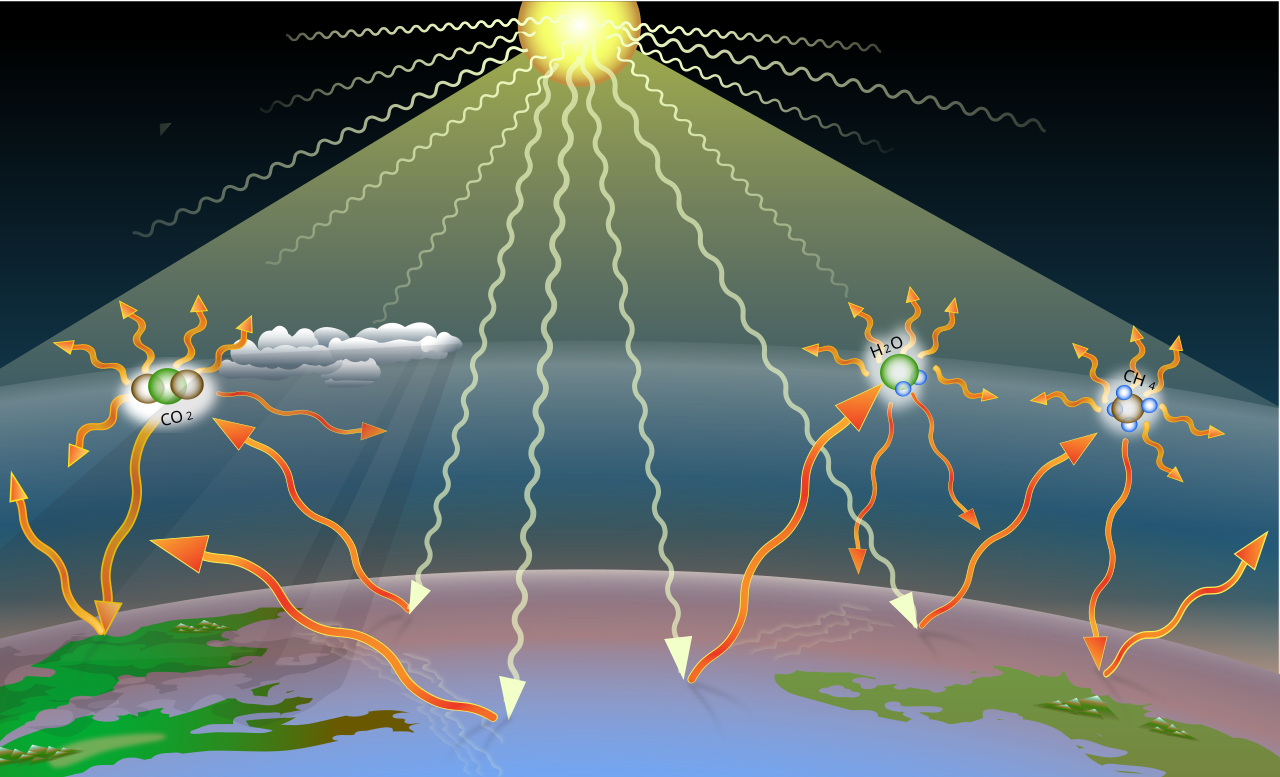
The greenhouse effect: short-wavelength solar radiation passes through the atmosphere and warms the surface, which re-emits longer-wavelength infrared. Greenhouse gas molecules — CO2, H2O vapour and CH4 — absorb this IR and re-radiate it in all directions, trapping heat in the lower atmosphere. Image: A loose necktie, CC BY-SA 4.0, via Wikimedia Commons.
CO₂ is the largest contributor by volume; CH₄ is ~25–80 times more potent per molecule over different time horizons; N₂O is ~300 times more potent than CO₂ (from fertilisers and fossil fuels); CFCs have an extremely high global warming potential (thousands of times CO₂) and also deplete ozone.
7. Water Pollution
BOD (Biochemical Oxygen Demand) measures the amount of dissolved oxygen (mg/L) consumed by aerobic microorganisms decomposing organic matter in 1 litre of water sample at 20°C over 5 days (standard BOD₅ test). High BOD indicates high organic pollution load. Clean water: BOD < 5 ppm; very polluted water: BOD > 17 ppm.
Eutrophication: Runoff of nitrogen and phosphorus from agricultural fertilisers and sewage into water bodies causes explosive growth of algae and cyanobacteria (algal blooms). As algae die and decompose, BOD surges, dissolved oxygen crashes, and fish and other aquatic organisms die. The water body becomes hypoxic/anoxic — a "dead zone".
Heavy metal contamination:
- Mercury (Hg): Industrial discharge (especially from chlor-alkali plants and paper mills using mercuric sulphate catalyst) → methylated by aquatic bacteria to methylmercury (CH₃Hg⁺, much more toxic and bioaccumulates in fish) → Minamata disease (Japan, 1950s): neurological damage, sensory loss, tremors, birth defects.
- Cadmium (Cd): From zinc-smelting effluents and phosphate fertilisers → replaces calcium in bones → Itai-itai disease (Japan, "ouch-ouch"): softening of bones, severe pain, fractures.
- Lead (Pb): From lead paints, old pipes, leaded petrol → damages CNS, particularly in children; affects haem synthesis.
- Arsenic (As): From geogenic sources and pesticides → hyperkeratosis, cancer.
8. Soil Pollution
Major causes of soil pollution include: (1) Pesticides and herbicides — persistent organochlorine compounds (DDT, aldrin, dieldrin) bioaccumulate up the food chain (biomagnification) because they are fat-soluble; (2) Industrial effluents and solid wastes — heavy metals, chemicals; (3) Radioactive wastes — from nuclear power plants, nuclear weapon testing fallout, and radioisotope use in medicine and research; ⁹⁰Sr (strontium-90) mimics calcium and deposits in bones; (4) Fertiliser overuse — nitrates leach into groundwater.
9. Green Chemistry
Green chemistry (sustainable chemistry) is the design of chemical products and processes to reduce or eliminate the use and generation of hazardous substances. Paul Anastas and John Warner (1998) formulated 12 principles, which include:
- Atom economy: Maximise the incorporation of starting materials into the final product; fewer by-products.
- Prevention: Prevent waste rather than treating or cleaning it up after it is formed.
- Safer solvents: Use benign solvents (water, supercritical CO₂) instead of hazardous organic solvents.
- Catalysis: Use catalytic reagents (not stoichiometric) to reduce energy and waste.
- Renewable feedstocks: Use raw materials derived from renewable sources (biomass) rather than petroleum.
- Design for degradation: Products should degrade into innocuous substances after use.
Examples of green chemistry in practice: (1) Dry-cleaning using liquid CO₂ instead of perchloroethylene (a chlorinated carcinogen); (2) Using H₂O₂ as a clean oxidant in manufacturing instead of chlorine-based oxidants; (3) Bhopal disaster-inspired avoidance: BASF now converts methylamine and phosgene into the final product without storing the intermediate MIC (methyl isocyanate); (4) Synthesis of ibuprofen by BHC Company using a 3-step catalytic process (99% atom economy) replacing the old 6-step process that produced much more waste.
Particulate Pollutants (Classification)
Particulates are tiny solid or liquid particles suspended in air. They are classified as:
- Viable particulates: living organisms — bacteria, fungi, moulds, algae — which can cause disease or allergies.
- Non-viable particulates: (a) Smoke — solid/liquid particles from combustion (oil smoke, cigarette smoke); (b) Dust — fine solids from crushing/grinding (cement, sawdust); (c) Mist — liquid droplets from condensation or spraying (sulphuric acid mist, herbicide spray); (d) Fumes — condensed vapours of metals or organics.
- By size, PM₁₀ (≤10 µm) and PM₂.₅ (≤2.5 µm) are the most harmful, as the finest particles reach deep into the lungs. Smog itself is a combination of smoke and fog.
International Standards for Drinking Water
To be safe for drinking, water must meet limits set by agencies such as the WHO and BIS. Key maximum permissible limits (approximate):
- Fluoride: ~1 ppm (a deficiency causes tooth decay; excess > 2 ppm causes brown mottling of teeth, and above ~10 ppm harms bones and teeth — fluorosis).
- Lead: ~50 ppb (0.05 ppm); damages the kidney, liver and nervous system.
- Nitrate: ~50 ppm; excess causes methaemoglobinaemia ("blue baby syndrome").
- Sulphate: ~500 ppm; excess has a laxative effect.
- Trace metals such as cadmium, mercury and arsenic have very low permissible limits owing to their high toxicity.
Strategies to Control Environmental Pollution
Controlling pollution centres on managing waste at every stage:
- Collection and segregation: separating biodegradable (kitchen/plant) waste from non-biodegradable (plastics, glass, metals) waste at source makes treatment far easier.
- Disposal: biodegradable waste is composted or used for landfill and biogas; hazardous and industrial waste needs specialised treatment before disposal.
- Recycling and reuse: recovering paper, glass, metal and some plastics conserves raw materials and energy and reduces landfill volume.
- Industrial-waste treatment: effluents are neutralised and toxic material removed before discharge; scrubbers and electrostatic precipitators remove gaseous and particulate pollutants from smokestacks; catalytic converters cut vehicle emissions.
- Sewage and household waste should be treated in treatment plants rather than dumped directly into rivers.
🔬 Advanced / Edge Cases
- Temperature inversion and classical smog: Normally, air temperature decreases with altitude, so warm polluted air near the surface rises and disperses. During a temperature inversion, a layer of warmer air sits above cooler surface air, acting as a lid that traps pollutants near the ground — this is why classical smog events are so catastrophic.
- Why is the BOD test conducted at 20°C for 5 days? 20°C represents a moderate temperate temperature at which typical sewage bacteria are most active; 5 days is sufficient to oxidise most readily degradable organics (~70–80%) without requiring too long a test period. The test is standardised internationally under these conditions (BOD₅,₂₀).
- PAN formation mechanism: CH₃CHO (acetaldehyde, from hydrocarbon oxidation) + OH• → CH₃CO• (acetyl radical) + H₂O; CH₃CO• + O₂ → CH₃C(O)OO• (peroxyacetyl radical); CH₃C(O)OO• + NO₂ ⇌ CH₃C(O)OONO₂ (PAN). PAN serves as a reservoir and long-range transporter of NOx; it decomposes in warmer regions to release NO₂ again.
- NOx catalytic ozone depletion cycle: This operates similarly to the CFC cycle: NO + O₃ → NO₂ + O₂; NO₂ + O → NO + O₂; net: O₃ + O → 2O₂. NOx from stratospheric aircraft exhaust and N₂O from soil denitrification (converted to NO in the stratosphere) are the primary sources.
- Montreal Protocol (1987): International treaty to phase out ozone-depleting substances (ODSs); considered the most successful global environmental treaty. CFC production in developed countries was phased out by 1996; the stratospheric ozone layer is slowly recovering.
- Biomagnification vs bioaccumulation: Bioaccumulation is the build-up of a substance within a single organism. Biomagnification is the progressive increase in concentration at each trophic level (e.g., DDT: phytoplankton → zooplankton → small fish → large fish → birds of prey; concentrations can increase ~10⁷-fold from water to top predator). DDT causes eggshell thinning in raptors, collapsing bird populations (led to the ban on DDT in many countries).
- Carbon monoxide as a secondary product: CO₂ + C → 2CO (at very high temperatures in furnaces); CO is also produced when CO₂ reacts with hot carbon. In addition, CO is produced in photochemical smog through the photooxidation of CH₄ and other hydrocarbons.
- Dissolved oxygen (DO) vs BOD: DO is the actual dissolved oxygen present in water at a given moment; BOD is the oxygen demand over 5 days. A clean river has DO ~8–10 mg/L and BOD < 2 mg/L. An inverse relationship exists: high BOD → low DO → ecological stress.
Worked Example: Acid Rain Damaging the Taj Mahal
Industries near Agra emit SO₂ and NOx. In the atmosphere: SO₂ is oxidised to SO₃ (catalysed by particulates), which dissolves in rain to form H₂SO₄. When this acid rain falls on the white marble (calcium carbonate, CaCO₃) of the Taj Mahal:
CaCO₃ + H₂SO₄ → CaSO₄ + H₂O + CO₂
CaSO₄ (calcium sulphate / gypsum) is relatively soluble, soft, and can be washed away by rain or crumble from the surface. Over decades, this chemical weathering causes irreversible pitting and yellowing — known as "marble cancer." The government created a Taj Trapezium Zone (TTZ) in 1996, banning coal/coke industries within a 10,400 km² area around the monument as a mitigation measure.