🎯 Key Points
- OIL RIG: Oxidation Is Loss (of electrons), Reduction Is Gain
- Oxidising agent gets reduced itself; reducing agent gets oxidised itself
- O is usually −2, H is usually +1, F is always −1; sum of oxidation states = 0 (neutral) or ion charge
- Two balancing methods: ion-electron (half-reaction) method, and oxidation number method
- Disproportionation = same element simultaneously oxidised and reduced in one reaction
- Electrochemical series ranks species by standard reduction potential — higher E° oxidises lower E°
Electron transfer in a redox reaction: zinc loses electrons (oxidised, acts as reducing agent) and copper(II) ions gain those same electrons (reduced, acts as oxidising agent).
Oxidation and Reduction
Redox reactions always occur together; you cannot have one without the other.
- Oxidation: Loss of electrons; increase in oxidation state; loss of hydrogen or gain of oxygen
- Reduction: Gain of electrons; decrease in oxidation state; gain of hydrogen or loss of oxygen
- OIL RIG: Oxidation Is Loss, Reduction Is Gain (of electrons)
- Oxidising agent: Accepts electrons; gets reduced itself; e.g., KMnO₄, K₂Cr₂O₇, Cl₂, HNO₃
- Reducing agent: Donates electrons; gets oxidised itself; e.g., Zn, Fe, H₂S, oxalic acid
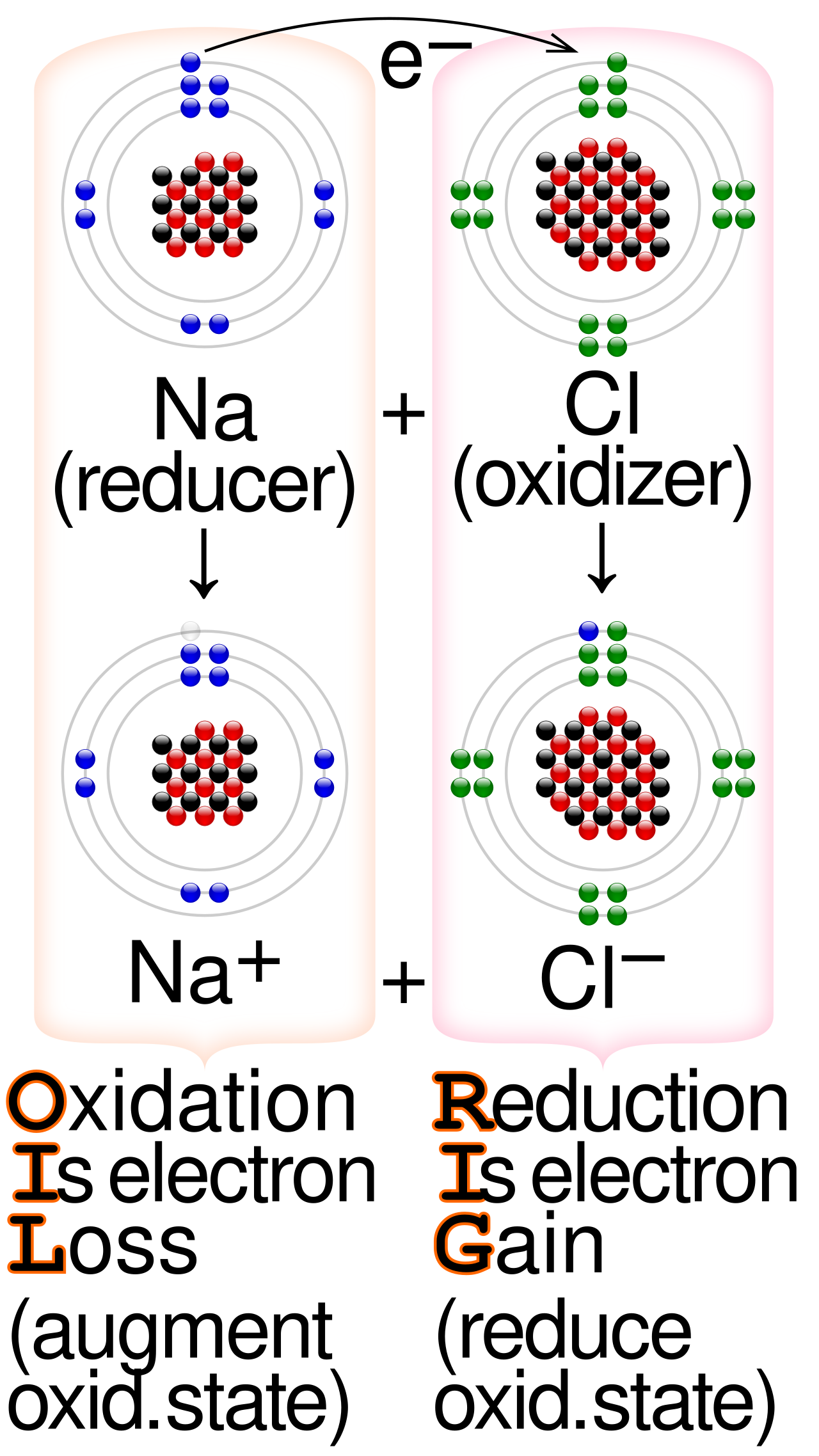
A redox reaction is an electron transfer: sodium loses an electron (oxidation) to become Na+ and acts as the reducing agent, while chlorine gains that electron (reduction) to become Cl− and acts as the oxidising agent. Remember OIL RIG — Oxidation Is Loss, Reduction Is Gain of electrons. Image: Cmglee, CC BY-SA 4.0, via Wikimedia Commons.
Rules for Assigning Oxidation States
- Free element: oxidation state = 0 (e.g., O₂, Zn, Fe)
- Monatomic ion: oxidation state = ionic charge (Na⁺ = +1, Cl⁻ = -1)
- O is usually -2 (except in peroxides: -1; in OF₂: +2)
- H is usually +1 (except in metal hydrides: -1)
- F is always -1
- Sum of oxidation states = 0 for neutral compound; = ion charge for polyatomic ions
Balancing Redox Reactions
Ion-electron (half-reaction) method:
- Split into oxidation and reduction half-reactions
- Balance atoms other than O and H
- Balance O by adding H₂O; balance H by adding H⁺ (acidic) or OH⁻ (basic)
- Balance charge by adding electrons
- Multiply to equalise electrons, then add the half-reactions
Oxidation number method:
- Assign oxidation states to all atoms
- Calculate change in oxidation state for each element
- Multiply coefficients so total increase = total decrease
- Balance remaining atoms and charge
Disproportionation Reactions
A single substance acts as both oxidising agent and reducing agent; the same element is simultaneously oxidised and reduced.
- Example: Cl₂ + 2NaOH → NaCl + NaOCl + H₂O (Cl goes from 0 to -1 and +1)
- Example: 2H₂O₂ → 2H₂O + O₂ (O goes from -1 to -2 and 0)
Electrochemical Series
- Lists standard reduction potentials (E°) from most positive (strongest oxidising agent) to most negative (strongest reducing agent)
- Species with higher E° will oxidise species with lower E°
- Fluorine (E° = +2.87 V) is the strongest oxidising agent
- Lithium (E° = -3.04 V) is the strongest reducing agent
Redox in Daily Life
- Rusting of iron: Fe is oxidised by O₂ in the presence of moisture (electrochemical process)
- Bleaching: Cl₂ and H₂O₂ work by oxidising coloured compounds
- Respiration: glucose is oxidised by O₂ to release energy (C₆H₁₂O₆ + 6O₂ → 6CO₂ + 6H₂O)
- Photography: light reduces Ag⁺ to Ag (photographic film)
Quick Tips
- In a redox reaction, identify the element that changes oxidation state first
- Electrons are never free in solution; every electron lost by one species is gained by another
- Always check: total charge increase = total charge decrease when balancing
Types of Redox Reactions
- Combination: two species combine, at least one being an element, with change in oxidation number — e.g., C + O₂ → CO₂; H₂ + Cl₂ → 2HCl.
- Decomposition: a compound breaks into two or more products — e.g., 2H₂O → 2H₂ + O₂; 2KClO₃ → 2KCl + 3O₂.
- Displacement: one element displaces another from its compound. Metal displacement: Zn + CuSO₄ → ZnSO₄ + Cu. Non-metal displacement: Cl₂ + 2KBr → 2KCl + Br₂.
- Disproportionation: the same element in one species is simultaneously oxidised and reduced — e.g., 2H₂O₂ → 2H₂O + O₂.
- Comproportionation: two species with the same element in different oxidation states form a product with an intermediate state — e.g., 2H₂S + SO₂ → 3S + 2H₂O.
Standard Electrode Potential and SHE
- Every electrode (metal in contact with its ion) develops a potential from the tendency to lose or gain electrons; measured relative to a reference.
- The Standard Hydrogen Electrode (SHE) is the reference, assigned E° = 0.00 V (Pt, H₂ gas at 1 bar, 1 M H⁺, 298 K).
- Standard electrode potential (E°) is the potential of an electrode measured against SHE under standard conditions, written as a reduction potential.
- A more positive E° means a greater tendency to be reduced (stronger oxidising agent); a more negative E° means a greater tendency to be oxidised (stronger reducing agent).
- Cell EMF, E°cell = E°cathode − E°anode; a positive value indicates a spontaneous (feasible) redox reaction.
Redox Titrations
In a redox titration, an oxidising agent is titrated against a reducing agent (or vice versa); the equivalence point is found using self-indicators or added indicators.
- Permanganometry: KMnO₄ (in acidic medium, dilute H₂SO₄) is its own indicator — the endpoint is the first permanent pale pink. Used to estimate Fe²⁺, oxalate, and H₂O₂.
- Dichrometry: K₂Cr₂O₇ in acidic medium, used with an external/internal redox indicator; a primary standard, stable in solution.
- Iodometry/iodimetry: involve I₂/I⁻ systems with starch as indicator (blue-black colour disappears at the endpoint).
- Calculations use N₁V₁ = N₂V₂, where normality = molarity × n-factor.
Predicting Feasibility of Redox Reactions
- A metal higher (more negative E°) in the electrochemical series displaces a metal ion lower in the series from solution — e.g., Zn displaces Cu²⁺, but Cu cannot displace Zn²⁺.
- Metals above hydrogen (negative E°) react with dilute acids to liberate H₂; those below hydrogen (positive E°, like Cu, Ag) do not.
- Overall reaction is feasible when E°cell = E°cathode − E°anode is positive (equivalently ΔG° = −nFE°cell is negative).
🚀 JEE Advanced Edge
n-factor for balancing: For oxidising/reducing agents, n-factor = number of electrons gained/lost per mole. KMnO₄ has n-factor 5 in acidic medium (Mn: +7→+2) but only 3 in neutral/faintly alkaline medium (Mn: +7→+4), and 1 in strongly alkaline medium (Mn: +7→+6) — the SAME reagent has different n-factors depending on the reaction medium, a classic JEE trap.
Equivalent mass in redox titrations: Equivalent mass = molar mass / n-factor. This is essential for normality-based redox titration calculations (N₁V₁ = N₂V₂), distinct from simple acid-base equivalents.
Worked problem: Balance MnO₄⁻ + C₂O₄²⁻ → Mn²⁺ + CO₂ in acidic medium. Approach: Mn: +7→+2 (gain 5e⁻); C: each C in C₂O₄²⁻ is +3, going to +4 in CO₂, so each oxalate ion loses 2e⁻ total. To equalise electrons: multiply MnO₄⁻ half-reaction by 2 (10e⁻ gained) and C₂O₄²⁻ half-reaction by 5 (10e⁻ lost). Final balanced equation: 2MnO₄⁻ + 5C₂O₄²⁻ + 16H⁺ → 2Mn²⁺ + 10CO₂ + 8H₂O.