🎯 Key Points
- Adsorption = surface accumulation; Absorption = uniform bulk distribution — different phenomena
- Physisorption: weak van der Waals, reversible, low ΔH (20-40 kJ/mol), decreases with temperature
- Chemisorption: chemical bonds, irreversible, high ΔH (80-240 kJ/mol), increases with temperature up to a point
- Freundlich isotherm: x/m = kP^(1/n); saturates at high pressure
- Colloids: particle size 1-1000 nm; show Tyndall effect, Brownian motion; coagulated by electrolytes (Hardy-Schulze rule: higher valency ion coagulates more effectively)
- Catalysis: homogeneous (same phase) vs heterogeneous (different phase) vs enzyme (biological, highly specific)
A typical adsorption isotherm: x/m (mass adsorbed per gram of adsorbent) rises steeply at low pressure, then flattens into a saturation plateau as the adsorbent surface fills up.
Adsorption
Adsorption is the accumulation of molecules of a gas or liquid (adsorbate) on the surface of a solid or liquid (adsorbent). It is different from absorption, where the substance is uniformly distributed throughout the bulk of the material.
- Physisorption (physical adsorption): Caused by weak van der Waals forces. It is reversible, not very specific, has low enthalpy of adsorption (20-40 kJ/mol), and increases with surface area while decreasing as temperature rises.
- Chemisorption (chemical adsorption): Involves formation of chemical bonds between adsorbate and adsorbent. It is irreversible, highly specific, has high enthalpy of adsorption (80-240 kJ/mol), and generally increases with temperature up to an optimum point.
Factors Affecting Adsorption
- Nature and surface area of the adsorbent: greater surface area means greater adsorption, so finely powdered or porous solids like activated charcoal adsorb strongly.
- Nature of the gas: easily liquefiable gases with high critical temperature are adsorbed more readily.
- Temperature: physisorption decreases with rising temperature; chemisorption first increases, then decreases.
- Pressure: adsorption of a gas generally increases with pressure at constant temperature.
Freundlich Adsorption Isotherm
The Freundlich isotherm gives an empirical relationship between the amount of gas adsorbed per gram of adsorbent (x/m) and the equilibrium pressure (P) at constant temperature: x/m = k.P^(1/n), where k and n are constants depending on the adsorbent and gas, and n is usually greater than 1. At low pressure x/m is proportional to P, and at high pressure x/m becomes independent of P, reaching a saturation value.
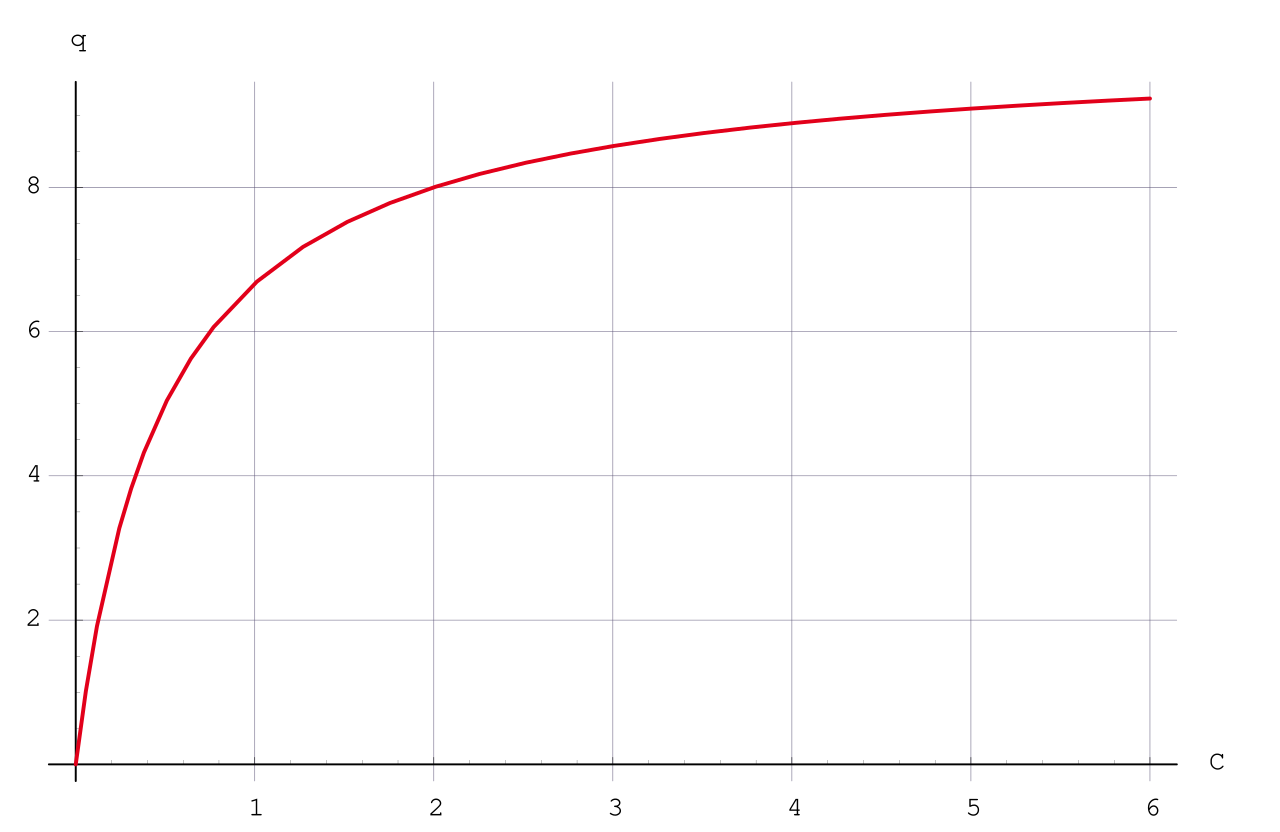
An adsorption isotherm plots the amount adsorbed (x/m) against pressure at constant temperature. At low pressure adsorption rises almost linearly with P; at high pressure it flattens to a saturation plateau as the surface becomes fully covered — the trend captured by the Freundlich relation x/m = k·P1/n. Image: Rosentod, Public Domain, via Wikimedia Commons.
Catalysis
- Catalyst: A substance that changes the rate of a chemical reaction without itself undergoing any permanent chemical change, by providing an alternate pathway with lower activation energy.
- Homogeneous catalysis: Catalyst and reactants are in the same phase, e.g., the lead chamber process for sulfuric acid using NO as catalyst.
- Heterogeneous catalysis: Catalyst and reactants are in different phases, e.g., the Haber process for ammonia synthesis using finely divided iron as catalyst.
- Enzyme catalysis: Enzymes are biological catalysts (proteins) that are highly specific and efficient even in tiny amounts, working best at an optimum temperature and pH, e.g., the conversion of starch to maltose by diastase.
- Adsorption theory of catalysis: Heterogeneous catalysis proceeds through adsorption of reactants on the catalyst surface, formation of an activated complex, and desorption of products, which frees the active sites for further reaction.
Colloids: Classification
A colloidal solution is a heterogeneous mixture where particle size of the dispersed phase lies between 1 nm and 1000 nm, too small to settle but large enough to scatter light.
- By physical state: Sol (solid in liquid, e.g., paint), Gel (liquid in solid, e.g., jelly, cheese), Emulsion (liquid in liquid, e.g., milk), Aerosol (liquid or solid in gas, e.g., fog, smoke), Foam (gas in liquid, e.g., shaving cream).
- By nature of interaction: Lyophilic colloids (solvent-loving, stable, reversible, e.g., gum, starch) and Lyophobic colloids (solvent-hating, unstable, irreversible, e.g., metal sols, sulfur sol).
- By type of particles: Multimolecular colloids (aggregates of small atoms or molecules, e.g., gold sol), Macromolecular colloids (single large polymer molecules, e.g., proteins, starch), and Associated colloids or micelles (form above a critical micelle concentration, e.g., soap solutions).
Properties of Colloids
- Tyndall effect: Scattering of light by colloidal particles, making the path of light visible when passed through a colloidal solution.
- Brownian motion: The continuous, zig-zag, random movement of colloidal particles caused by unequal bombardment from molecules of the dispersion medium; this keeps colloidal particles from settling under gravity.
- Electrophoresis: Movement of charged colloidal particles toward an oppositely charged electrode under an applied electric field.
- Charge on colloidal particles: All particles of a given colloidal sol carry the same type of charge (either all positive or all negative), which gives the sol its stability.
- Coagulation (precipitation): The setting of colloidal particles into a precipitate, often caused by adding an electrolyte that neutralizes the charge on the particles.
- Hardy-Schulze rule: Greater the valency of the oppositely charged ion added, the more effective it is at causing coagulation. For example, for a negatively charged sol, Al3+ coagulates more effectively than Ba2+, which in turn is more effective than Na+.
Emulsions and Their Applications
- An emulsion is a colloidal system of two immiscible liquids, classified as oil-in-water (e.g., milk) or water-in-oil (e.g., butter, cold cream).
- Emulsifying agents (e.g., soaps, proteins) stabilize emulsions by forming a protective film around dispersed droplets.
- Demulsification: Breaking an emulsion into its constituent liquids, achieved by heating, freezing, or centrifuging.
Applications of Colloids and Surface Chemistry
- Purification of drinking water using alum, which coagulates suspended impurities.
- Electrostatic precipitators (Cottrell precipitator) remove charged smoke particles from factory chimneys.
- Medicines, such as colloidal silver and many emulsified drug formulations, rely on colloidal properties for better absorption.
- Heterogeneous catalysts in the petroleum and chemical industries rely on adsorption at solid surfaces.
- Delta formation at river mouths occurs because river water colloids coagulate on meeting the electrolytes present in sea water.
Common Exam Question
Q: Why does fog appear as a visible beam when light passes through it at night?
A: Fog is a colloidal dispersion of water droplets in air. Light is scattered by these colloidal-sized particles, an example of the Tyndall effect, making the beam visible.
Promoters, Poisons and Catalyst Selectivity
- Promoters: Substances that increase the activity of a catalyst though not catalysts themselves, e.g. molybdenum promotes iron in the Haber process
- Poisons: Substances that reduce or destroy catalytic activity by getting strongly adsorbed on active sites, e.g. arsenic poisons the platinum catalyst in the Contact process
- Activity: The ability of a catalyst to accelerate a reaction; it depends on how strongly reactants are adsorbed (strong enough to react, but not so strong that products cannot leave)
- Selectivity: The ability of a catalyst to direct a reaction toward one specific product; e.g. CO and H2 give methane with Ni, methanol with Cu/ZnO, and hydrocarbons with Co, depending on the catalyst chosen
Shape-Selective Catalysis by Zeolites
- Zeolites are porous aluminosilicates (three-dimensional networks of SiO4 and AlO4 tetrahedra) with a honeycomb of cavities and channels of precise molecular dimensions
- Catalysis is "shape-selective" because only molecules small enough to enter the pores react, so the reaction depends on the pore size relative to the reactant/product molecules
- ZSM-5 is an important zeolite used in the petroleum industry to convert alcohols directly into gasoline (petrol) by dehydration; zeolites are also used as cracking catalysts and as molecular sieves for drying
Preparation of Colloids
- Dispersion methods (breaking large particles down to colloidal size): mechanical grinding in a colloid mill; Bredig's arc method (striking an electric arc between metal electrodes under water to make metal sols like gold or silver); and peptisation (converting a fresh precipitate back into a colloid by adding a small amount of a suitable electrolyte)
- Condensation methods (building colloidal particles up from smaller ions/molecules): by chemical reactions such as oxidation (SO2 to sulphur sol), reduction (gold sol from AuCl3), hydrolysis (Fe(OH)3 sol from FeCl3) and double decomposition (arsenious sulphide sol)
Purification of Colloids
- Dialysis: Removal of dissolved ions/small molecules from a sol by placing it in a parchment/cellophane bag suspended in running water; the small ions diffuse out through the semipermeable membrane while colloidal particles are retained
- Electrodialysis: Dialysis carried out under an applied electric field, which speeds up the removal of charged impurity ions
- Ultrafiltration: Filtering a sol through a specially prepared filter paper (impregnated with collodion) whose pores are too fine for colloidal particles to pass, separating them from the dispersion medium
🚀 JEE Advanced Edge
Langmuir adsorption isotherm: Unlike Freundlich's purely empirical isotherm, Langmuir's model assumes a fixed number of identical adsorption sites, giving x/m = (aP)/(1+bP) — at low pressure this reduces to x/m ∝ P (first order), and at high pressure x/m approaches a constant maximum (all sites occupied), correctly predicting saturation, which Freundlich's isotherm cannot do at the high-pressure limit.
Why nanoparticle catalysts are so effective: Reducing particle size dramatically increases surface-area-to-volume ratio, exposing far more atoms as active catalytic sites per gram of material — this is the principle behind modern nanocatalysts used in catalytic converters and industrial cracking.
Protective colloids and the gold number: Lyophilic colloids (like gelatin) can be added to protect lyophobic colloids (like gold sol) from coagulation by forming a protective layer around the particles. The "gold number" measures protective power: the SMALLER the gold number, the GREATER the protective power (less of the protecting colloid is needed to prevent coagulation of a standard gold sol).