🎯 Key Points
- PV = nRT (ideal gas equation); R = 0.0821 L atm K⁻¹mol⁻¹ = 8.314 J K⁻¹mol⁻¹
- Boyle's Law: P₁V₁ = P₂V₂ (const T); Charles' Law: V₁/T₁ = V₂/T₂ (const P); Gay-Lussac: P₁/T₁ = P₂/T₂ (const V)
- Graham's Law: r₁/r₂ = √(M₂/M₁) — lighter gas diffuses/effuses faster
- Dalton's Law: Ptotal = ΣPi; partial pressure = mole fraction × total pressure
- Compressibility factor Z = PV/nRT; Z = 1 for ideal gas; Z < 1 means attraction dominates, Z > 1 means molecular volume dominates
- Van der Waals equation: (P + an²/V²)(V − nb) = nRT — "a" corrects for attraction, "b" for finite molecular size
- Above the critical temperature, no amount of pressure can liquefy a gas
Intermolecular Forces and States of Matter
Matter exists in three common physical states: solid, liquid, and gas. The state depends on the balance between intermolecular forces of attraction (which pull particles together) and thermal energy (which keeps particles moving apart). Solids have strong intermolecular forces and fixed shape; liquids have moderate forces and take the shape of their container; gases have negligible forces and expand to fill any available space.
Postulates of the Kinetic Theory of Gases
- Gases consist of tiny particles in constant, random, straight-line motion.
- The volume of gas particles is negligible compared to the total volume of the container.
- There is no force of attraction or repulsion between gas particles or between particles and the walls of the container.
- Collisions between particles, and with the container walls, are perfectly elastic, meaning there is no net loss of kinetic energy.
- Pressure of a gas arises from collisions of particles with the walls of the container.
- The average kinetic energy of gas particles is directly proportional to the absolute temperature.
- At any instant, different particles have different speeds and kinetic energies, since collisions are continuous.
The Gas Laws
- Boyle Law: At constant temperature, the volume of a fixed amount of gas is inversely proportional to its pressure. PV = constant, or P1V1 = P2V2.
- Charles Law: At constant pressure, the volume of a fixed amount of gas is directly proportional to its absolute temperature. V/T = constant, or V1/T1 = V2/T2.
- Gay-Lussac Law: At constant volume, the pressure of a fixed amount of gas is directly proportional to its absolute temperature. P/T = constant, or P1/T1 = P2/T2.
- Avogadro Law: Equal volumes of all gases, at the same temperature and pressure, contain equal numbers of moles (or molecules). V is proportional to n.
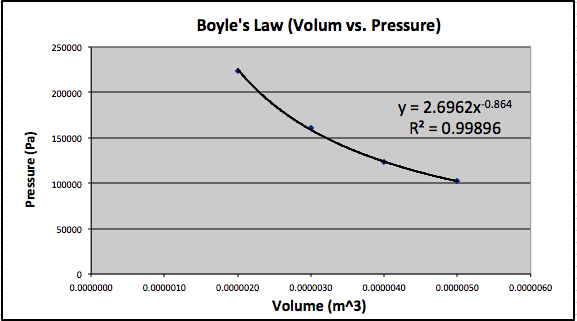
Boyle's law: at constant temperature the pressure of a fixed mass of gas is inversely proportional to its volume (P ∝ 1/V), so the P–V plot is a hyperbola — halving the volume doubles the pressure. Image: Reginaprice2013, CC BY-SA 3.0, via Wikimedia Commons.
Ideal Gas Equation
Combining the gas laws gives the ideal gas equation: PV = nRT, where P is pressure, V is volume, n is the number of moles, R is the universal gas constant (0.0821 L atm K⁻¹ mol⁻¹, or 8.314 J K⁻¹ mol⁻¹), and T is the absolute temperature in kelvin.
- Density form: PM = dRT, where M is molar mass and d is density.
- At STP (0°C, 1 atm), one mole of any ideal gas occupies 22.4 L.
- Combined gas law: P1V1/T1 = P2V2/T2 (for a fixed amount of gas).
Dalton Law of Partial Pressures
At constant temperature, the total pressure exerted by a mixture of non-reacting gases is the sum of the partial pressures of each gas. Ptotal = P1 + P2 + P3 + ...
- Partial pressure of a component = mole fraction of that component x total pressure.
- This law does not apply to gases that react chemically with each other.
Graham Law of Diffusion
The rate of diffusion (or effusion) of a gas is inversely proportional to the square root of its molar mass, at constant temperature and pressure. r1/r2 = sqrt(M2/M1). Lighter gases diffuse faster than heavier gases.
Real Gases and Deviation from Ideal Behavior
Real gases deviate from ideal gas behavior, especially at high pressure and low temperature, because the kinetic theory assumptions of negligible volume and no intermolecular forces break down.
Compressibility factor (Z) vs pressure. Gases with strong attraction (CO2, NH3) dip below Z=1 before rising; weakly-attracting gases (H2, He) rise above Z=1 from the start.
- Compressibility factor: Z = PV / nRT. For an ideal gas, Z = 1. For real gases, Z deviates from 1, indicating non-ideal behavior.
- At low/moderate pressure, attractive forces dominate and Z can fall below 1 (real volume smaller than ideal — gas is more compressible than expected).
- At very high pressure, the finite volume of molecules dominates and Z rises above 1 (real volume larger than ideal — gas is harder to compress than expected).
- Van der Waals equation: (P + an²/V²)(V - nb) = nRT, where "a" corrects for intermolecular attraction and "b" corrects for the finite size of molecules.
Critical Constants and Liquefaction
- Critical temperature (Tc): The temperature above which a gas cannot be liquefied no matter how much pressure is applied.
- Critical pressure (Pc): The minimum pressure needed to liquefy a gas at its critical temperature.
- Critical volume (Vc): The volume occupied by one mole of gas at the critical temperature and critical pressure.
Liquid State: Key Properties
- Vapour pressure: The pressure exerted by vapour in equilibrium with its liquid at a given temperature. It increases with temperature; the liquid boils when vapour pressure equals atmospheric pressure.
- Surface tension: The force acting per unit length perpendicular to a line drawn on the liquid surface, arising from unbalanced intermolecular attraction at the surface. It decreases as temperature rises and causes phenomena like capillary rise and the spherical shape of droplets.
- Viscosity: A measure of a liquid resistance to flow, caused by internal friction between layers of liquid moving at different speeds. Viscosity decreases as temperature increases.
Common Exam Question
Q: A gas occupies 2 L at 1 atm. What is its volume at 2 atm, at constant temperature?
A: By Boyle Law, P1V1 = P2V2, so 1 x 2 = 2 x V2, giving V2 = 1 L.
Types of Intermolecular Forces
Intermolecular (van der Waals) forces are weak attractions between molecules that decide the physical state, boiling point, and viscosity of a substance. In increasing strength:
- London (dispersion) forces: instantaneous, induced dipole-induced dipole attractions present in ALL molecules; the only force in non-polar species (e.g., H₂, Cl₂, noble gases). Strength increases with molecular size and polarisability.
- Dipole-dipole forces: between permanent dipoles of polar molecules (e.g., HCl, SO₂); stronger than dispersion forces of similar-size molecules.
- Dipole-induced dipole forces: a permanent dipole induces a temporary dipole in a nearby non-polar molecule.
- Hydrogen bonding: an especially strong dipole-dipole attraction when H is bonded to the highly electronegative N, O, or F. It explains the abnormally high boiling point of water, HF, and NH₃.
Ion-dipole forces (between an ion and a polar molecule, e.g., Na⁺ with water) are stronger still and drive the dissolution of ionic salts in water.
Molecular Speeds and Kinetic Energy
Gas molecules move at a range of speeds. Three characteristic speeds are defined (M = molar mass in kg/mol):
- Most probable speed, ump = √(2RT/M) — the speed possessed by the largest fraction of molecules.
- Average (mean) speed, uavg = √(8RT/πM).
- Root-mean-square speed, urms = √(3RT/M) — the largest of the three.
- Their ratio is fixed: ump : uavg : urms = 1 : 1.128 : 1.224.
- Average kinetic energy per mole = (3/2)RT, depending only on temperature — not on the identity of the gas.
- All speeds increase with √T and decrease with √M, so lighter gases move faster (consistent with Graham's Law).
Maxwell-Boltzmann Distribution of Speeds
- At a given temperature, molecular speeds follow the Maxwell-Boltzmann distribution — an asymmetric curve with a peak at the most probable speed and a long tail toward high speeds.
- Raising the temperature broadens and flattens the curve and shifts the peak to higher speed, increasing the fraction of fast-moving molecules.
- Heavier gases at the same temperature have a narrower distribution peaked at a lower speed.
- The high-speed tail explains why only a fraction of molecules have enough energy to react or escape (relevant to reaction rates and evaporation).
🚀 JEE Advanced Edge
Critical constants from van der Waals constants: Tc = 8a/27Rb, Pc = a/27b², Vc = 3b. These relations let you calculate a and b from experimentally measured critical constants, or predict critical behaviour from known a, b values.
Boyle temperature: The temperature at which a real gas behaves most ideally over an appreciable pressure range (the initial slope of the Z vs P curve is zero). Above the Boyle temperature, Z always increases with P; below it, Z first decreases then increases (the characteristic dip seen for CO₂-like gases).
Effusion vs diffusion numericals: Effusion (escape through a tiny pinhole into vacuum) and diffusion (mixing through another gas) both follow Graham's Law, but watch for problems giving effusion time instead of rate directly — rate is inversely proportional to time for the same volume, so r₁/r₂ = t₂/t₁ = √(M₂/M₁).
Worked problem: A mixture of CH₄ and He in a 2:1 mole ratio is enclosed in a vessel at total pressure 'P'. Find the partial pressure of He. Approach: mole fraction of He = 1/(2+1) = 1/3, so partial pressure of He = P/3 — mole ratio directly gives mole fraction since moles are additive regardless of gas identity (Dalton's Law assumes no chemical reaction between components).