🎯 Key Points
- V=IR; R=ρL/A; Series: R_eq=ΣRᵢ (current same, voltage splits); Parallel: 1/R_eq=Σ(1/Rᵢ) (voltage same, current splits)
- KCL: current in = current out at a junction (charge conservation); KVL: sum of EMFs and IR drops around any loop = 0
- Terminal voltage V=E−Ir while discharging; short-circuit current I_sc=E/r
- Wheatstone bridge balanced when P/Q=R/S (galvanometer shows zero current)
- Potentiometer uses a null (zero-current) method, making it more accurate than a voltmeter for measuring EMF
Ohm's Law and Resistance
In series, the same current flows through both resistors; in parallel, the current splits between branches and the voltage across each resistor is the same.
- V = IR; R = ρL/A (ρ = resistivity)
- Temperature dependence: R = R₀(1 + αΔT)
- Series: R = ΣRᵢ; Parallel: 1/R = Σ(1/Rᵢ)
- Power: P = VI = I²R = V²/R
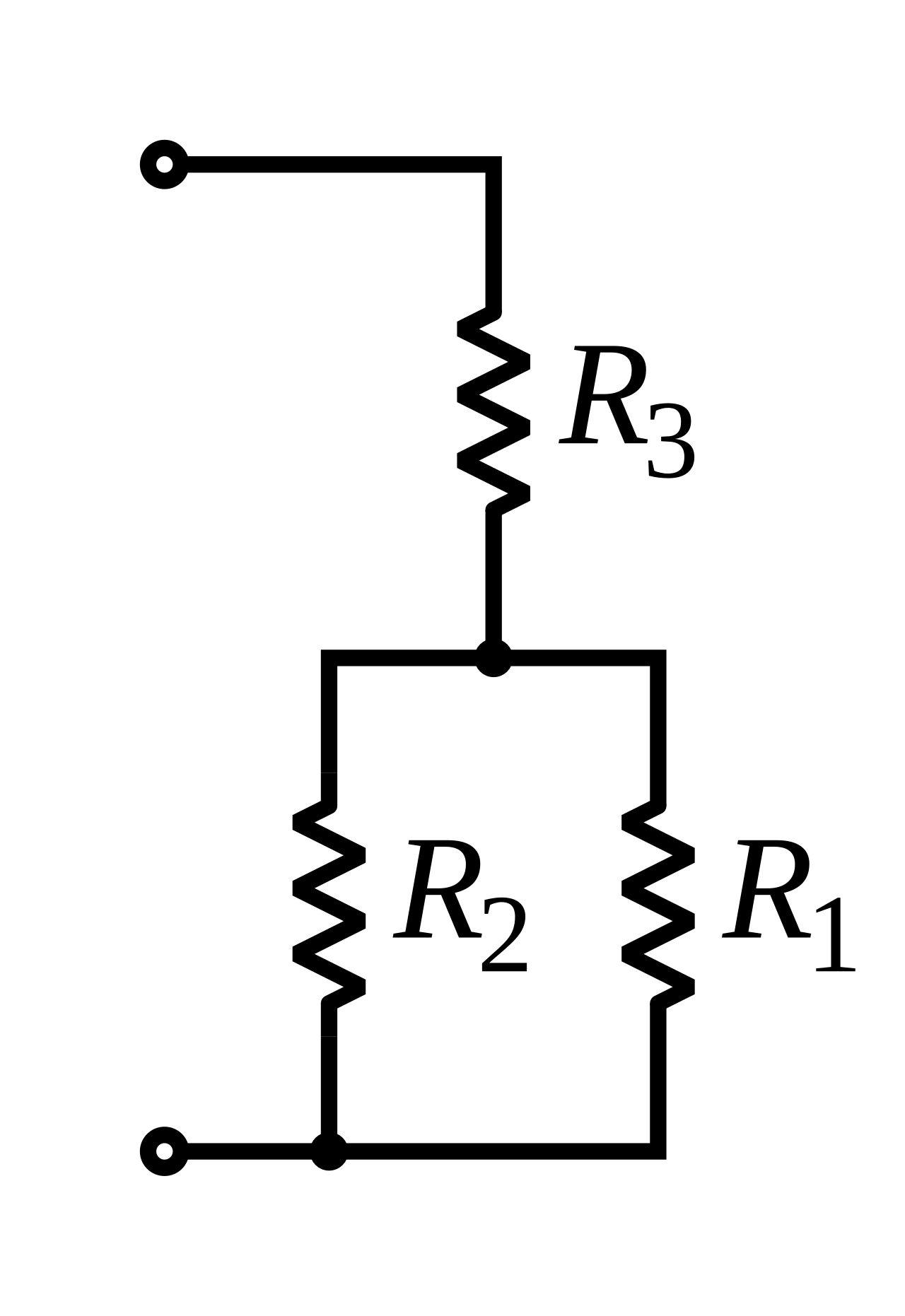
Series and parallel combination: R₁ and R₂ in parallel (1/R = 1/R₁ + 1/R₂) then in series with R₃. Image: Omegatron, CC BY-SA 3.0, via Wikimedia Commons.
Kirchhoff's Laws
- KCL: sum of currents at a junction = 0 (charge conservation)
- KVL: sum of EMFs and potential drops in a loop = 0 (energy conservation)
Cells and Batteries
- Terminal voltage: V = E - Ir (E = EMF, r = internal resistance)
- Short circuit current: I_sc = E/r
- Cells in series: E_total = ΣEᵢ, r_total = Σrᵢ
Measuring Instruments
- Wheatstone bridge: balanced when P/Q = R/S (no current through galvanometer)
- Potentiometer: null method; more accurate than voltmeter
- Meter bridge: variation of Wheatstone bridge
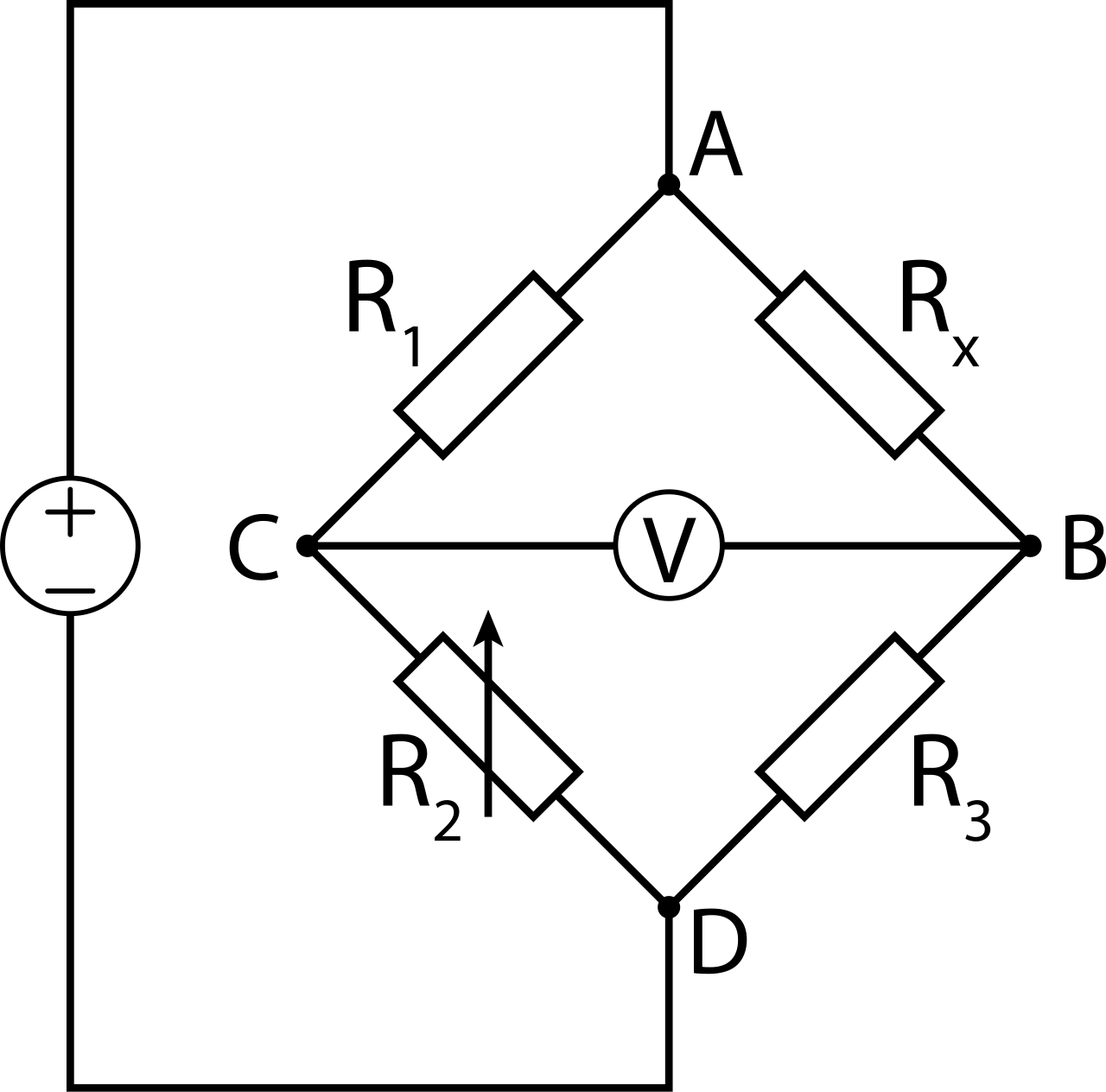
Wheatstone bridge: at balance the detector reads zero and R₁/R₂ = Rₓ/R₃, which is how an unknown resistance is measured. Image: jjbeard, Public Domain, via Wikimedia Commons.
Drift Velocity, Mobility and Current Density
- Drift velocity v_d: the small average velocity (typically ~10⁻⁴ m/s) that free electrons acquire opposite to the applied field, superimposed on their random thermal motion; v_d = eEτ/m, where τ is the mean relaxation time between collisions
- Current–drift relation: I = neAv_d, where n is the free-electron density, A the cross-sectional area, e the electronic charge
- Mobility: μ = v_d/E = eτ/m — drift velocity per unit field (units m²/V·s); larger mobility means a better conductor
- Current density: J = I/A = nev_d; microscopic (vector) form of Ohm's law: J = σE, where σ = 1/ρ is the conductivity
- Although v_d is tiny, current appears almost instantly everywhere because the electric field propagates through the wire at nearly the speed of light
Resistivity and Its Temperature Dependence
- Resistivity ρ = m/(ne²τ) depends on the material, not on dimensions; R = ρL/A
- Metals (conductors): resistivity increases with temperature — ρ = ρ₀[1 + α(T − T₀)], α > 0, because more frequent collisions reduce τ
- Semiconductors and insulators: resistivity DECREASES with temperature (α negative), as heating frees more charge carriers (n rises sharply, outweighing the fall in τ)
- Alloys like manganin and constantan have very low, nearly temperature-independent α — used for standard resistance coils
- Superconductors have exactly zero resistivity below a critical temperature
Meter Bridge and Potentiometer
- Meter bridge is a practical Wheatstone bridge on a 1 m wire; at balance (null point at length l from one end): unknown R = S · l/(100 − l), where S is the known resistance in the other gap
- Potentiometer compares potentials by a null method, drawing zero current at balance — so it measures the true EMF of a cell (unlike a voltmeter, which draws current and reads terminal voltage V < E)
- Potential gradient along the wire: k = V/L; unknown EMF E = k·l, where l is the balancing length
- Comparing two EMFs: E₁/E₂ = l₁/l₂ (ratio of balancing lengths)
- Measuring internal resistance: r = R(l₁ − l₂)/l₂, where l₁ balances the open-cell EMF and l₂ balances the terminal voltage with external resistance R connected
Combination of Cells
- Series (n cells, each EMF E, internal resistance r): E_eq = nE, r_eq = nr; current through external R is I = nE/(R + nr) — advantageous when R ≫ r
- Parallel (m identical cells): E_eq = E, r_eq = r/m; current I = E/(R + r/m) = mE/(mR + r) — advantageous when R ≪ r
- Mixed grouping (m rows in parallel, each of n cells in series): maximum current is delivered when external resistance R = nr/m (impedance matching)
- If cells of unequal EMF are connected in parallel, use the general result: E_eq/r_eq = Σ(Eᵢ/rᵢ) with 1/r_eq = Σ(1/rᵢ)
🚀 JEE Advanced Edge
Wheatstone bridge with unbalanced condition: When the bridge is NOT balanced, you can't use P/Q=R/S directly — instead apply Kirchhoff's laws fully (set up loop equations) to find the galvanometer current, or use the more general "delta-to-star" / Thevenin equivalent technique for complex resistor networks.
Cells in combination with internal resistance: For n identical cells in series (each EMF E, internal resistance r) driving external resistance R: I = nE/(R+nr). For the same n cells in parallel: I = E/(R+r/n). Series is better when R≫r; parallel is better when R≪r (maximises current in each regime).
Worked problem: A battery of EMF 10V and internal resistance 1Ω is connected to an external resistance of 4Ω. Find the terminal voltage and power delivered to the external resistor. Approach: I=E/(R+r)=10/5=2A. Terminal voltage V=E−Ir=10−2(1)=8V. Power=I²R=4×4=16W.