🎯 Key Points
- Electric potential V = W/q: work done per unit positive test charge in bringing it from infinity to that point against the electric force; unit: Volt (V) = J/C; it is a scalar quantity
- V due to a point charge: V = kq/r (k = 9×10⁹ N·m²/C²); V is positive for positive q and negative for negative q; unlike field E, potential is a scalar so you simply add values algebraically at any point
- E = −dV/dr: the electric field equals the negative spatial gradient of potential; field points in the direction of decreasing potential (from high V to low V); for a uniform field, E = −ΔV/Δx
- Equipotential surfaces: surfaces on which V is constant; field lines are always perpendicular to them; no work is done moving a charge along an equipotential (W = qΔV = 0); the entire surface of a conductor in electrostatic equilibrium is an equipotential
- Parallel plate capacitor: C = ε₀A/d (ε₀ = 8.85×10⁻¹² F/m); inserting a dielectric of constant K fills the gap and gives C′ = Kε₀A/d = KC; K > 1 always, so a dielectric always increases capacitance
- Series capacitors: 1/C_eq = 1/C₁ + 1/C₂ + … (same charge Q on each; voltage divides); Parallel capacitors: C_eq = C₁ + C₂ + … (same voltage across each; charge divides)
- Energy stored in a capacitor: U = ½CV² = Q²/2C = ½QV; energy density (energy per unit volume) in the electric field between the plates: u = ½ε₀E²
📖 Full Explanation
Electric Potential
Electric potential at a point is defined as the work done by an external agent in slowly bringing a unit positive test charge from infinity to that point, without any acceleration:
V = Wext / q
It is a scalar quantity measured in volts (V), where 1 V = 1 J/C. Because it is a scalar, the potential due to a group of charges is simply the algebraic sum of individual potentials — no vector addition needed.
For a point charge Q at distance r:
V = kQ/r = Q/(4πε₀r)
V is positive if Q is positive and negative if Q is negative. V → 0 as r → ∞, which defines the reference (zero) of potential at infinity.
Potential Due to an Electric Dipole
For a dipole of moment p = q·2a, the potential at a point P at distance r from the centre (r >> a) making angle θ with the dipole axis:
V = kp cosθ / r²
- On the axial line (θ = 0°): V = kp/r² (non-zero)
- On the equatorial line (θ = 90°): V = 0 (potential is zero, but field is not)
This is a key distinction: the equatorial plane of a dipole is an equipotential surface at V = 0, yet the electric field there is not zero — it points antiparallel to the dipole moment.
Relationship Between E and V
The electric field is the negative gradient of the electric potential:
E = −dV/dr
The negative sign means the field points in the direction of steepest decrease in potential — from high potential to low potential. In a uniform field between parallel plates with separation d and potential difference V: E = V/d.
The unit of electric field can therefore be expressed as V/m (volts per metre), equivalent to N/C.
Equipotential Surfaces
An equipotential surface is a surface on which the electric potential has the same value everywhere.
- Perpendicular to field lines: If the field had a component along an equipotential, it would do work moving charges along it — contradicting the definition of zero potential difference. So E is always ⊥ to equipotential surfaces.
- No work done: W = qΔV = q × 0 = 0 for any displacement along an equipotential.
- Cannot intersect: Two different equipotential surfaces can never cross (that would imply a point has two different potentials simultaneously).
- Conductors: The entire surface (and interior) of a conductor in electrostatic equilibrium is an equipotential. This is why E = 0 inside and E is perpendicular to the surface just outside.
- For a single point charge, equipotential surfaces are concentric spheres centred on the charge.
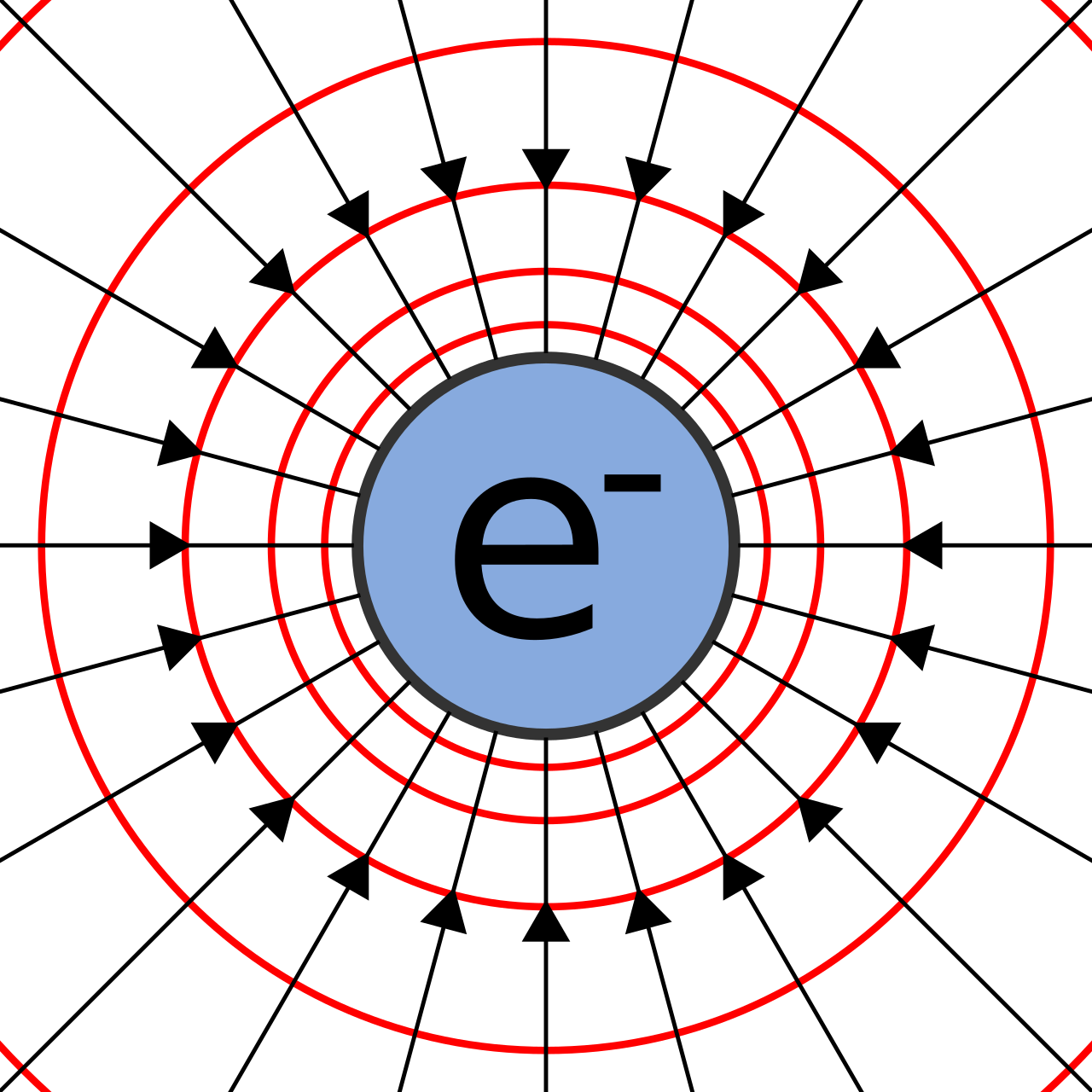
Field lines (radial) and equipotential lines (concentric circles) of a point charge. Equipotential surfaces are always perpendicular to the field lines. Image: Sjlegg, Public Domain, via Wikimedia Commons.
Potential Energy of a System of Charges
The electrostatic potential energy of a system is the total work done by an external agent in assembling the charges from infinity, one by one:
- Two charges: U = kq₁q₂/r₁₂ (positive if same sign — they repel; negative if opposite sign — they attract)
- Three charges: U = k(q₁q₂/r₁₂ + q₁q₃/r₁₃ + q₂q₃/r₂₃) — sum over all distinct pairs
- Work done by external force to move a charge q from point A to point B: W = q(VB − VA) = qΔV
- The work done by the electric force itself is Welectric = −ΔU (negative change in potential energy)
Conductors in Electrostatic Equilibrium
In electrostatic equilibrium, the following hold for any conductor:
- E = 0 inside the conductor (free electrons redistribute until the net internal field is zero)
- All free charge resides on the outer surface (a consequence of Gauss's law: E = 0 inside means Q_enclosed = 0 for any Gaussian surface inside)
- The surface is an equipotential, and E just outside is perpendicular to it with magnitude σ/ε₀
- Electrostatic shielding: a cavity inside a conductor has E = 0, completely shielded from external fields (Faraday cage principle)
- Surface charge density σ is largest at sharper points of the conductor, which is why lightning rods have pointed tips
Dielectrics and Polarisation
A dielectric is an insulating material with no free charges. When placed in an electric field:
- In polar dielectrics (e.g. water), molecules that already have a permanent dipole moment partially align with the field
- In non-polar dielectrics, the external field distorts the electron cloud, inducing a dipole moment in each molecule
- The result is a net layer of bound (induced) surface charges on the dielectric faces, creating an internal field Ep opposing the external field
- The net field inside the dielectric is reduced: Enet = E0/K, where K is the dielectric constant (relative permittivity)
- K ≥ 1 always; for vacuum K = 1; for most materials K is between 2 and 80 (water: K ≈ 80)
Capacitors and Capacitance
A capacitor is a system of two conductors (called plates) separated by an insulator, used to store electric charge and energy. The capacitance C is defined as:
C = Q/V
where Q is the charge on one plate and V is the potential difference between the plates. The SI unit is the farad (F), where 1 F = 1 C/V. Practical capacitors are usually in microfarads (μF) or picofarads (pF).
For a parallel plate capacitor with plate area A and separation d:
C = ε₀A/d
With a dielectric of constant K filling the gap completely:
C′ = Kε₀A/d = KC
Physically: the dielectric reduces the field (and hence V = Ed) for the same charge Q, so C = Q/V increases. K is also called the dielectric constant or relative permittivity (εᵣ).
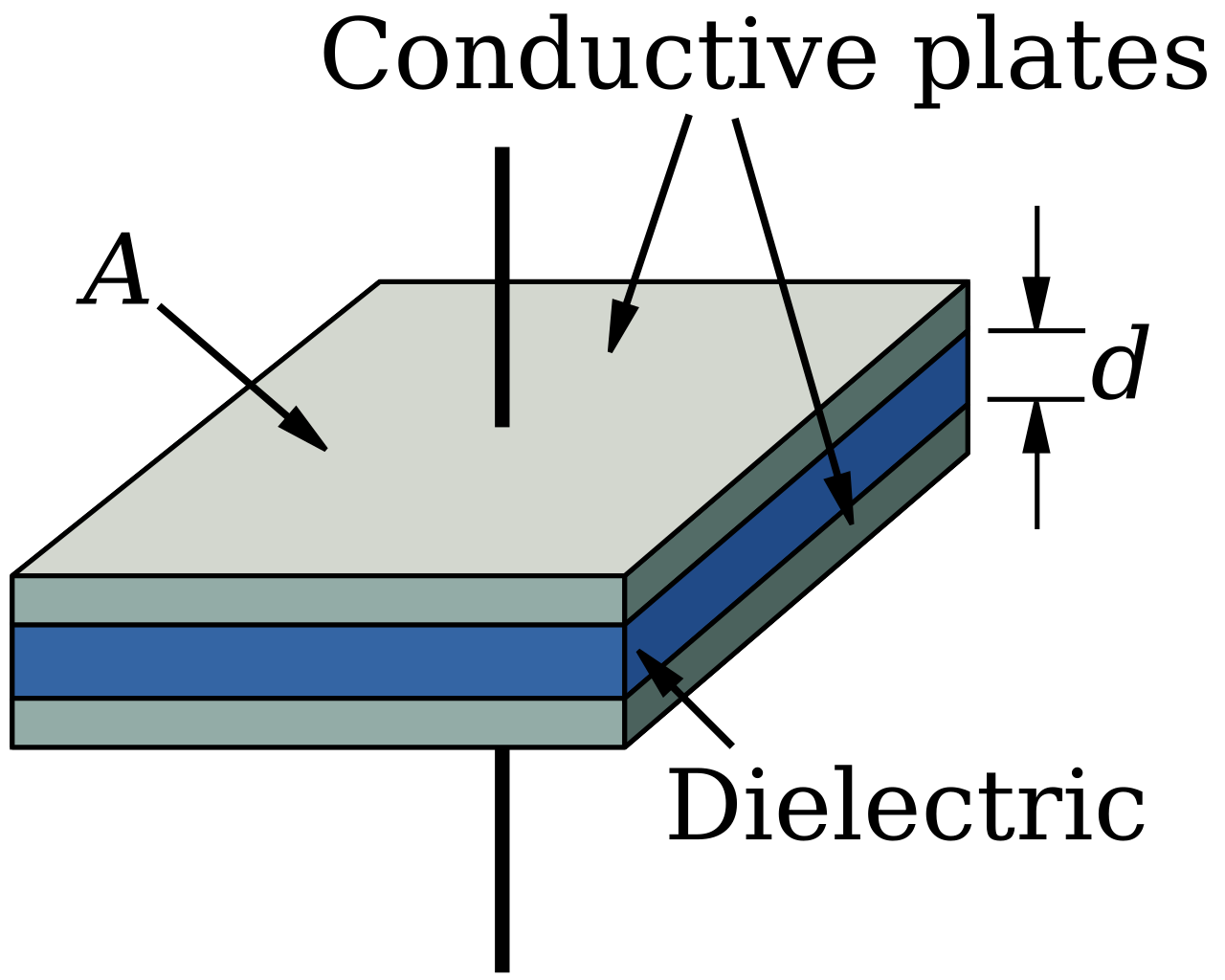
A parallel-plate capacitor: capacitance C = ε0εrA/d rises with plate area A and the dielectric constant, and falls as the plate separation d increases. Image: inductiveload, Public Domain, via Wikimedia Commons.
Combinations of Capacitors
Series combination (capacitors connected end-to-end, same charge Q on each):
1/C_eq = 1/C₁ + 1/C₂ + 1/C₃ + …
- Charge on each capacitor is the same: Q₁ = Q₂ = … = Q
- Voltage divides: V = V₁ + V₂ + …; a larger capacitor gets a smaller share of the voltage (V = Q/C)
- C_eq is always less than the smallest individual capacitance
Parallel combination (all capacitors share the same two nodes, same voltage V across each):
C_eq = C₁ + C₂ + C₃ + …
- Voltage across each capacitor is the same: V₁ = V₂ = … = V
- Charge divides: Q = Q₁ + Q₂ + …; a larger capacitor stores more charge
- C_eq is always greater than the largest individual capacitance
Energy Stored in a Capacitor
The work done in charging a capacitor (moving charge incrementally from one plate to the other against the growing potential difference) is stored as electrostatic potential energy:
U = ½CV² = Q²/(2C) = ½QV
All three forms are equivalent (use whichever two of Q, C, V are known). Note that doubling the voltage quadruples the stored energy.
The energy is stored in the electric field in the space between the plates. The energy density (energy per unit volume of the field region) is:
u = ½ε₀E²
This result holds for any electric field, not just inside a capacitor — it is a universal expression for the energy stored in an electric field.
Potential Due to a Charged Spherical Shell
For a thin conducting shell of radius R carrying total charge Q, the potential behaves differently inside and outside:
- Outside (r ≥ R): V = kQ/r — the shell acts exactly like a point charge at its centre
- On the surface (r = R): V = kQ/R
- Inside (r < R): V = kQ/R = constant — the potential is the SAME everywhere inside and equals the surface value, even though the field E = 0 there
This is a key idea: inside the shell E = 0 but V ≠ 0. Since E = −dV/dr, a constant V (zero gradient) is fully consistent with zero field. The interior is an equipotential region.
Potential Energy in an External Field
Distinct from the mutual energy of assembling charges, this is the energy of charges placed in a pre-existing external field with potential V:
- Single charge q: U = qV(r), where V is the external potential at the charge's location
- System of two charges in external field: U = q₁V(r₁) + q₂V(r₂) + kq₁q₂/r₁₂ — the external terms PLUS their mutual interaction energy
- Electric dipole in a uniform external field: U = −p·E = −pE cosθ; minimum U = −pE when p aligns with E (stable), maximum U = +pE when antiparallel (unstable)
- Work to rotate a dipole from angle θ₁ to θ₂: W = pE(cosθ₁ − cosθ₂)
Capacitance of Special Geometries
| Capacitor type | Capacitance |
|---|---|
| Isolated conducting sphere (radius R) | C = 4πε₀R |
| Spherical capacitor (radii a < b) | C = 4πε₀ · ab/(b−a) |
| Cylindrical capacitor (length L, radii a < b) | C = 2πε₀L / ln(b/a) |
| Parallel plate (area A, gap d) | C = ε₀A/d |
- An isolated sphere has a definite capacitance because the second "plate" is effectively at infinity (V = 0 reference)
- Earth's very large radius gives it an enormous capacitance, so it can absorb/supply charge with negligible change of potential — the basis of "earthing"
🚀 JEE Advanced Edge
Partially inserted dielectric slab: If a dielectric slab of thickness t and constant K is inserted into a parallel plate capacitor of plate separation d (t < d), the gap behaves as two capacitors in series — one air gap of thickness (d − t) and one dielectric layer of thickness t:
C = ε₀A / (d − t + t/K)
When t → d (full insertion), C → Kε₀A/d = KC, recovering the standard result.
Energy change when a dielectric is inserted: Consider a capacitor charged to V and then disconnected from the battery before inserting a dielectric:
- Q is constant (no path for charge to flow); C increases to KC; so V drops to V/K and energy drops from U to U/K
- The lost energy goes into the work done by the electric force pulling the dielectric slab in
If instead the battery stays connected (V is held constant): Q increases to KQ; C increases to KC; and energy increases from U to KU. The battery supplies extra energy.
Charge redistribution and energy loss: When a charged capacitor C₁ (charged to V₀) is connected to an initially uncharged C₂, charge redistributes until both reach the same potential. By charge conservation: Q_total = C₁V₀. Common potential V_f = C₁V₀/(C₁+C₂). Initial energy = ½C₁V₀². Final energy = ½(C₁+C₂)V_f² = ½C₁²V₀²/(C₁+C₂). Energy lost = ½ · C₁C₂/(C₁+C₂) · V₀² — always positive, dissipated as heat even in ideal wires (a classic JEE conceptual trap: charge is conserved but energy is not).
Van de Graaff generator: Exploits the fact that charge placed inside a hollow conductor redistributes to the outer surface, allowing charge to be continually transported to the outer surface and building up very high potentials (millions of volts) that a single external source could not sustain.
Worked Example: Combination Network
Three capacitors C₁ = 2μF, C₂ = 3μF, and C₃ = 6μF are connected: C₁ in series with the parallel combination of C₂ and C₃. A 90 V battery is applied across the network. Find the charge on C₁ and the energy stored in C₂.
Step 1 — Parallel sub-group: C₂₃ = C₂ + C₃ = 3 + 6 = 9μF
Step 2 — Series equivalent: 1/C_eq = 1/C₁ + 1/C₂₃ = 1/2 + 1/9 = 9/18 + 2/18 = 11/18 → C_eq = 18/11 μF ≈ 1.636 μF
Step 3 — Charge on C₁ (same charge flows through the series branch): Q₁ = C_eq × V = (18/11) × 90 = 1620/11 μC ≈ 147.3 μC
Step 4 — Voltage across parallel group: V₂₃ = Q₁/C₂₃ = (1620/11)/9 = 180/11 V ≈ 16.36 V
Step 5 — Energy in C₂: U₂ = ½C₂V₂₃² = ½ × 3×10⁻⁶ × (180/11)² = ½ × 3×10⁻⁶ × 267.77 ≈ 401.7 μJ