🎯 Key Points
- F=kq₁q₂/r², k=1/4πε₀=9×10⁹ N·m²/C²; E=F/q=kQ/r²; V=kQ/r; E=−dV/dr
- Gauss's Law: ΦE=Q_enclosed/ε₀ — gives quick E for symmetric charge distributions (sphere, line, sheet) without integration
- Capacitor: C=Q/V=ε₀A/d; Series: 1/C_eq=Σ(1/Cᵢ) (like resistors in parallel-pattern math); Parallel: C_eq=ΣCᵢ
- Energy stored U=½CV²=½QV=Q²/2C; energy density u=½ε₀E²
- Dipole: axial field E=2kp/r³ is TWICE the equatorial field E=kp/r³ at the same distance; torque τ=pEsinθ
- Field inside a conductor in electrostatic equilibrium is always zero; all charge resides on the outer surface
Field lines always point from positive to negative charge, are denser where the field is stronger, and never cross; an isolated positive charge has lines radiating symmetrically outward, while a dipole's lines curve from the positive to the negative charge.
Coulomb's Law
- F = kq₁q₂/r² where k = 1/4πε₀ = 9 × 10⁹ N·m²/C²
- Electric field: E = F/q = kQ/r² (field due to point charge)
Electric Field
- Superposition: total field = vector sum of individual fields
- Field lines originate from + charge and terminate at - charge
- Field inside conductor = 0; field at surface is perpendicular
Gauss's Law
- ΦE = Q_enclosed/ε₀ (total flux through closed surface)
- For uniformly charged sphere outside: E = kQ/r²
- For infinite line charge: E = λ/2πε₀r
- For infinite sheet: E = σ/2ε₀
Electric Potential
- V = kQ/r (due to point charge)
- E = -dV/dr (field is negative gradient of potential)
- Work done: W = q·ΔV
- Potential energy: U = kq₁q₂/r
Capacitors
- C = Q/V = ε₀A/d (parallel plate)
- Series: 1/C = Σ(1/Cᵢ); Parallel: C = ΣCᵢ
- Energy stored: U = ½CV² = ½QV = Q²/2C
- Dielectric: C' = KC (K = dielectric constant)
Electric Dipole
- Dipole moment: p = q × 2a (directed from negative to positive charge)
- Field on axial line: E = 2kp/r³ (for r >> a)
- Field on equatorial line: E = kp/r³ (for r >> a), direction opposite to dipole moment
- Torque on dipole in uniform field: τ = pE·sin(θ) = p × E
- Potential energy of dipole: U = -p·E·cos(θ); minimum (most stable) when dipole aligns with field
Electrostatic Properties of Conductors
- Electric field inside a conductor in electrostatic equilibrium is always zero
- Charge resides only on the outer surface of a charged conductor
- Field just outside a charged conductor surface: E = σ/ε₀ (perpendicular to surface)
- Electrostatic shielding: field inside a cavity within a conductor is zero, used in Faraday cages
Combination of Capacitors
- Series combination: same charge Q on each capacitor; 1/C_eq = 1/C₁ + 1/C₂ + ...; effective capacitance is less than the smallest individual capacitance
- Parallel combination: same voltage V across each; C_eq = C₁ + C₂ + ...; effective capacitance is greater than the largest individual value
- Energy density in a parallel plate capacitor: u = ½ε₀E²
Basic Properties of Electric Charge
- Quantisation: charge exists only in integer multiples of the elementary charge e = 1.6×10⁻¹⁹ C, i.e. q = ±ne (n = 1, 2, 3, …); fractional charge is never observed in free particles
- Conservation: the total charge of an isolated system is constant; charge can be transferred but never created or destroyed
- Additivity: total charge is the algebraic (signed) sum of individual charges, since charge is a scalar
- Like charges repel, unlike charges attract; a charged body attracts a neutral body by induction
Coulomb's Law in Vector Form and Superposition
- Vector form: F₁₂ = (kq₁q₂/r²) r̂₁₂, where r̂₁₂ is the unit vector pointing from charge 1 to charge 2; the sign of q₁q₂ automatically gives repulsion (+) or attraction (−)
- Principle of superposition: the net force on any charge is the vector sum of the forces due to every other charge, each computed independently as if the others were absent: F_net = F₁ + F₂ + F₃ + …
- Coulomb forces obey the inverse-square law and act along the line joining the two point charges (a central force)
- In a medium of dielectric constant K, the force is reduced by a factor K: F_medium = F_vacuum/K
Properties of Electric Field Lines
- Field lines start on positive charges (or infinity) and end on negative charges (or infinity); they are continuous curves with no breaks
- The tangent to a field line at any point gives the direction of E there
- Lines are denser where the field is stronger; the number of lines per unit area (⊥ to lines) is proportional to E
- Two field lines never cross — if they did, the field would have two directions at that point
- Field lines do not form closed loops (electrostatic field is conservative) and are always perpendicular to the surface of a conductor
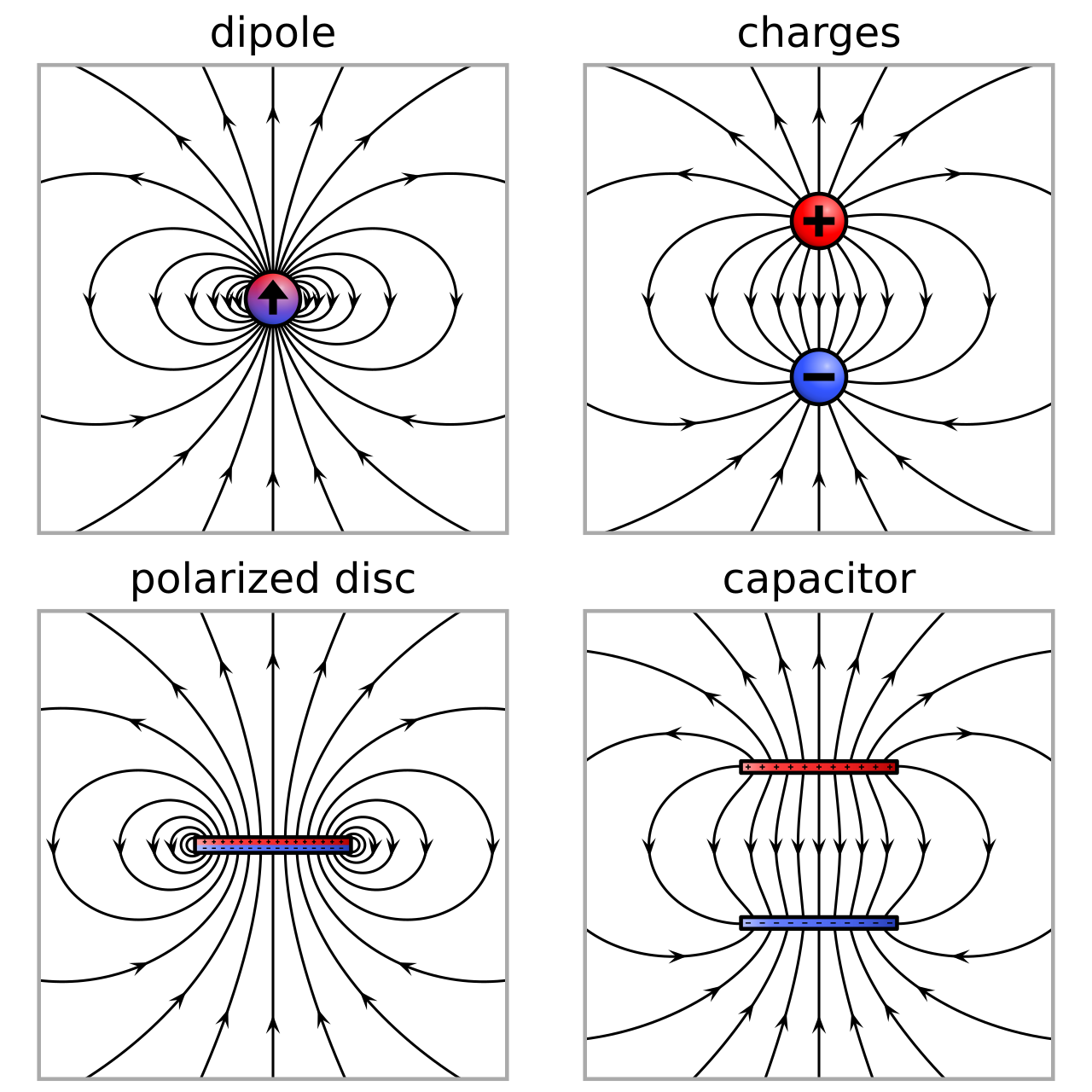
Electric field lines start on positive charge and end on negative charge, never cross, and crowd where the field is strong. Image: Geek3, CC BY-SA 4.0, via Wikimedia Commons.
Continuous Charge Distributions
- For large-scale charged bodies, charge is treated as continuous, described by a density: linear λ = dq/dl (C/m), surface σ = dq/dA (C/m²), or volume ρ = dq/dV (C/m³)
- The field is found by integrating the contribution of each element dq: E = k ∫ (dq/r²) r̂ over the whole distribution
- Total charge: q = ∫λ dl = ∫σ dA = ∫ρ dV depending on the geometry
Applications of Gauss's Law
By choosing a Gaussian surface matching the symmetry of the charge, E comes out of the flux integral and is found without integration:
| Charge distribution | Field magnitude E | Distance behaviour |
|---|---|---|
| Infinite line charge (density λ) | λ/2πε₀r | ∝ 1/r |
| Infinite plane sheet (density σ) | σ/2ε₀ | uniform (independent of r) |
| Two oppositely charged sheets (between) | σ/ε₀ | uniform |
| Charged spherical shell (outside, r > R) | kQ/r² | ∝ 1/r² (acts as point charge) |
| Charged spherical shell (inside, r < R) | 0 | zero everywhere inside |
- Field of a conducting sheet (charge on both faces) is σ/ε₀ just outside — twice that of a single thin charged sheet
- For a solid uniformly charged sphere, the internal field grows linearly: E = kQr/R³ for r < R
🚀 JEE Advanced Edge
Capacitor with dielectric partially filling the gap: When a dielectric slab of thickness t (less than the full plate separation d) is inserted, treat it as the original capacitor in series with an air-gap capacitor of thickness (d−t): C = ε₀A / (d−t+t/K).
Charge redistribution when capacitors are connected: When a charged capacitor is connected to an uncharged one, charge redistributes until both reach the same potential (conservation of charge, not voltage); energy is LOST in this process (dissipated as heat/radiation during the transient), even though charge is conserved — a classic "energy not conserved but charge is" JEE trap.
Worked problem: A parallel plate capacitor of capacitance 2μF is charged to 100V, then connected to an uncharged 3μF capacitor. Find the common potential. Approach: Charge conservation: Q_initial = C₁V₁ = 2×100 = 200μC. Common V = Q_total/(C₁+C₂) = 200/(2+3) = 40V.