🎯 Key Points
- Kidney filters ~180 L/day of plasma (GFR ~125 mL/min) but produces only ~1-1.5 L of urine — over 99% of the filtrate is reabsorbed
- Nephron: Bowman's capsule (filtration) → PCT (bulk, unregulated reabsorption of most glucose/amino acids/water/ions) → Loop of Henle (counter-current mechanism, builds the medullary concentration gradient) → DCT (regulated reabsorption/secretion) → Collecting duct (ADH-controlled final water reabsorption)
- ADH increases water reabsorption specifically at the collecting duct; Aldosterone increases Na⁺ reabsorption specifically at the DCT — different hormones acting at different tubule segments on different ions, frequently confused
- RAAS pathway: low blood pressure/volume → renin released by the juxtaglomerular apparatus (JGA) → angiotensinogen → angiotensin I → angiotensin II (via ACE in the lungs) → vasoconstriction + aldosterone release → blood pressure restored
- Ammonia (most toxic, needs lots of water to excrete) → Urea (liver's urea cycle converts toxic NH₃ to far less toxic urea) → Uric acid (least toxic, needs least water) — different organisms are adapted to excrete whichever form suits their water availability
Filtrate flows through four functionally distinct stages of the nephron: Bowman's capsule filters blood, the PCT reabsorbs most useful substances unconditionally, the Loop of Henle builds a concentration gradient via counter-current exchange, the DCT secretes selected substances, and the collecting duct performs the final ADH-controlled water reabsorption.
Nitrogenous Waste and Excretory Organs
- Ammonia: highly toxic, requires large amounts of water to excrete safely (ammonotelism — most bony fish)
- Urea: produced in the liver's urea cycle by converting toxic ammonia into a much less toxic, water-soluble compound (ureotelism — humans and most mammals)
- Uric acid: largely insoluble, can be excreted as a semi-solid paste using very little water (uricotelism — birds, reptiles, insects; an adaptation that saves water and weight, useful for flight and life in dry/shelled-egg environments)
- The kidneys are the primary excretory organ in humans, but the skin (sweat), lungs (CO₂), and liver (bile pigments) all serve as accessory excretory routes
Urine Formation in the Nephron
- Glomerular filtration: blood pressure forces water and small solutes from glomerular capillaries into Bowman's capsule, forming the filtrate; glomerular filtration rate (GFR) is about 125 mL/minute
- Reabsorption: most filtrate (glucose, amino acids, most water and ions) is reabsorbed back into the blood, mainly in the proximal convoluted tubule (PCT), via active and passive transport
- Secretion: tubular cells actively secrete substances like H⁺, K⁺, and certain drugs into the filtrate, mainly in the distal convoluted tubule (DCT), helping fine-tune blood pH and ion balance
- Counter-current mechanism: the Loop of Henle and the surrounding vasa recta work together to maintain a steadily increasing osmotic gradient in the kidney medulla (more concentrated deeper in), which the collecting duct can then exploit (with ADH present) to reabsorb water and produce urine far more concentrated than blood plasma
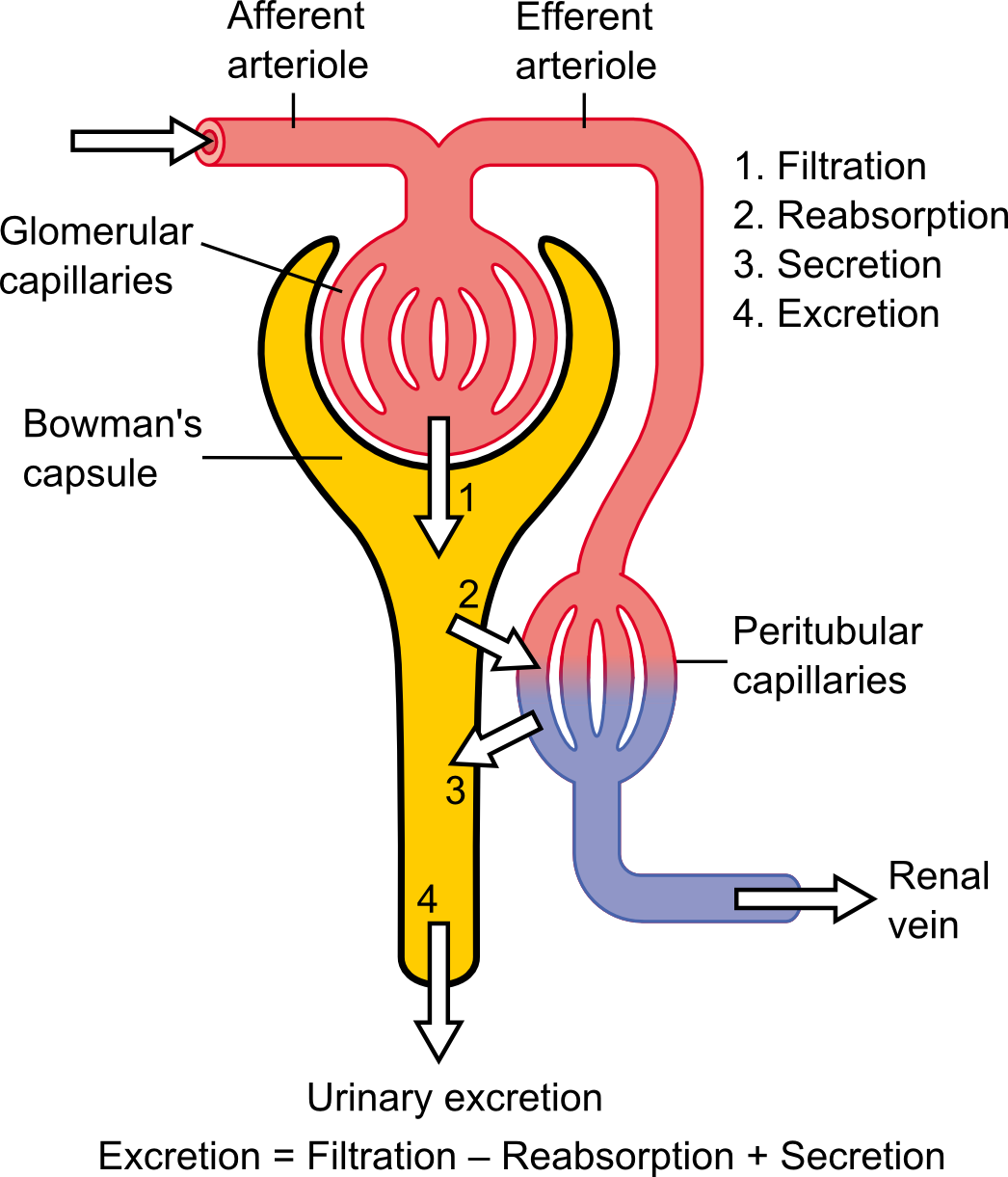
Urine formation: Excretion = Filtration − Reabsorption + Secretion. Image: Madhero88, CC BY 3.0, via Wikimedia Commons.
Hormonal Regulation of Kidney Function
- ADH (antidiuretic hormone/vasopressin): released by the posterior pituitary in response to rising blood osmolarity (dehydration); increases water reabsorption specifically at the collecting duct by inserting aquaporin-2 water channels into its cell membranes
- Aldosterone: released by the adrenal cortex; increases Na⁺ reabsorption (and indirectly water, since water follows Na⁺ osmotically) specifically at the DCT
- RAAS (Renin-Angiotensin-Aldosterone System): triggered by low blood pressure or low blood volume, sensed by the juxtaglomerular apparatus (JGA) in the kidney; renin converts angiotensinogen to angiotensin I, which is converted to angiotensin II by ACE (mainly in lung capillaries); angiotensin II directly constricts blood vessels AND stimulates aldosterone release — a dual-action mechanism that restores blood pressure both quickly (vasoconstriction) and more lastingly (aldosterone-driven Na⁺/water retention)
- Atrial Natriuretic Factor (ANF): released by the atrial wall of the heart when blood pressure rises; it causes vasodilation and increased Na⁺/water excretion, thereby LOWERING blood pressure — a check that directly opposes the RAAS pathway
The Human Excretory System: Kidney and Nephron Structure
- The human excretory system consists of a pair of kidneys, two ureters, a urinary bladder and a urethra; each bean-shaped kidney has an outer cortex and inner medulla, the medulla being divided into conical medullary pyramids that project into the calyces
- The nephron is the functional unit of the kidney (about one million per kidney); each begins with a Malpighian body (renal corpuscle) — a glomerulus of capillaries cupped within a Bowman's capsule — followed by the PCT, loop of Henle, DCT and collecting duct
- Cortical nephrons have a short loop of Henle that barely enters the medulla, whereas juxtamedullary nephrons have a long loop reaching deep into the medulla and are chiefly responsible for concentrating the urine
- The juxtaglomerular apparatus (JGA) is a specialised structure formed where the DCT contacts the afferent arteriole of its own nephron; it senses a fall in blood pressure and secretes renin
Micturition and the Role of Other Organs
- Micturition is the act of passing urine; urine collects in the bladder until stretch receptors in its wall signal the CNS, triggering the micturition reflex — the smooth (detrusor) muscle of the bladder contracts and the urethral sphincter relaxes, expelling the urine
- An adult human normally excretes about 1–1.5 litres of urine per day; healthy urine is pale yellow (due to the pigment urochrome) and slightly acidic
- Accessory excretory organs: the lungs remove large amounts of CO2 and some water vapour; the liver excretes bile pigments (bilirubin and biliverdin), cholesterol and certain drugs; the skin removes water, salts, urea and lactic acid through sweat and sebaceous secretions
Disorders of the Excretory System
- Uraemia: harmful accumulation of urea in the blood due to kidney malfunction, which may lead to kidney failure; the urea can be removed by haemodialysis using an artificial kidney
- Haemodialysis: blood is drawn from an artery, mixed with an anticoagulant (heparin), and passed through tubing bathed in a dialysing fluid whose composition matches plasma except that it lacks nitrogenous wastes; the wastes diffuse out, and the cleared blood is returned to a vein after adding anti-heparin
- Renal calculi (kidney stones): insoluble crystallised masses of oxalate and other salts formed within the kidney, which can obstruct and damage the urinary tract
- Glomerulonephritis: inflammation of the glomeruli of the kidney, which impairs filtration and may allow proteins and blood cells to leak into the urine
🚀 NEET Advanced Edge
GFR and clearance calculations: If a substance is filtered but NEITHER reabsorbed NOR secreted anywhere along the nephron (e.g. inulin, used experimentally), its clearance rate directly equals GFR (~125 mL/min ≈ 180 L/day) — this is exactly the basis of using inulin or creatinine clearance tests to measure kidney function clinically.
Why ADH and aldosterone are often confused but regulate different things: ADH responds to blood OSMOLARITY (water concentration) and acts on the collecting duct to retain pure water; aldosterone responds to blood VOLUME/pressure (via RAAS) and acts on the DCT to retain Na⁺ specifically — a dehydrated-but-normal-blood-volume state would primarily trigger ADH, while a blood-volume-loss (e.g. haemorrhage) state would primarily trigger the RAAS/aldosterone pathway, even though both ultimately help retain fluid.
Worked reasoning: A patient with damaged PCT cells would show glucose and amino acids in their urine (glycosuria) even with completely normal blood glucose levels, since the PCT is where most active reabsorption of these substances happens — this is distinct from the glycosuria of diabetes mellitus, where it occurs because blood glucose levels EXCEED the kidney's reabsorption capacity, not because of any tubule damage.