🎯 Key Points
- Mono-/di-/polysaccharides classified by number of sugar units; sucrose is non-reducing (no free anomeric -OH after glycosidic bonding)
- Protein structure: 1° (sequence) → 2° (α-helix/β-sheet, H-bonds) → 3° (3D fold) → 4° (multiple chains); denaturation disrupts 2°/3° structure only, NOT the peptide bonds themselves
- DNA: double helix, A-T/G-C pairing; RNA: single strand, A-U/G-C pairing
- Amino acids exist as zwitterions at their isoelectric point; all naturally occurring ones (except glycine) are optically active, mostly L-configuration
- Enzymes: lock-and-key model, each has an optimum T and pH; cofactors/coenzymes (often vitamin-derived) are needed for many enzymes to function
Two amino acids join via a condensation reaction: the carboxyl -OH of one and an amine -H of the other are eliminated as water, leaving a peptide bond (-CO-NH-) linking them into a dipeptide; repeating this builds a full protein chain.
Carbohydrates
General formula Cₙ(H₂O)ₙ. Classified by the number of sugar units.
- Monosaccharides: Simplest sugars; glucose (C₆H₁₂O₆), fructose, galactose; cannot be hydrolysed further
- Disaccharides: Two monosaccharides joined by a glycosidic bond; sucrose (glucose + fructose), lactose (glucose + galactose), maltose (glucose + glucose)
- Polysaccharides: Many units; starch (storage in plants), glycogen (storage in animals), cellulose (structural in plants)
- Reducing sugars: have a free aldehyde or ketone group; test positive with Tollens'/Fehling's; sucrose is non-reducing
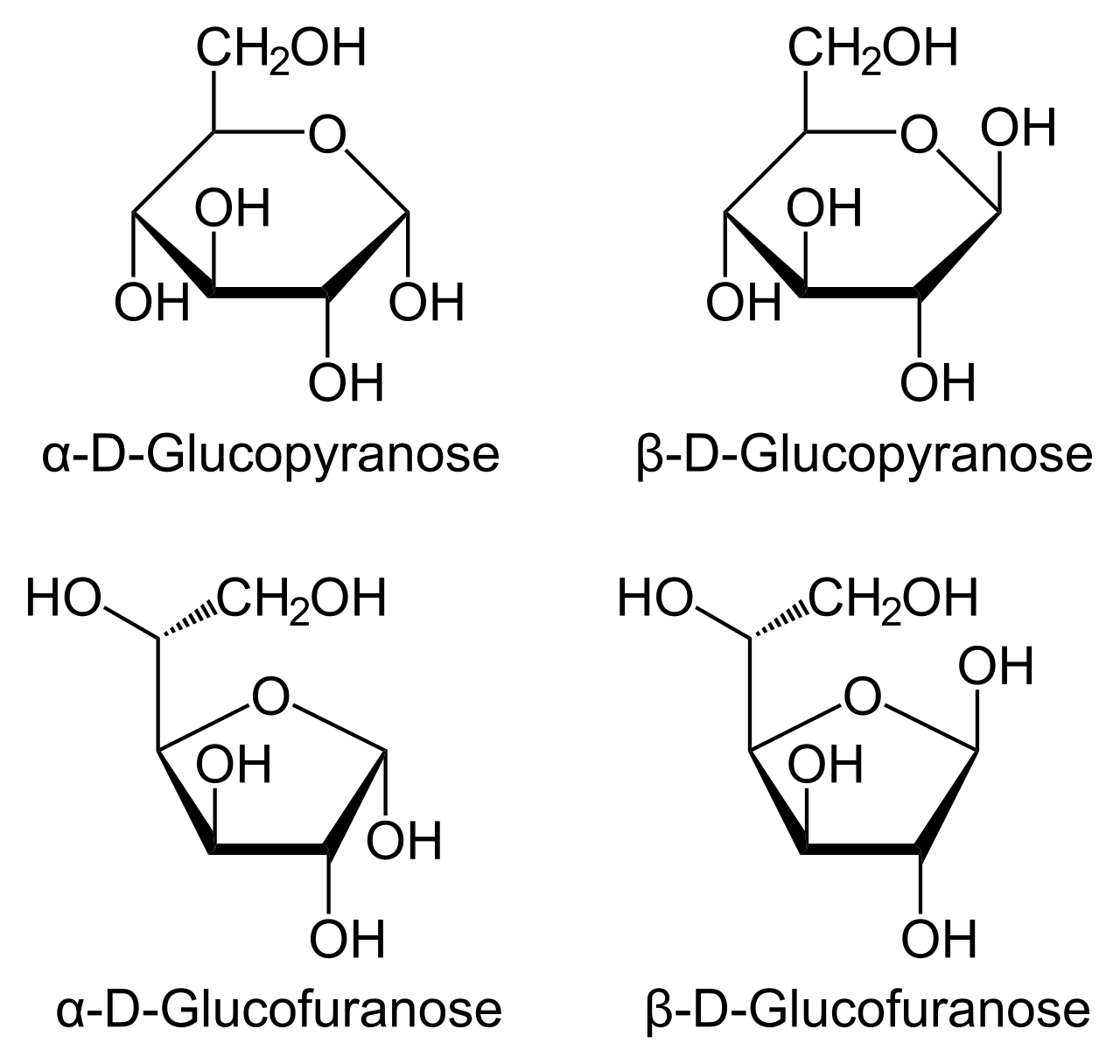
Haworth projections of glucose. When the open-chain −CHO group closes into a ring it creates a new stereocentre at C1: if that OH points down we have the α anomer, if up the β anomer. The six-membered pyranose ring dominates for glucose in solution. Image: NEUROtiker, Public Domain, via Wikimedia Commons.
Proteins
- Polymers of amino acids linked by peptide bonds (-CO-NH-)
- 20 standard amino acids; the sequence is the primary structure
- Protein structure levels: 1° (amino acid sequence), 2° (alpha-helix or beta-sheet via H-bonds), 3° (3D folding), 4° (multiple chains)
- Denaturation: disruption of secondary or tertiary structure without breaking peptide bonds; caused by heat, pH change, or chemicals
- Enzymes are biological catalysts (proteins); highly specific; affected by temperature and pH
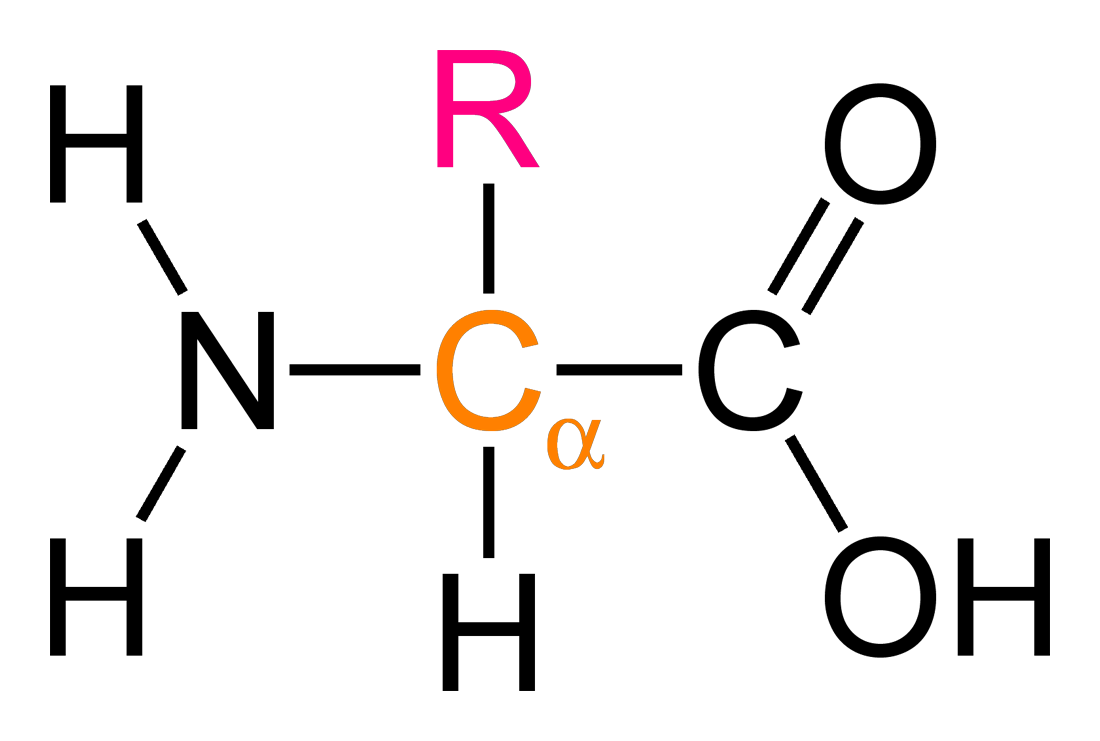
Every α-amino acid shares the same core: a central α-carbon carrying an amino group (−NH2), a carboxylic acid group (−COOH), an H atom, and a variable side chain R that distinguishes the 20 standard amino acids. Image: Benjah-bmm27, Public Domain, via Wikimedia Commons.
Nucleic Acids
- DNA: double helix; A-T and G-C base pairing; stores genetic information
- RNA: single strand; A-U and G-C; transfers information for protein synthesis
- Nucleotide = phosphate + sugar + nitrogenous base
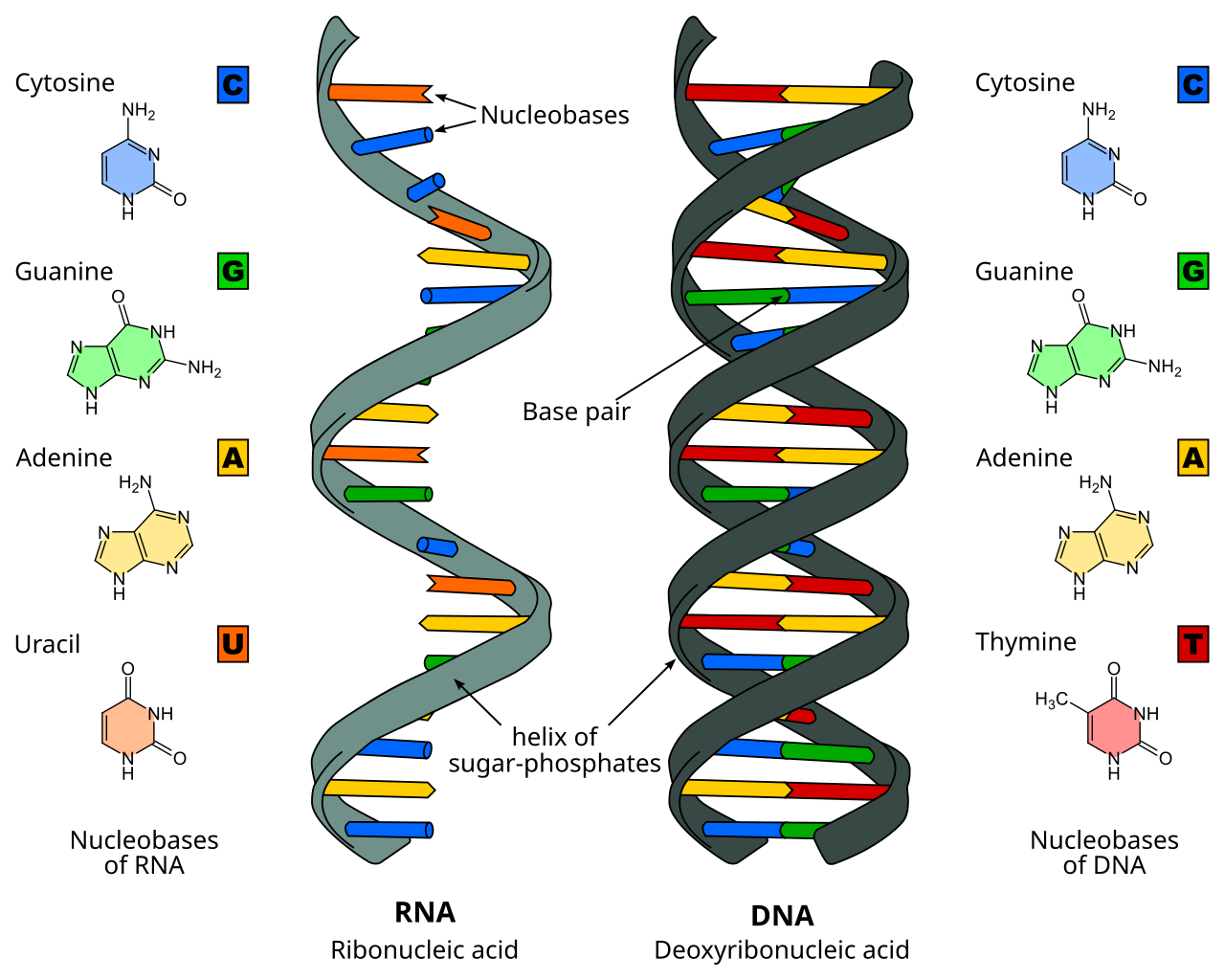
DNA versus RNA: DNA is a double helix carrying adenine, thymine, guanine and cytosine on a deoxyribose–phosphate backbone, while RNA is usually single-stranded, uses ribose, and replaces thymine with uracil (U). Image: Sponk, CC BY-SA 3.0, via Wikimedia Commons.
Vitamins
- Water-soluble: B group vitamins and vitamin C; fat-soluble: A, D, E, K
- Deficiency diseases: A (night blindness), C (scurvy), D (rickets), B1 (beriberi), B12 (pernicious anaemia)
Glucose Structure in Detail
- Open-chain (Fischer projection) form has an aldehyde group at C1 and -OH groups at C2-C5, with the configuration at C5 defining D- or L- glucose
- Glucose exists mainly in cyclic form: alpha and beta anomers differ in the orientation of -OH at C1 (the anomeric carbon), formed by reaction of the C5-OH with the C1 aldehyde (forms a hemiacetal, six-membered pyranose ring)
- Mutarotation: Change in specific rotation when a freshly prepared solution of one anomer slowly equilibrates to a mixture of both alpha and beta forms
Enzyme Classification and Mechanism
- Enzymes are classified by reaction type: oxidoreductases, transferases, hydrolases, lyases, isomerases, and ligases
- Lock and key model: Substrate fits into a specific active site on the enzyme like a key into a lock, forming an enzyme-substrate complex
- Enzyme activity is affected by temperature (each enzyme has an optimum, usually around 37°C in humans) and pH (each enzyme has an optimum pH range)
- Cofactors and coenzymes: Non-protein components (metal ions or organic molecules like vitamins) required for enzyme activity
Amino Acids in More Depth
- Amino acids exist as zwitterions (dipolar ions, both +NH₃ and -COO⁻ groups) at a specific pH called the isoelectric point
- Essential amino acids (e.g., valine, leucine, lysine) cannot be synthesised by the body and must come from diet; non-essential ones can be synthesised in the body
- All naturally occurring amino acids (except glycine) are optically active and mostly exist in the L-configuration
Lipids
- Esters of long-chain fatty acids with glycerol (triglycerides); can be saturated (solid fats) or unsaturated (liquid oils, containing C=C double bonds)
- Phospholipids form the bilayer structure of cell membranes
- Steroids like cholesterol are also classified as lipids despite a very different ring structure
Structure of Fructose
- Fructose (C₆H₁₂O₆) is a ketohexose — it has a ketone group (at C2) rather than an aldehyde, unlike glucose
- In its cyclic form it forms a five-membered furanose ring (fructofuranose) by reaction of the C5-OH with the C2 keto group
- Although it is a ketose, fructose is a reducing sugar (positive Tollens'/Fehling's) because in the basic medium of the test it isomerises to an aldose (via an enediol intermediate)
- Glucose and fructose are related as a functional-group pair and both give the same osazone, confirming that they differ only at C1 and C2
Starch, Cellulose and Glycogen (Polysaccharides in Depth)
- Starch: the storage carbohydrate of plants; a mixture of amylose (about 15-20%, a linear alpha-1,4 chain that gives a blue colour with iodine) and amylopectin (about 80-85%, a branched alpha-1,4 and alpha-1,6 chain)
- Glycogen: the storage carbohydrate of animals ("animal starch"), stored in liver and muscles; structurally like amylopectin but even more highly branched
- Cellulose: the structural material of plant cell walls; a linear polymer of beta-D-glucose units joined by beta-1,4 glycosidic bonds, giving straight chains held by hydrogen bonds — humans lack the enzyme to digest the beta linkage
- The alpha (starch, digestible) versus beta (cellulose, indigestible) glycosidic linkage is the single structural difference that explains their very different biological roles
Chemical Reactions of Glucose (Structure Elucidation)
- With HI and red phosphorus, glucose gives n-hexane, showing that all six carbons are in a straight chain
- With hydroxylamine (NH₂OH) it forms an oxime, and with HCN it forms a cyanohydrin, confirming a carbonyl (aldehyde) group
- Mild oxidation with bromine water gives gluconic acid (six-carbon monocarboxylic acid), confirming an aldehyde group; stronger oxidation with dilute HNO₃ gives saccharic (glucaric) acid, confirming a primary -OH as well
- With acetic anhydride it forms a penta-acetate, confirming five -OH groups
- Some reactions (e.g. failure to give certain aldehyde tests like the Schiff test and no bisulphite addition) could not be explained by the open-chain structure, leading to the cyclic (pyranose) hemiacetal structure
Nucleotides, Nucleosides and the DNA Double Helix
- Nucleoside = nitrogenous base + pentose sugar (ribose in RNA, 2-deoxyribose in DNA); nucleotide = nucleoside + phosphate group
- Bases are purines (adenine A, guanine G — two rings) and pyrimidines (cytosine C, thymine T in DNA, uracil U in RNA — one ring)
- Nucleotides are joined by phosphodiester bonds between the sugar of one and the phosphate of the next, forming the sugar-phosphate backbone
- In DNA two strands coil into a right-handed double helix (Watson-Crick model) running antiparallel, held by complementary hydrogen bonding: A pairs with T (2 H-bonds), G pairs with C (3 H-bonds)
- Biological functions: DNA stores and transmits hereditary information via replication; RNA (mRNA, tRNA, rRNA) carries out transcription and translation to synthesise proteins
Hormones
- Hormones are chemical messengers secreted by endocrine glands directly into the blood, regulating metabolism and body functions
- Steroid hormones: testosterone and estrogen (sex hormones), cortisol and aldosterone (from the adrenal cortex)
- Amino-acid-derived hormones: adrenaline (epinephrine) and noradrenaline from the adrenal medulla (fight-or-flight response); thyroxine (an iodine-containing hormone) from the thyroid — its deficiency causes goitre
- Peptide/protein hormones: insulin and glucagon regulate blood glucose; a deficiency of insulin causes diabetes mellitus
- Hormones differ from vitamins: hormones are synthesised in the body, whereas vitamins must largely be supplied through diet
🚀 JEE Advanced Edge
Why sucrose is non-reducing but maltose is reducing: In sucrose, the glycosidic bond forms between BOTH anomeric carbons (C1 of glucose and C2 of fructose), leaving no free anomeric -OH to open into the reactive aldehyde/ketone form. In maltose, the bond is between C1 of one glucose and C4 of the other, leaving the second glucose's anomeric C1 free to open and reduce Tollens'/Fehling's reagent.
Secondary structure stabilisation: The alpha-helix is stabilised by hydrogen bonds between the C=O of one peptide bond and the N-H of another peptide bond four residues away (intramolecular, within the same chain); beta-sheets form H-bonds between adjacent strands (can be the same or different chains) — recognising which H-bonding pattern is described in a question identifies the secondary structure.
Worked problem: Explain why egg white turns solid/opaque when heated or when lemon juice (acid) is added, even though no covalent bond is broken. Approach: Both heat and acid disrupt the weak hydrogen bonds and ionic interactions holding the protein's secondary and tertiary structure together (denaturation), causing the protein to unfold and aggregate into a different physical form — the primary structure (amino acid sequence, held by strong covalent peptide bonds) remains completely intact throughout.