🎯 Key Points
- Drugs interact with biological macromolecules (mostly proteins — enzymes and receptors) to produce a therapeutic effect; agonists mimic the natural messenger, antagonists block the binding site without activating it
- Antibiotics: bactericidal (kill bacteria, e.g. penicillin) vs bacteriostatic (inhibit growth, e.g. erythromycin); broad-spectrum (acts against many types) vs narrow-spectrum (acts against one or few types)
- Antacids neutralise excess stomach acid (e.g. Mg(OH)₂) or block acid-producing histamine receptors (e.g. ranitidine, a more targeted approach)
- Artificial sweeteners (saccharin, aspartame, sucralose, alitame) provide sweetness without sugar's calories; food preservatives (e.g. sodium benzoate) and antioxidants (e.g. BHA, BHT) extend shelf life
- Soaps (sodium/potassium salts of long-chain fatty acids) are biodegradable but fail in hard water; synthetic detergents work in hard water too, and may or may not be biodegradable depending on chain branching
The hydrophobic hydrocarbon tail of each soap/detergent molecule dissolves into an oily dirt droplet, while the hydrophilic (ionic) head stays in the surrounding water — trapping the grease inside a micelle that rinses away with water.
Drugs and their Classification
- Drugs are chemicals of low molecular mass (roughly 100-500 u) that interact with macromolecular targets (mostly proteins) to produce a biological response
- By pharmacological effect: e.g. analgesics (relieve pain), antipyretics (reduce fever), antibiotics (act against microbes)
- By drug action: drugs that act without binding a specific receptor (e.g. simple antacids that just neutralise acid) vs drugs that interact with a specific receptor or enzyme
- By chemical structure: drugs sharing a common structural feature, e.g. sulphonamides, often show similar pharmacological activity
- By molecular target: classified by the specific biomolecule (enzyme, receptor, nucleic acid) the drug binds to in the body
Drug-Target Interaction
- Enzymes as targets: a drug can block the enzyme's active site (competitive inhibition, structurally resembling the substrate) or bind elsewhere to change the enzyme's shape (allosteric inhibition), reducing catalytic activity
- Receptors as targets: receptors are protein targets, often embedded in cell membranes, that bind a chemical messenger and trigger a response; agonists mimic the natural messenger and activate the receptor; antagonists bind the receptor without activating it, blocking the natural messenger from acting
- Drugs bind their target with high affinity through the same kinds of weak interactions (hydrogen bonds, ionic interactions, van der Waals forces) that hold a substrate to an enzyme
Therapeutic Action of Different Drug Classes
- Antacids: neutralise excess stomach acid; older antacids simply reacted with the acid (e.g. milk of magnesia, Mg(OH)₂); modern antacids like ranitidine block histamine (H₂) receptors in the stomach lining, reducing acid SECRETION at the source instead of just mopping it up
- Antihistamines: block a different histamine receptor subtype (H₁) to relieve allergy symptoms — distinct from H₂-receptor antacids despite both targeting histamine receptors
- Analgesics: relieve pain without affecting consciousness; narcotic analgesics (e.g. morphine, derived from opium) are also used as anaesthetics in surgery but carry addiction risk; non-narcotic analgesics (e.g. aspirin, paracetamol) relieve mild to moderate pain without these risks
- Antimicrobials: a broad term covering antibiotics, antiseptics, and disinfectants; antiseptics are applied to living tissue (skin wounds) without harming it, while disinfectants are applied to inanimate objects and would damage living tissue at the concentrations used
- Antibiotics: bactericidal drugs (e.g. penicillin, aminoglycosides) kill bacteria directly; bacteriostatic drugs (e.g. erythromycin, tetracycline) only inhibit growth, relying on the immune system to clear the infection; broad-spectrum antibiotics act against both gram-positive and gram-negative bacteria, while narrow-spectrum antibiotics act against a single organism or small group
- Antifertility drugs: synthetic hormone-based drugs (e.g. norethindrone, a progesterone derivative) used in oral contraceptives to prevent ovulation
Chemicals in Food
- Artificial sweeteners: provide sweetness with little to no calorie contribution, often safe for diabetics; e.g. saccharin (oldest, about 550× sweeter than sucrose), aspartame (unstable on heating, used in cold foods/soft drinks), sucralose (heat-stable, structurally resembles sugar), alitame (high sweetening intensity, stable to heat)
- Food preservatives: prevent spoilage from microbial growth, e.g. sodium benzoate, sodium metabisulphite; salt, sugar, and vegetable oils have been used as natural preservatives for centuries
- Antioxidants: added to food to retard oxidation (rancidity of fats/oils), e.g. butylated hydroxyanisole (BHA) and butylated hydroxytoluene (BHT) — distinct from preservatives, which target microbial spoilage rather than oxidative spoilage
Cleansing Agents: Soaps and Detergents
- Soaps: sodium or potassium salts of long-chain fatty acids (e.g. sodium stearate, C₁₇H₃₅COONa); fully biodegradable, but form an insoluble precipitate ("scum") with Ca²⁺/Mg²⁺ ions in hard water, reducing cleaning efficiency
- Synthetic detergents: typically sulphonate or alkylbenzenesulphonate salts (or quaternary ammonium salts); work effectively even in hard water, since their calcium/magnesium salts remain soluble
- Detergent types by the charge on the hydrophilic head: anionic (negatively charged head, e.g. sodium lauryl sulphate, common in toothpastes/shampoos), cationic (positively charged head, usually a quaternary ammonium salt, often used as fabric softeners and have germicidal properties), non-ionic (no charge, e.g. esters of polyethylene glycol with long-chain fatty acids)
- Biodegradability: straight-chain (unbranched) detergents are readily biodegraded by microorganisms; branched-chain detergents resist microbial breakdown and accumulate as water pollutants — this is why detergent design shifted toward linear alkyl chains
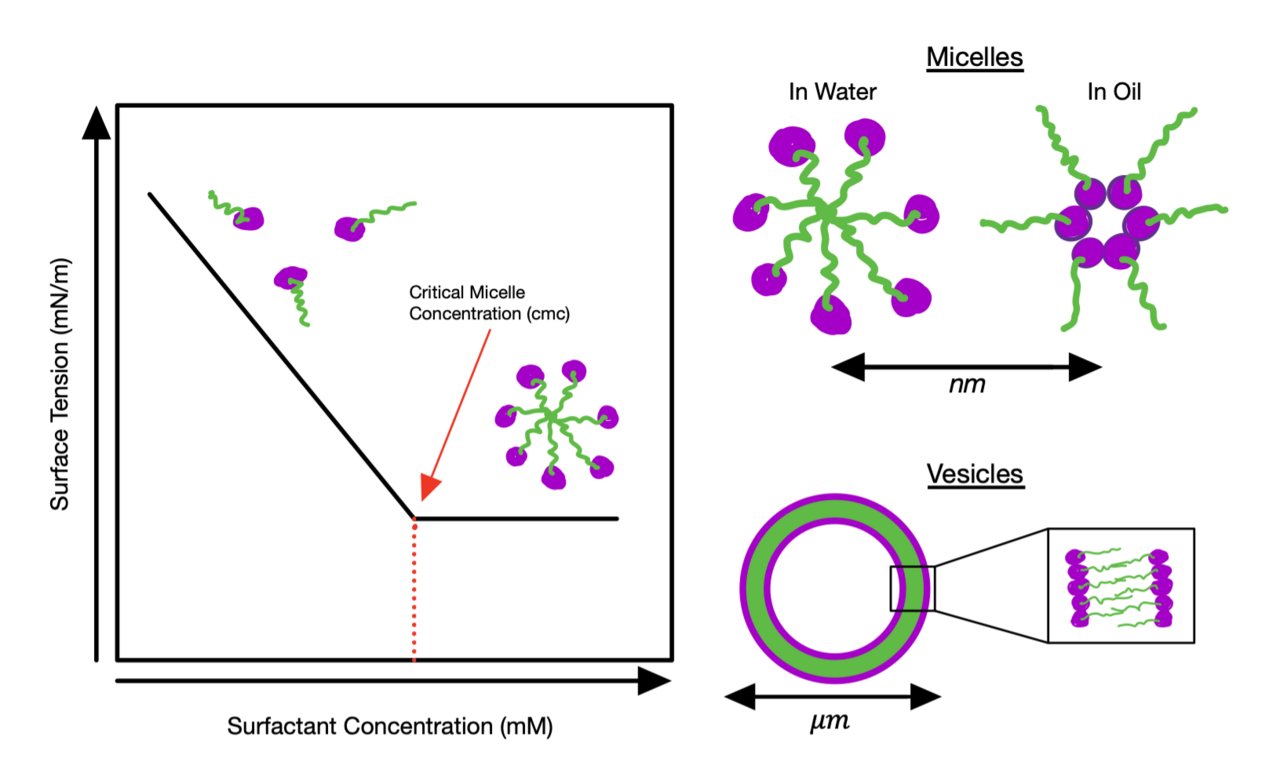
Above the critical micelle concentration soap molecules cluster into micelles: the hydrophilic (−COO−Na+) heads face the surrounding water while the hydrophobic hydrocarbon tails point inward, trapping oil and grease in the core so they can be rinsed away. Image: Davidson72, CC BY-SA 4.0, via Wikimedia Commons.
Tranquilisers and Antidepressants
- Tranquilisers are neurologically active drugs used to treat stress, mild and severe mental disorders; they are a key component of sleeping pills and relieve anxiety by acting on the central nervous system
- Mild tranquilisers such as veronal, amytal and equanil belong to the barbiturate class and are used to relieve tension; equanil is also used to control depression and high blood pressure
- Antidepressants such as iproniazid and phenelzine inhibit the enzyme (monoamine oxidase) that breaks down noradrenaline, so more of this mood-elevating messenger is available, relieving depression
- Chlordiazepoxide and meprobamate are relatively milder tranquilisers suitable for relieving tension
Antiseptics and Disinfectants (Examples)
- Antiseptics are applied to living tissue to kill or prevent the growth of microorganisms: examples include dettol (a mixture of chloroxylenol and terpineol), bithionol (added to soaps), tincture of iodine (2-3% iodine in alcohol-water), and iodoform (a powerful antiseptic for wounds)
- Disinfectants are applied to inanimate objects such as floors, drains and instruments: examples include 1% phenol solution, chlorine (at ~0.2-0.4 ppm in drinking water), and sulphur dioxide in very low concentrations
- Boric acid in dilute aqueous solution is a weak antiseptic used for the eyes
Types of Soaps and Saponification
- Saponification: Soaps are made by heating fats or oils (glyceryl esters of fatty acids) with aqueous NaOH or KOH, which hydrolyses the ester to give the fatty-acid salt (soap) plus glycerol
- Toilet soaps are made using better grades of fat/oil with excess alkali removed; adding dyes and perfumes; transparent soaps are made by dissolving soap in ethanol and evaporating the solvent
- Medicated soaps contain antiseptics (e.g. bithionol); shaving soaps contain glycerol to prevent rapid drying and a gum (rosin, which forms sodium rosinate that lathers well)
- Laundry soaps contain fillers such as sodium rosinate, sodium silicate and borax; hard soaps use sodium salts, while soft soaps use potassium salts
Mechanism of Cleansing Action
- A soap/detergent molecule has a long non-polar hydrocarbon tail (hydrophobic, oil-loving) and a polar ionic head (hydrophilic, water-loving)
- When grease/oil is present, the hydrophobic tails dissolve into the oil droplet while the hydrophilic heads point outward into the water, surrounding the droplet to form a micelle
- The negatively charged micelle surfaces repel one another, so the oil droplets stay dispersed and do not re-deposit; agitation with water then washes the emulsified grease away (see the micelle diagram above)
🚀 JEE Advanced Edge
The same chemical can be an antiseptic OR a disinfectant — concentration decides: Phenol at low concentration (about 0.2%) is used as an antiseptic on skin, but at higher concentration (about 1%) the very same chemical acts as a disinfectant on inanimate surfaces. This is a frequently tested trap: the classification depends on concentration and application, not on the chemical's identity alone.
Why branched-chain detergents resist biodegradation: Bacterial enzymes break down hydrocarbon chains through a stepwise oxidation process starting from the terminal (end) carbon. A branched chain disrupts this enzymatic recognition at the branch point, so microorganisms cannot fully degrade it — this is exactly why linear alkylbenzene sulphonates replaced the older branched detergents as the environmentally preferred design.
Worked reasoning: Why must a competitive enzyme inhibitor closely resemble the enzyme's natural substrate, while a receptor antagonist does not need to closely resemble the receptor's natural messenger? A competitive inhibitor works specifically by competing for the SAME binding site as the substrate, so close structural resemblance is what allows it to fit there at all. An antagonist, however, only needs to occupy a site that blocks receptor activation — many antagonists bind near (but not identical to) the natural messenger's site, or change the receptor's shape allosterically, so close structural mimicry is not strictly required.