🎯 Key Points
- p-block spans Groups 13-18: boron family, carbon family, nitrogen family, oxygen family, halogens, noble gases
- First element of each group is anomalous (B≠Al, C≠Si, N≠P, O≠S, F≠Cl) — usually due to small size and no available d-orbitals
- Reactivity/oxidising power of halogens: F₂ > Cl₂ > Br₂ > I₂
- Maximum covalency: N=4 (no d-orbitals), P/As/Sb/Bi can expand to 5/6 using d-orbitals
- Carbon shows strong catenation + stable π bonds; Silicon catenates poorly and rarely forms π bonds
- Noble gases are inert due to fully-filled valence shells; only Xe/Kr form well-characterised compounds (with F, O)
Diamond's rigid 3D tetrahedral network makes it the hardest natural material, while graphite's flat hexagonal sheets are held together only by weak forces, letting them slide past each other (used as a lubricant and in pencils).
Group 15: Nitrogen Family (N, P, As, Sb, Bi)
- Nitrogen: Makes up 78% of air; forms NH₃ by Haber process
- HNO₃ (nitric acid): Strong oxidising acid; used in fertilisers and explosives
- Phosphorus allotropes: white P (toxic), red P (stable), black P
- PCl₃ and PCl₅ are important chlorides of phosphorus
Group 16: Oxygen Family (O, S, Se, Te, Po)
- Oxygen: Most electronegative element after F; essential for life and combustion
- Ozone (O₃): Allotrope of oxygen; absorbs harmful UV radiation in the stratosphere
- Sulphur allotropes: rhombic (stable at room temp), monoclinic
- H₂SO₄ (sulphuric acid): Most important industrial chemical; strong diprotic acid
Group 17: Halogens (F, Cl, Br, I, At)
- Most electronegative non-metals; one electron short of noble gas configuration
- Reactivity and oxidising power: F₂ > Cl₂ > Br₂ > I₂
- Cl₂ used in water purification; bleaching powder = Ca(OCl)Cl
- Interhalogen compounds: ClF, BrF₃, IF₅, IF₇
Group 18: Noble Gases (He, Ne, Ar, Kr, Xe)
- Completely filled outer shells; chemically inert under normal conditions
- He used in balloons and diving tanks; Ar in welding; Ne in sign boards
- Xenon compounds (XeF₂, XeF₄, XeOF₄) are the most stable noble gas compounds
Quick Tips
- F₂ is the strongest oxidising agent among all elements
- Cl₂ can displace Br₂ and I₂ from their salt solutions (higher reactivity)
- Noble gases: He has the lowest boiling point of any substance (-269°C)
Anomalous Behaviour of the First Element in Each Group
- Boron (Group 13) differs from Al: B is a metalloid/non-metal while Al is a metal; B forms only covalent compounds and shows a maximum covalency of 4 (e.g., BF₄⁻)
- Carbon (Group 14) differs from Si: C shows strong catenation and forms stable pi bonds (multiple bonds), while Si rarely forms stable pi bonds due to larger atomic size
- Nitrogen (Group 15) differs from P: N₂ is a stable diatomic gas with a triple bond, while phosphorus exists as reactive P₄ tetrahedral molecules; N has a maximum covalency of 4 (no d-orbitals), P can expand to 5 or 6
- Oxygen (Group 16) differs from S: O forms strong pi bonds, giving diatomic O₂, while S prefers catenation forming S₈ rings
- Fluorine (Group 17) differs from Cl: F shows only -1 oxidation state (no d-orbitals), while Cl can show +1 to +7 states; F has an anomalously low bond dissociation energy due to lone pair-lone pair repulsion in the small F₂ molecule
Important Compounds: Borax and Silicones
- Borax (Na₂B₄O₇.10H₂O): On heating, swells and forms a transparent glassy bead of sodium metaborate and B₂O₃ (used in the borax bead test to identify coloured metal ions)
- Boric acid (H₃BO₃): A weak monobasic Lewis acid; acts as an acid by accepting OH⁻ from water rather than donating H⁺
- Silicones: Synthetic polymers with a repeating -Si-O-Si-O- backbone and organic side groups; water repellent, heat resistant, used as sealants, lubricants, and in waterproofing fabrics
- Silicates and zeolites: Built from SiO₄ tetrahedra; zeolites (porous aluminosilicates) are used as molecular sieves and catalysts in petrochemical cracking
Allotropes Recap with Structural Detail
- Carbon: Diamond (sp³, tetrahedral network, hardest natural substance, poor conductor); graphite (sp², hexagonal layers, good conductor, lubricant); fullerene (C₆₀, soccer-ball-shaped, sp²)
- Phosphorus: White P (P₄ tetrahedra, reactive, glows in dark, kept under water); red P (polymeric, less reactive, non-poisonous); black P (most stable, layered structure)
- Sulphur: Rhombic (alpha-sulphur, stable form, S₈ crown-shaped rings); monoclinic (beta-sulphur, stable above 369 K)
Oxoacids and Hydrides Trends
- Acidic strength of hydrides decreases down a group for the same family in some cases, but increases across a period: NH₃ < PH₃ < AsH₃ (basicity decreases down group 15 instead)
- Oxoacids of chlorine in increasing acidic and oxidising strength order: HOCl < HOClO < HOClO₂ < HOClO₃ (more oxygen atoms stabilise the conjugate base better through resonance)
General Trends in Groups 13 and 14
- Electronic configuration: Group 13 is ns2np1 (max oxidation state +3); Group 14 is ns2np2 (max oxidation state +4)
- Atomic radius: Increases down each group, but Ga is anomalously smaller than Al (poor shielding by intervening 3d electrons); similarly the size increase from Si to Pb is not regular
- Ionisation enthalpy: Decreases down the group overall, though small increases appear (e.g. Ga, Tl) due to poor d/f-electron shielding
- Electronegativity: Decreases from B to Al, then stays roughly constant; Group 14 elements are slightly more electronegative than Group 13 in the same period
- Inert pair effect: The stability of the lower oxidation state (+1 for Group 13, +2 for Group 14) increases down the group. So Tl+ is more stable than Tl3+, and Pb2+ is more stable than Pb4+; consequently PbO2 and Tl2O3 are strong oxidising agents
- Metallic character: Increases down each group — B is a metalloid while Al, Ga, In, Tl are metals; C is a non-metal, Si and Ge are metalloids, Sn and Pb are metals
Group 13: The Boron Family (B, Al, Ga, In, Tl)
- Anomalous behaviour of boron: Small size, high ionisation enthalpy and absence of d-orbitals restrict B to a maximum covalency of 4 (e.g. BF4-); B is a non-metallic metalloid forming only covalent compounds, unlike the metallic rest of the group
- Electron deficiency and Lewis acidity: BX3 molecules have only 6 electrons around B (incomplete octet), so they are strong Lewis acids that accept a lone pair to complete the octet
- Amphoteric nature of aluminium: Al reacts with both acids (2Al + 6HCl gives 2AlCl3 + 3H2) and alkalis (2Al + 2NaOH + 2H2O gives 2NaAlO2 + 3H2), so Al2O3 and Al(OH)3 are amphoteric
- Reactions of aluminium: Forms a thin protective oxide film (passivation) that resists further corrosion; reacts with dilute mineral acids to give H2, but concentrated HNO3 renders it passive; used in the thermite process (2Al + Fe2O3 gives Al2O3 + 2Fe) for welding rails
- Aluminium chloride: Exists as the dimer Al2Cl6 (chlorine-bridged) in the vapour and non-polar solvents, relieving Al's electron deficiency
Diborane and Boron Hydrides
- Boranes: Boron forms a series of covalent hydrides such as diborane (B2H6), tetraborane (B4H10) and higher members; they are electron-deficient molecules
- Structure of diborane (B2H6): Contains four terminal B-H bonds (normal 2-centre-2-electron bonds) in a plane and two bridging B-H-B bonds; each bridge is a 3-centre-2-electron "banana" bond in which two electrons are shared among three atoms
- Diborane has 12 valence electrons but would need more for eight conventional bonds, so the two bridging bonds are the hallmark of its electron-deficient bonding
- Preparation: 3LiAlH4 + 4BF3 gives 2B2H6 + 3LiF + 3AlF3; diborane catches fire spontaneously in air, releasing large amounts of energy
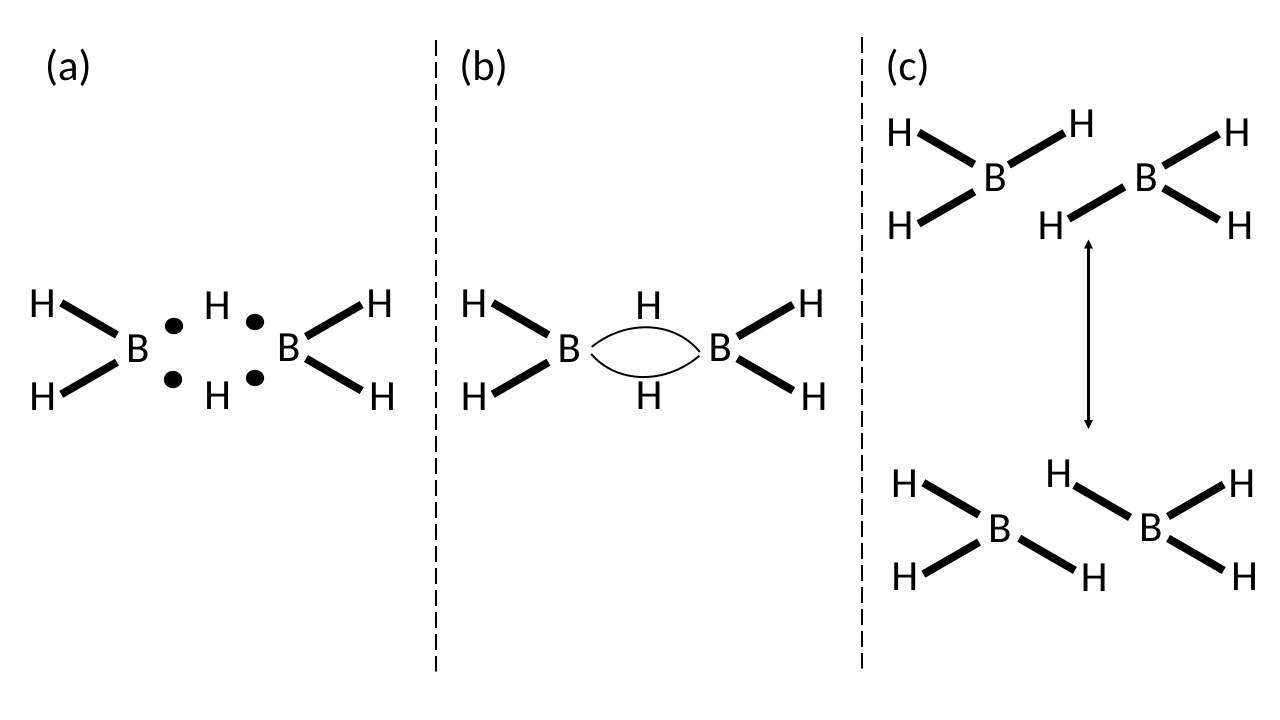
Diborane (B2H6) is electron-deficient: each boron carries two normal terminal B–H bonds, and the two borons are held together by two bridging hydrogens through three-centre two-electron “banana” bonds. Image: Grajkowf, CC BY-SA 4.0, via Wikimedia Commons.
Group 14: The Carbon Family (C, Si, Ge, Sn, Pb)
- Catenation: The tendency to form long chains/rings through self-linking is strongest for carbon (very strong C-C bonds, ~348 kJ/mol) and falls sharply down the group (Si-Si is weaker); this underlies the vast number of organic compounds
- Tendency to form pi bonds: Carbon forms stable p pi-p pi multiple bonds (C=C, C=O), whereas the heavier elements rarely do because of their larger size and poor orbital overlap
- Allotropes of carbon: Diamond (sp3 3D network, hardest natural solid), graphite (sp2 layers, conductor and lubricant), and fullerene (C60 "buckyball", sp2 closed cage) — see the allotropes section above for structural detail
- Oxidation states: All show +4, but the +2 state grows more stable down the group owing to the inert pair effect; Sn(II) is a reducing agent while Pb(IV) is an oxidising agent
- Silicates and silicones: Silicates are built from SiO44- tetrahedra linked in chains, sheets or 3D networks; zeolites are porous aluminosilicates used as molecular sieves and cracking catalysts; silicones are water-repellent -Si-O-Si- polymers (covered above)
Oxides of Carbon: CO and CO2
- Carbon monoxide (CO): A neutral oxide formed by incomplete combustion of carbon; highly poisonous because it binds haemoglobin ~300 times more strongly than O2, forming carboxyhaemoglobin and blocking oxygen transport; a good reducing agent used in metallurgy (Fe2O3 + 3CO gives 2Fe + 3CO2)
- Carbon dioxide (CO2): A weakly acidic oxide (gives carbonic acid with water); a linear non-polar molecule; produced by respiration, combustion and fermentation; a major greenhouse gas whose rising level drives global warming
- Solid CO2 ("dry ice") sublimes directly and is used as a refrigerant
🚀 JEE Advanced Edge
Back-bonding strength order: In boron trihalides (BX₃), the Lewis acidic strength order is BF₃ < BCl₃ < BBr₃ < BI₃ — the OPPOSITE of what electronegativity alone would predict. This is because back-bonding (halogen lone pair donating into boron's empty p-orbital) is strongest for F (best orbital size match with B) and weakest for I, so BF₃'s electron deficiency is most "patched up," making it the weakest Lewis acid of the four.
Inert pair effect in stability of oxidation states: Down Group 15, the +5 state becomes progressively less stable relative to +3 (e.g., BiCl₅ is far less stable than BiCl₃) because the heavier elements' ns² electron pair resists getting involved in bonding — this is why Bi(V) compounds like NaBiO₃ are actually strong oxidising agents (they "want" to drop down to the more stable +3 state).
Worked problem: Explain why XeF₂ is linear despite Xe having 3 lone pairs. Approach: Xe has 8 valence electrons; 2 are used in Xe-F bonds, leaving 3 lone pairs. Total electron pairs = 5 → sp³d hybridisation, trigonal bipyramidal electron geometry. The 3 lone pairs occupy the 3 equatorial positions (where repulsion is minimised), forcing the 2 bonding pairs into the axial positions — giving a linear molecular shape.