🎯 Key Points
- 4 main extraction steps: mining/crushing → concentration (remove gangue) → reduction → refining
- Concentration methods: gravity separation, froth flotation (sulphide ores), magnetic separation, leaching
- Reduction methods: carbon reduction (Fe, Cu, Zn), electrolytic reduction (Al, Na, Mg - very reactive metals)
- Refining: electrolytic refining (Cu, Ag, Au), zone refining (semiconductors), Mond process (Ni), Van Arkel (Ti, Zr)
- Ellingham diagram: a metal can reduce another's oxide only if its own ΔG° line is below the other's at that temperature
- Hall-Heroult process: Al extraction by electrolysis of Al₂O₃ dissolved in molten cryolite
An Ellingham diagram plots ΔG° of oxide formation against temperature for different metals; whichever line is LOWER (more negative ΔG°) at a given temperature reduces the oxide of any metal whose line sits above it — the basis of carbon reduction (Fe, Zn) vs electrolytic reduction (Al, Mg, Na) decisions.
Occurrence of Metals
Most metals occur as ores in the Earth's crust. An ore is a mineral from which a metal can be profitably extracted.
- Native (free) state: Au, Ag, Pt (unreactive)
- As oxides: Fe₂O₃ (haematite), Al₂O₃ (bauxite)
- As sulphides: Cu₂S, ZnS, PbS
- As carbonates: CaCO₃, ZnCO₃
Steps in Extraction
- Mining and crushing: Ore is extracted and ground
- Concentration of ore: Remove gangue (unwanted rock)
- Reduction: Convert metal compound to metal
- Refining: Purify the extracted metal
Concentration Methods
- Gravity separation: For dense ores (e.g., gold panning)
- Froth flotation: For sulphide ores; ore is preferentially wetted by oil
- Magnetic separation: For magnetic ores like magnetite (Fe₃O₄)
- Leaching: Chemical dissolution using acid/base/cyanide (e.g., Al₂O₃ in NaOH)
Reduction Methods
- Carbon reduction: Fe, Cu, Zn; Fe₂O₃ + 3CO → 2Fe + 3CO₂ (blast furnace)
- Electrolytic reduction: Al, Na, Mg (highly reactive metals; Hall-Heroult process for Al)
- Thermite reaction: Aluminium reduces metal oxides; used in welding railway tracks
Refining Methods
- Electrolytic refining: Cu, Ag, Au (impure metal = anode; pure metal deposits at cathode)
- Zone refining: For semiconductors like Si and Ge
- Mond process: Refining Ni using Ni(CO)₄
Quick Tips
- Aluminium is extracted by electrolysis despite carbon being available (C reduces Al only at very high temperature)
- Slag = CaSiO₃; formed in blast furnace by reaction of CaO and SiO₂ (impurity)
Thermodynamic Principle of Reduction: Ellingham Diagram
- Ellingham diagram plots standard Gibbs free energy of formation of an oxide (ΔG°) against temperature for different metals
- A metal can reduce the oxide of another metal only if its own oxide-formation line lies below that metal's line at the given temperature (more negative ΔG°)
- Most ΔG° vs T lines slope upward (less negative ΔG° as T rises) because entropy decreases when gaseous O₂ is consumed to form solid oxide
- The carbon line (C to CO) slopes downward, so above about 983°C, carbon can reduce almost any metal oxide, which is why coke is so widely used in extraction at high temperature
Extraction by Reactivity Series
- Highly reactive metals (K, Na, Ca, Mg, Al): extracted by electrolytic reduction of molten salts/oxides since chemical reducing agents are not strong enough
- Moderately reactive metals (Fe, Zn, Pb, Cu, Sn): extracted by chemical reduction using carbon (coke) or carbon monoxide
- Least reactive/noble metals (Ag, Au, Pt): found in native (free) state; extracted by simple physical methods or cyanide leaching (e.g., Ag and Au by MacArthur-Forrest cyanide process)
Hall-Heroult and Other Named Processes
- Hall-Heroult process: Purified Al₂O₃ (alumina) is dissolved in molten cryolite (Na₃AlF₆) to lower its melting point, then electrolysed; Al deposits at the cathode, O₂ is released at the carbon anode (which is gradually consumed)
- Bayer's process: Bauxite ore is purified by digesting with hot concentrated NaOH; Al₂O₃ dissolves as sodium aluminate, leaving impurities (Fe₂O₃) undissolved, then pure Al₂O₃ is reprecipitated
- Van Arkel method: Refines metals like Ti and Zr by converting the impure metal to a volatile iodide, which decomposes on a hot tungsten filament to deposit ultra-pure metal
Refining: Vapour Phase Method and Poling
- Mond process (vapour phase refining): Impure Ni heated in CO forms volatile Ni(CO)₄, which decomposes at higher temperature to give pure Ni and CO is recycled
- Poling: Molten impure Cu is stirred with green wood poles; hydrocarbon gases released reduce Cu₂O impurity (cuprous oxide) back to pure copper
- Liquation: Low-melting impure metal (like Sn) is melted on a sloping hearth so the pure metal flows away from higher-melting impurities
Roasting and Calcination
- Roasting: heating a concentrated (usually sulphide) ore strongly in the presence of excess air, below its melting point, to convert it to the oxide and drive off volatile impurities; e.g. 2ZnS + 3O₂ → 2ZnO + 2SO₂
- Calcination: heating a carbonate or hydrated ore in the absence (or limited supply) of air to expel CO₂ or water and leave the oxide; e.g. ZnCO₃ → ZnO + CO₂ and Al₂O₃·2H₂O → Al₂O₃ + 2H₂O
- Both convert the ore to the oxide because oxides are far easier to reduce to the metal than sulphides or carbonates
- Roasting is oxidising (excess air) whereas calcination excludes air — this is the key distinction
Extraction of Iron (Blast Furnace)
- Roasted/calcined haematite ore (Fe₂O₃) is mixed with coke and limestone (CaCO₃) and fed into the top of a blast furnace; hot air is blasted in at the bottom
- Coke burns to CO₂, which is reduced by more coke to CO — the actual reducing agent: C + O₂ → CO₂; CO₂ + C → 2CO
- CO reduces the ore in stages down the furnace: 3Fe₂O₃ + CO → 2Fe₃O₄ + CO₂; Fe₃O₄ + CO → 3FeO + CO₂; FeO + CO → Fe + CO₂
- Limestone decomposes (CaCO₃ → CaO + CO₂) and the CaO removes silica gangue as fusible slag: CaO + SiO₂ → CaSiO₃ (slag), which floats on the molten iron and is tapped off separately
- The product is molten pig iron (about 4% carbon); it is refined to cast iron, wrought iron and steel
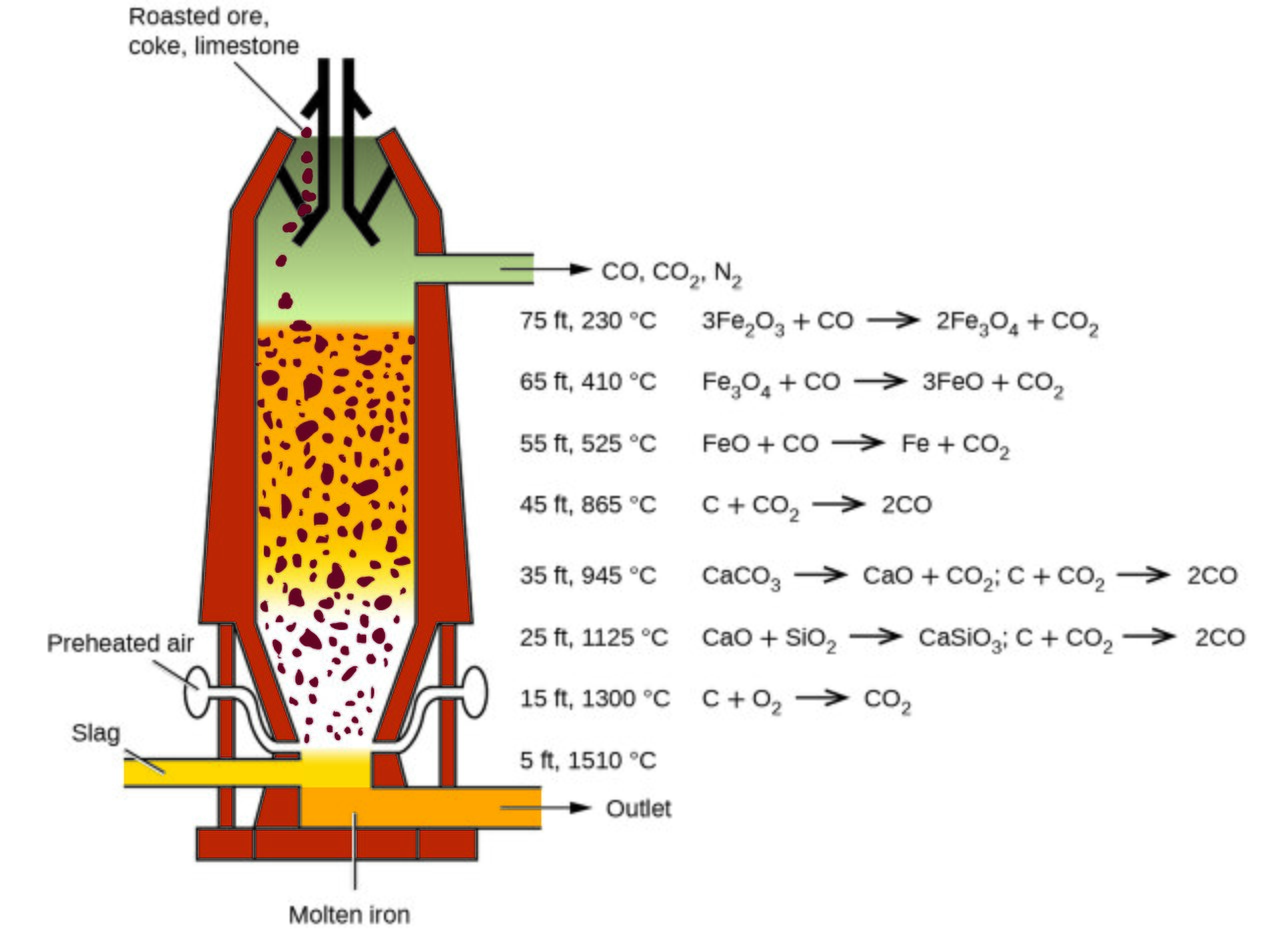
The blast furnace for extracting iron: roasted haematite (Fe2O3), coke and limestone are charged at the top while hot air is blasted in at the base. Rising CO reduces the ore in stages down the furnace as temperature increases (Fe2O3 → Fe3O4 → FeO → Fe); limestone decomposes and forms CaSiO3 slag, and molten iron collects at the bottom. Image: OpenStax, CC BY-SA 4.0, via Wikimedia Commons.
Extraction of Copper and Zinc
- Copper (from copper pyrites, CuFeS₂): concentrated by froth flotation, then roasted and smelted to give copper matte (Cu₂S + FeS); in a Bessemer converter, a blast of air performs self-reduction: 2Cu₂O + Cu₂S → 6Cu + SO₂, giving blister copper (refined electrolytically)
- Zinc (from zinc blende ZnS, or calamine ZnCO₃): the ore is roasted/calcined to ZnO, then reduced with coke: ZnO + C → Zn + CO; zinc distils off (it is volatile) and is refined by fractional distillation or electrolytically
- Copper's self-reduction works because copper is a low-reactivity metal, so its sulphide and oxide react together directly without an external reducing agent
Uses of Aluminium, Copper, Zinc and Iron
- Aluminium: aircraft and vehicle bodies, wires, foil and utensils (light, corrosion-resistant); thermite welding
- Copper: electrical wiring and cables (excellent conductor), alloys (brass, bronze), and heat exchangers
- Zinc: galvanising iron to prevent rusting, dry cells, and alloys such as brass
- Iron/steel: construction, machinery, tools and transport — the most widely used structural metal
🚀 JEE Advanced Edge
Reading Ellingham diagram crossover points: The Mg line and Al line cross at a certain temperature — below it, Al can reduce MgO; above it, Mg can reduce Al₂O₃. Identifying which metal's line is lower at the EXACT temperature given in a question (not just generally) is the key skill for Ellingham diagram problems.
Why electrolytic reduction is needed for very reactive metals: Carbon CANNOT reduce the oxides of K, Na, Ca, Mg, Al under normal conditions because these metals' oxide-formation ΔG° is more negative than carbon's even at very high temperatures (their Ellingham lines stay below carbon's line) — these metals are simply too eager to stay as oxides for carbon's reducing power to overcome them, so a stronger driving force (electrical energy) is required.
Worked problem: Explain why the thermite reaction (2Al + Fe₂O₃ → Al₂O₃ + 2Fe) is highly exothermic and self-sustaining. Approach: Al's oxide-formation ΔG° is significantly more negative than Fe's at the reaction temperature (Al's Ellingham line lies well below Fe's), so the reaction releases a large amount of heat — enough to melt the iron product directly, which is why this reaction is used for on-site welding of railway tracks without external heating.