🎯 Key Points
- Colligative properties depend on NUMBER of solute particles, not their identity: vapour pressure lowering, ΔTb, ΔTf, osmotic pressure (π)
- Molality (not molarity) is used for colligative properties since it's temperature-independent
- Van't Hoff factor i: dissociation gives i > 1 (e.g. NaCl, i≈2); association gives i < 1 (e.g. benzoic acid dimer, i≈0.5); non-electrolytes i=1
- Modified equations: ΔTb=iKbm, ΔTf=iKfm, π=iCRT
- Ideal solutions obey Raoult's law exactly (ΔHmix=0); positive deviation → minimum boiling azeotrope; negative deviation → maximum boiling azeotrope
- Henry's Law: gas solubility ∝ partial pressure — explains why soda goes flat when opened
Adding a non-volatile solute lowers the solvent's vapour pressure at every temperature, which is the root cause behind all four colligative properties: it shifts the freezing point down and the boiling point up.
Types of Solutions
A solution is a homogeneous mixture. The component in larger amount is the solvent; the smaller is the solute.
Concentration Terms
- Molarity (M): Moles of solute per litre of solution
- Molality (m): Moles of solute per kg of solvent (temperature-independent)
- Mole fraction (X): Moles of component / total moles
- ppm: Parts per million (for very dilute solutions)
Colligative Properties
These depend only on the number of solute particles, not their chemical nature.
- Vapour pressure lowering: ΔP/P° = Xsolute (Raoult's law)
- Boiling point elevation: ΔTb = Kb × m
- Freezing point depression: ΔTf = Kf × m
- Osmotic pressure: π = iMRT
Van't Hoff Factor (i)
- Electrolytes that dissociate: i > 1
- Solutes that associate: i < 1
- Non-electrolytes: i = 1
Henry's Law
Mass of gas dissolved is proportional to its partial pressure: p = KH × X. This explains why carbonated drinks go flat when opened (pressure drops).
Quick Tips
- Molality is used for colligative properties (not molarity) because it is temperature-independent
- Antifreeze (ethylene glycol) works by depression of freezing point
- Osmotic pressure is used to determine molar mass of large molecules like proteins
Raoult's Law for Ideal and Non-Ideal Solutions
- Raoult's law (general): For a solution of volatile liquids, partial vapour pressure of each component is proportional to its mole fraction: pA = pA° × xA
- Ideal solutions: Obey Raoult's law at all concentrations; ΔHmixing = 0, ΔVmixing = 0 (e.g., benzene + toluene, n-hexane + n-heptane)
- Non-ideal solutions with positive deviation: A-B interactions weaker than A-A/B-B; vapour pressure higher than predicted (e.g., ethanol + acetone, water + ethanol); forms a minimum boiling azeotrope
- Non-ideal solutions with negative deviation: A-B interactions stronger than A-A/B-B; vapour pressure lower than predicted (e.g., chloroform + acetone, HNO₃ + water); forms a maximum boiling azeotrope
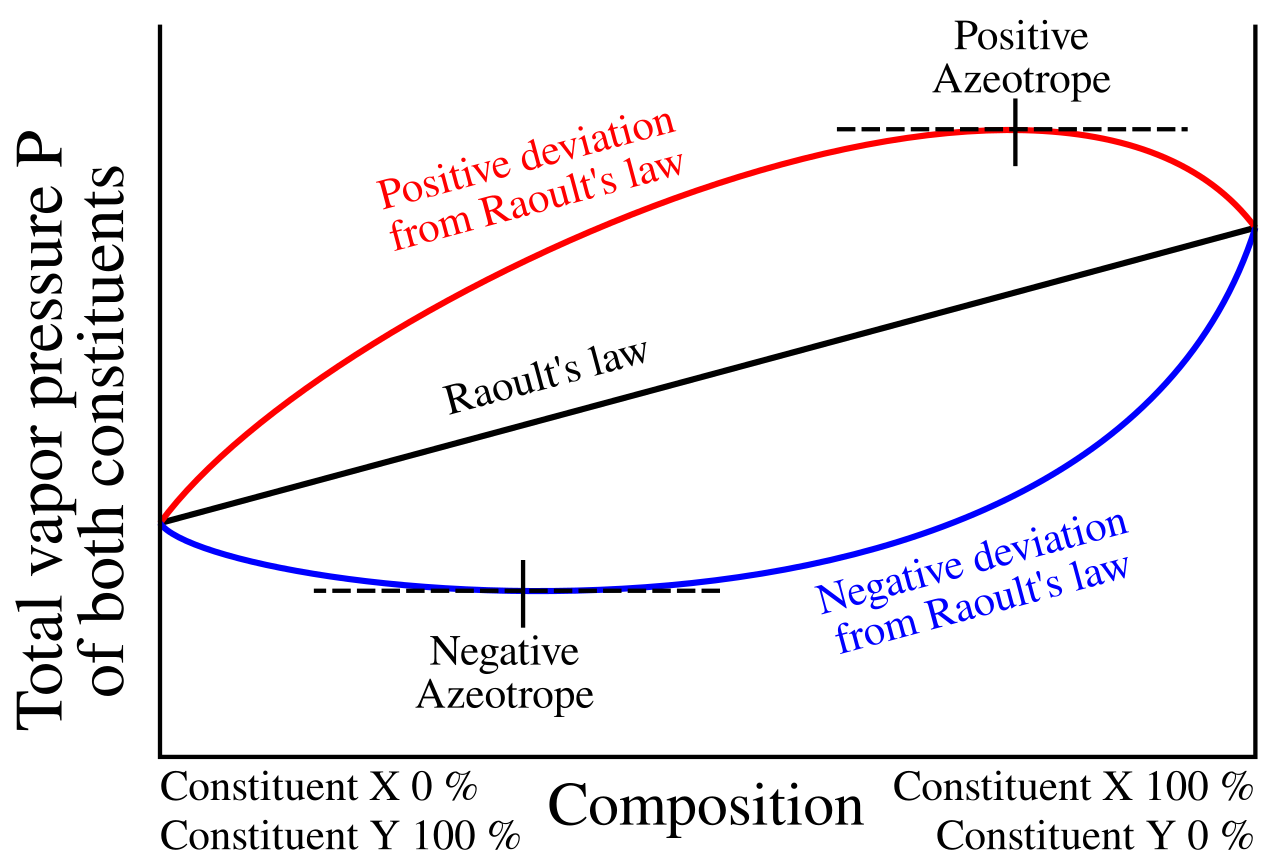
Real solutions deviate from Raoult's law: positive deviation (red) occurs when A–B attractions are weaker than in the pure liquids, giving a higher vapour pressure and a minimum-boiling azeotrope; negative deviation (blue) occurs when A–B attractions are stronger, giving a maximum-boiling azeotrope. Image: Д.Ильин (vectorization), CC0, via Wikimedia Commons.
Azeotropes
Mixtures of two liquids that boil at a constant temperature and have the same composition in liquid and vapour phase, so they cannot be separated by simple fractional distillation. Ethanol-water (95.6% ethanol) is a classic minimum boiling azeotrope.
Van't Hoff Factor: Worked Reasoning
- i = (observed colligative property)/(calculated colligative property) = (normal molar mass)/(observed/abnormal molar mass)
- NaCl in water: i ≈ 2 (dissociates into Na⁺ and Cl⁻)
- K₂SO₄ in water: i ≈ 3 (dissociates into 2K⁺ and SO₄²⁻)
- Benzoic acid in benzene: i ≈ 0.5 (dimerises due to hydrogen bonding, halving the effective number of particles)
Modified Colligative Property Equations (with i)
- ΔTb = i × Kb × m
- ΔTf = i × Kf × m
- π = i × CRT
- ΔP/P° = i × xsolute
Types of Solutions (by Physical State)
Depending on the state of solute and solvent, nine kinds of solution exist:
| Solute | Solvent | Example |
|---|---|---|
| Gas | Gas | Air (O₂ in N₂) |
| Gas | Liquid | CO₂ in soda water |
| Gas | Solid | H₂ adsorbed in palladium |
| Liquid | Liquid | Ethanol in water |
| Solid | Liquid | Salt/sugar in water |
| Solid | Solid | Alloys (brass, bronze) |
Solubility: Effect of Temperature and Pressure
- Solid in liquid: If dissolution is endothermic (most salts, e.g. KNO₃), solubility increases with temperature; if exothermic (e.g. Ce₂(SO₄)₃), it decreases. Pressure has almost no effect on solids/liquids
- Gas in liquid: Solubility DECREASES with temperature (dissolution of a gas is exothermic) and INCREASES with pressure (Henry's law) — warm soda holds less CO₂ and fizzes more
Osmosis and Types of Solutions
- Osmosis: Net flow of solvent from a dilute (or pure) solution to a concentrated solution across a semipermeable membrane
- Osmotic pressure (π): The external pressure that must be applied on the concentrated side to just stop osmosis; π = iCRT
- Isotonic solutions have the same osmotic pressure (no net flow); a cell in isotonic 0.9% NaCl stays intact
- Hypertonic (higher π) causes a cell to shrink (exosmosis); hypotonic (lower π) causes it to swell/burst (endosmosis)
- Reverse osmosis: Applying pressure greater than π forces solvent backward through the membrane — used for desalination of sea water
Abnormal Molar Mass
- When a solute associates or dissociates, the number of particles differs from what the formula suggests, so the molar mass calculated from a colligative property is "abnormal"
- Dissociation (more particles) gives an observed molar mass LOWER than the true value (e.g. KCl in water)
- Association (fewer particles) gives an observed molar mass HIGHER than the true value (e.g. acetic/benzoic acid in benzene, which dimerise)
- The van't Hoff factor corrects for this: i = normal molar mass / observed molar mass
Applications of Henry's Law
- Soft-drink bottles are sealed under high CO₂ pressure to increase gas solubility
- Deep-sea divers face "bends" (nitrogen bubbles in blood) on rapid ascent; diving cylinders use helium-diluted air to reduce dissolved N₂
- At high altitude the low partial pressure of O₂ lowers blood oxygen, causing anoxia/altitude sickness
- A higher value of the Henry's constant KH means LOWER solubility of the gas at a given pressure
🚀 JEE Advanced Edge
Degree of dissociation/association from i: For a solute dissociating into n ions with degree of dissociation α: i = 1 + (n−1)α. For a solute associating into clusters of n molecules with degree of association α: i = 1 − α + α/n. Rearranging either equation lets you solve for α directly from an experimentally measured i.
Relative lowering of vapour pressure for molar mass determination: ΔP/P° = (moles solute)/(moles solute + moles solvent) ≈ wB×M_A/(M_B×W_A) for dilute solutions — measuring vapour pressure lowering precisely gives a route to determine the unknown molar mass M_B of a solute.
Worked problem: 0.1 m aqueous solution of an electrolyte AB₂ has ΔTf = 0.6°C (Kf for water = 1.86 K·kg/mol, assume complete dissociation). Find the van't Hoff factor and verify it matches AB₂ → A²⁺ + 2B⁻. Approach: i = ΔTf/(Kf×m) = 0.6/(1.86×0.1) = 3.23 ≈ 3, matching the expected i=3 for complete dissociation into 3 ions (1 A²⁺ + 2 B⁻), confirming near-complete dissociation.