🎯 Key Points
- At equilibrium, forward rate = reverse rate; concentrations stay constant, not necessarily equal
- Kc = [products]/[reactants] (powers = coefficients); Kp = Kc(RT)^Δn
- Le Chatelier: a system at equilibrium shifts to oppose any applied stress (concentration, pressure, temperature change)
- pH = −log[H⁺]; pH + pOH = 14 at 25°C; pH<7 acidic, =7 neutral, >7 basic
- Buffers resist pH change; Henderson-Hasselbalch: pH = pKa + log([salt]/[acid])
- Ksp (solubility product) predicts precipitation: if ionic product > Ksp, precipitation occurs
- Common ion effect: adding an ion already present in an equilibrium suppresses further ionization/dissociation
Dynamic Equilibrium
As the reaction proceeds, reactant concentration falls and product concentration rises until both level off at equilibrium.
A reversible reaction reaches equilibrium when the forward and reverse rates become equal. Concentrations of reactants and products remain constant (not necessarily equal).
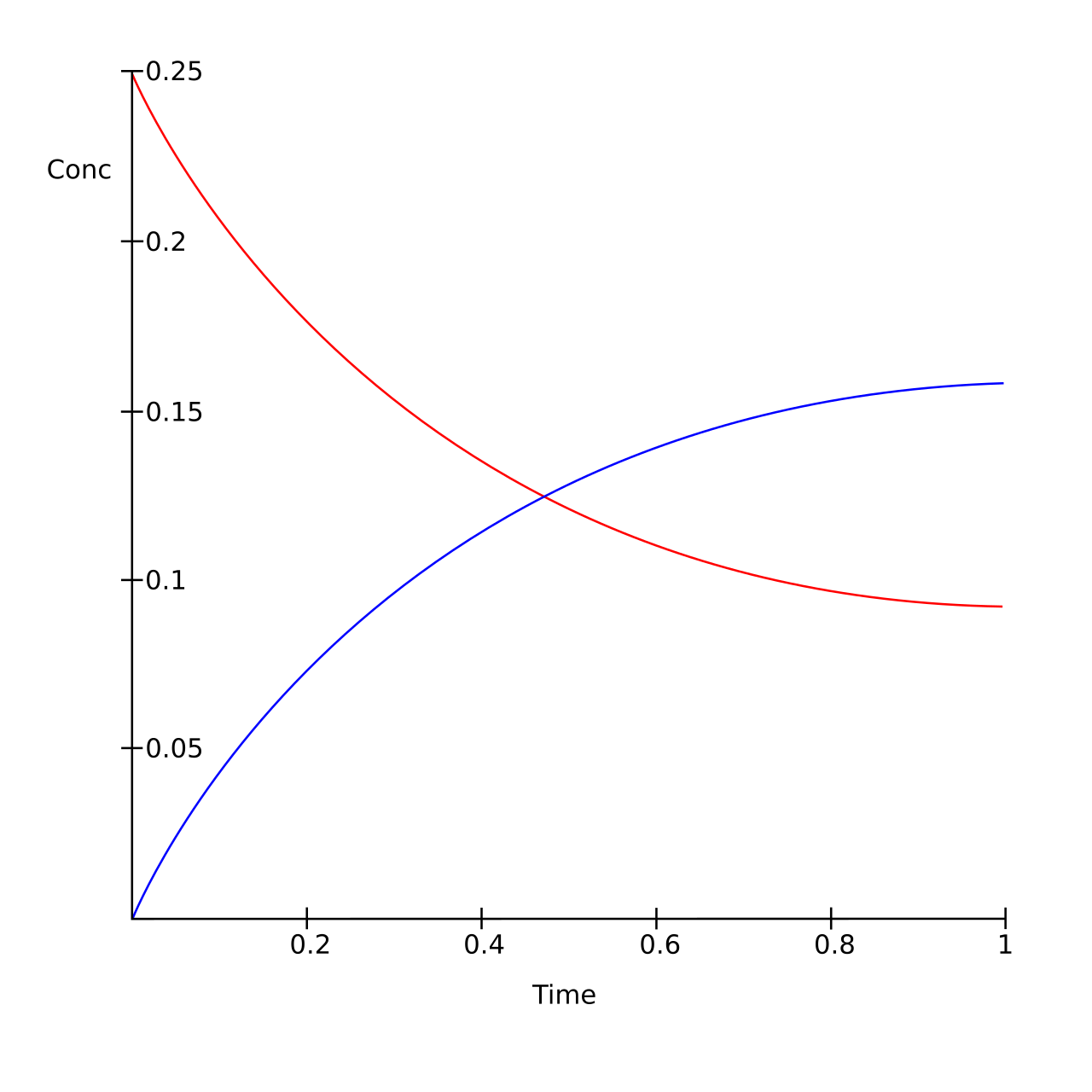
Approach to equilibrium: as reactant concentration (red) falls and product concentration (blue) rises, the forward and reverse rates converge until both concentrations become constant. At this point the reaction is at dynamic equilibrium — not stopped, but proceeding equally in both directions. Image: Fintelia, CC BY-SA 3.0, via Wikimedia Commons.
Equilibrium Constant
For: aA + bB ⇌ cC + dD
- Kc = [C]ᶜ[D]ᵈ / [A]ᵃ[B]ᵇ (in concentration)
- Kp = Pc^c × Pd^d / Pa^a × Pb^b (in partial pressure)
- Kp = Kc(RT)^Δn, where Δn = moles of gaseous products - reactants
Degree of Dissociation & Le Chatelier's Principle
Degree of dissociation (α) is the fraction of the initial amount that dissociates at equilibrium. It is used to set up "initial / change / equilibrium" (ICE) tables for calculating Kc from given starting concentrations and α.
When a system at equilibrium is disturbed, it shifts in the direction that partially opposes the disturbance:
- Adding reactant: equilibrium shifts forward (toward products) to consume some of the added reactant
- Increasing pressure (for gaseous equilibria): shifts toward the side with fewer moles of gas
- Increasing temperature: shifts in the endothermic direction (absorbs the added heat)
- Adding an inert gas at constant volume: no effect on equilibrium position (partial pressures of reacting gases unchanged)
- Adding a catalyst: speeds up both forward and reverse rates equally — equilibrium position is unchanged, only reached faster
Acid-Base Theories
- Arrhenius theory: An acid produces H⁺ ions in water; a base produces OH⁻ ions in water. Limited — only applies to aqueous solutions.
- Bronsted-Lowry theory: An acid is a proton (H⁺) donor; a base is a proton acceptor. Introduces the idea of conjugate acid-base pairs (e.g., in HCl + H₂O → H₃O⁺ + Cl⁻, Cl⁻ is the conjugate base of HCl).
- Lewis theory: An acid is an electron-pair acceptor; a base is an electron-pair donor. The broadest definition — covers species like BF₃ (Lewis acid) that have no H⁺ to donate at all.
Ionization Constants (Ka, Kb) and pH
- pH = −log[H⁺]; pOH = −log[OH⁻]; pH + pOH = 14 at 25°C (since Kw = [H⁺][OH⁻] = 10⁻¹⁴)
- Strong acids/bases dissociate (ionize) completely in water; weak acids/bases dissociate only partially, governed by their ionization constant Ka or Kb
- For a weak acid HA: Ka = [H⁺][A⁻]/[HA]; pKa = −log(Ka). Smaller Ka (larger pKa) means a weaker acid.
- Relationship: Ka × Kb = Kw for a conjugate acid-base pair — a stronger acid always has a weaker conjugate base, and vice versa
Common Ion Effect & Salt Hydrolysis
The common ion effect suppresses the ionization of a weak acid/base when a common ion (from a strong electrolyte) is added — e.g., adding sodium acetate (CH₃COONa) to acetic acid solution shifts the acetic acid's own ionization equilibrium backward, lowering [H⁺] and raising pH. This is the basis of buffer action.
Salt hydrolysis: salts of a strong acid + weak base hydrolyse to give an acidic solution (e.g., NH₄Cl); salts of a weak acid + strong base hydrolyse to give a basic solution (e.g., CH₃COONa); salts of strong acid + strong base do not hydrolyse (neutral, e.g., NaCl); salts of weak acid + weak base can be acidic, basic, or neutral depending on the relative strengths of Ka and Kb.
Buffer Solutions
A buffer resists pH change when small amounts of acid or base are added. It contains either a weak acid and its conjugate base (acidic buffer, e.g., CH₃COOH + CH₃COONa) or a weak base and its conjugate acid (basic buffer, e.g., NH₄OH + NH₄Cl).
Henderson-Hasselbalch equation: pH = pKa + log([salt]/[acid]) for an acidic buffer — this lets you calculate the exact pH of a buffer mixture, or design a buffer for a target pH by choosing the right ratio of salt to acid.
Solubility Product (Ksp)
For a sparingly soluble salt AxBy ⇌ xA + yB, Ksp = [A]ˣ[B]ʸ at saturation. Comparing the actual ionic product (Q) with Ksp predicts behaviour: if Q < Ksp, the solution is unsaturated (more solid can dissolve); if Q = Ksp, the solution is exactly saturated; if Q > Ksp, precipitation occurs until Q falls back to Ksp.
Common Exam Question
Q: What is the pH of 0.01 M HCl?
A: HCl is a strong acid (fully dissociates), so [H⁺] = 0.01 = 10⁻², giving pH = 2.
Law of Mass Action and Reaction Quotient
The law of mass action states that the rate of a reaction is proportional to the product of the active masses (molar concentrations) of the reactants, each raised to the power of its stoichiometric coefficient. Applying it to both forward and reverse reactions gives the equilibrium constant expression.
The reaction quotient (Q) uses the same expression as Kc but with the concentrations at any moment (not just at equilibrium). Comparing Q with K predicts the direction of net change:
- Q < K: too few products — reaction proceeds forward (toward products).
- Q = K: system is at equilibrium — no net change.
- Q > K: too many products — reaction proceeds backward (toward reactants).
Types of Equilibria
- Physical equilibrium: between two physical states of the same substance — solid ⇌ liquid (melting point), liquid ⇌ vapour (vapour pressure), and dissolution of a solute/gas in a solvent at saturation.
- Chemical equilibrium: between reactants and products of a reversible reaction.
- Homogeneous equilibrium: all species in the same phase (e.g., N₂(g) + 3H₂(g) ⇌ 2NH₃(g)).
- Heterogeneous equilibrium: species in more than one phase (e.g., CaCO₃(s) ⇌ CaO(s) + CO₂(g)). Pure solids and pure liquids have constant activity (= 1) and are omitted from the K expression.
Characteristics of the Equilibrium Constant
- K has a fixed value at a given temperature and changes only with temperature (not with concentration, pressure, or a catalyst).
- For the reverse reaction, K' = 1/K; if coefficients are multiplied by n, the new constant is Kⁿ.
- The magnitude of K indicates extent: very large K means reaction nearly complete; very small K means little product forms.
- K does not tell us the rate or the time taken to reach equilibrium, only the position.
Ostwald's Dilution Law
For a weak electrolyte (weak acid/base) with degree of dissociation α and concentration C, the ionization constant is Ka = Cα²/(1 − α). When α is small (α ≪ 1), this simplifies to α ≈ √(Ka/C).
- The degree of dissociation increases on dilution (as C decreases, α rises).
- For a weak acid, [H⁺] = Cα = √(Ka·C), so pH can be found directly from Ka and concentration.
🚀 JEE Advanced Edge
Simultaneous equilibria: When two equilibria share a common species (e.g., a diprotic acid's two dissociation steps, or a complex ion equilibrium combined with a solubility equilibrium), multiply the individual K values to get the overall equilibrium constant for the combined process.
Buffer capacity: A buffer resists pH change best when [salt] ≈ [acid] (ratio close to 1), since this is where the system has the most "room" to absorb added H⁺ or OH⁻ before being overwhelmed. Buffer capacity is also higher with more concentrated solutions.
Selective precipitation using Ksp: When adding a precipitating reagent to a mixture of two ions (e.g., Cl⁻ and Br⁻ both reacting with Ag⁺), the salt with the SMALLER Ksp precipitates first, and almost completely, before the second ion begins to precipitate — this is the basis of qualitative salt analysis separation schemes.
Worked problem: Calculate the pH of a buffer made from 0.3 mol CH₃COOH and 0.2 mol CH₃COONa in 1 L solution (Ka of CH₃COOH = 1.8×10⁻⁵, pKa ≈ 4.74). Approach: pH = pKa + log([salt]/[acid]) = 4.74 + log(0.2/0.3) = 4.74 + log(0.667) = 4.74 − 0.176 ≈ 4.56.